Soft launch: Soldier biographies and research notes vary in completeness. Prefer class-roster, NARA, newspapers, and other cited sources for contested facts — treat Research notes as leads, not settled history. Anyone can correct a page; contact us with questions.
Heym, Stefan (32860259): Difference between revisions
Publish Facebook post enrichment (lead/bio/fields/gallery) |
Remove redundant Notable Ritchie Boys slides research note |
||
| (21 intermediate revisions by the same user not shown) | |||
| Line 7: | Line 7: | ||
|class_number=9 | |class_number=9 | ||
|class_section=5D | |class_section=5D | ||
|class_rank= | |class_rank=Private | ||
|birth_year=1913 | |birth_year=1913 | ||
|death_year=2001 | |death_year=2001 | ||
|nativity= | |nativity=Germany | ||
|religion= | |religion=Jewish | ||
|enlistment_place=NEW YORK CITY NEW YORK | |enlistment_place=NEW YORK CITY NEW YORK | ||
|state=NEW YORK | |state=NEW YORK | ||
|rank_final= | |rank_final=Technical Sergeant | ||
|education=University of Chicago | |education=University of Chicago | ||
|occupation=Writer | |occupation=Writer | ||
| Line 27: | Line 27: | ||
|birth_date=10 April 1913 | |birth_date=10 April 1913 | ||
|death_date=16 December 2001 | |death_date=16 December 2001 | ||
|birth_place=Chemnitz, Kingdom of Saxony | |birth_place=Chemnitz, Kingdom of Saxony | ||
|death_place=Ein Bokek, Tamar Regional Council | |death_place=Ein Bokek, Tamar Regional Council | ||
|known_for=Writer | |known_for=Writer | ||
}} | }} | ||
<div class="soldier-lead"> | <div class="soldier-lead"> | ||
'''Stefan Heym''' (1913–2001) was a Ritchie Boy (born Flieg; Helmut; from Germany; Jewish) who trained at Camp Ritchie in class 9. | '''[[Heym, Stefan (32860259)|Stefan Heym]]''' (1913–2001) was a Ritchie Boy (born Flieg; Helmut; from Germany; Jewish) who trained at Camp Ritchie in class 9. | ||
</div> | </div> | ||
== Biography == | == Biography == | ||
He was honoured with honorary doctorates from the University of Bern (1990) and University of Cambridge (1991), and honorary citizenship of Chemnitz, his birthplace (2001). Flieg, born to a Jewish merchant family in Chemnitz, was an antifascist from an early age. | |||
He completed school in Berlin, and began a degree in media studies there. Roster notes also show enlisted at New York City New York; education listed as 2 years of college; civilian occupation listed as Authors editors and reporters. | |||
He lived in the United States and trained at Camp Ritchie in 1943, making him one of the Ritchie Boys of World War II. | |||
Helmut Flieg (10 April 1913 – 16 December 2001) was a German writer, known by his pseudonym Stefan Heym . After the 1933 Reichstag fire, he fled to Czechoslovakia, where he took the name Stefan Heym. Between 1937 and 1939 he was based in New York as Editor-in-Chief of the German-language weekly Deutsches Volksecho, which was close to the Communist Party of the USA. | |||
After the newspaper ceased publication in November 1939, Heym worked as a freelance author in English, and achieved a bestseller with his first novel, Hostages (1942). McCarthy reached a crescendo, Heym left the United States with his American wife, Gertrude Gelbin, whom he had married in 1944. Toward the end of 1945 and in 1951, fearing investigation by the House Un-American Activities Committee as the hunt for Communists led by Senator Joseph R. | |||
In 1952 he gave all his American military commendations back in protest against the Korean War and moved first to Prague, then in the following year to the German Democratic Republic, after the GDR government had restored his former German citizenship. He was awarded the 1953 Heinrich Mann Prize, the 1959 National Prize of East Germany (2nd class), and the 1993 Jerusalem Prize. Between 1953 and 1956, he worked at the Berliner Zeitung, thereafter primarily as a freelance author. | |||
Previously he had won the Heinrich-Mann-Prize (1953), and the National Prize of the GDR, 2nd class (1959). Conflicts with the GDR authorities became apparent from 1956 on, as despite the destalinisation of the leadership, the publication of Heym's book on the 17 June 1953, uprising, Five Days in June, was rejected. In 1969, Heym was convicted of breaching the exchange control regulations after publishing his novel Lassalle in West Germany. | |||
In 1976, Heym was among those GDR authors who signed the petition protesting against the exile of Wolf Biermann. In 1978, and his books continued to appear, albeit in lower print runs, in the GDR. He was also awarded the Jerusalem Prize (1993) for literature 'for the freedom of the individual in society', and the peace medal of the IPPNW. | |||
As President by right of age of the Bundestag he held the opening speech of the new Parliament in November 1994, but resigned in October 1995 in protest against a planned constitutional amendment raising MP expense allowances. He wrote about the Berlin Document Center. He published works in English and German at home and abroad, and despite longstanding criticism of the GDR remained a committed socialist. | |||
During this time he signed his articles under several pseudonyms, including Melchior Douglas, Gregor Holm and Stefan Heym. He was a member of the Ritchie Boys, a unit for psychological warfare under the command of émigré Hans Habe. These experiences formed the background for a later novel, The Crusaders, and were the basis for Reden an den Feind (Speeches to the Enemy), a collection of those texts. | |||
Because of his refusal to soften his critical stance toward Nazism and the German elites that had collaborated with it and his refusal to begin to discreetly weave doubts about Soviet intentions into his editorials, Heym was transferred back to the U.S. In the following years he worked as a freelance author once again. He lived with his wife in a state-provided villa in Berlin-Grünau. | |||
Heym's works, which he continued to write in English, were published by a publishing house founded for him (Seven Seas Publishers). In German, translations were printed in large numbers. He was nonetheless able to leave the GDR on foreign trips, such as his two-month visit to the U.S. | |||
From this point on Heym could only publish his works in the West, and he began composing works in German. | |||
He died in 2001, aged 88, and was buried in the Weißensee Cemetery. After the war Heym led the Ruhrzeitung in Essen, and then became editor in Munich of Die Neue Zeitung, one of the most important newspapers of the American occupying forces. Heym died suddenly of heart failure in Ein Bokek in Israel whilst attending a Heinrich Heine Conference. | |||
== Research notes == | == Research notes == | ||
* Author | * Author | ||
* to 2nd MRBC, 12/31/43 | * to 2nd MRBC, 12/31/43 | ||
* PI 23 | * PI 23 | ||
* | * The Wandering Jew | ||
== Gallery == | == Gallery == | ||
<div class="soldier-gallery"> | <div class="soldier-gallery"> | ||
<gallery mode="packed" heights="140px"> | <gallery mode="packed" heights="140px"> | ||
4448187125203174.jpg| | 4448187125203174.jpg|All the men identified in the pix are "Ritchie Boys." Seated - [[Habe-Bekessy, Hans (32719455)|Hans Habe]]. Standing L-R - Unknown, [[Wynder, Ernest L (32926486)|Ernest Wynder]], [[Kellen, Konrad (39701828)|Konrad Kellen]], unknown, [[Heym, Stefan (32860259)|Stefan Heym]], [[Atlas, Louis (32258804)|Louis Atlas]], [[Weidenreich, Peter H. (32791342)|Peter Weidenreich]] (last name later changed to Wyden), unknown, [[Eaton, Joseph W. (32498461)|Joseph Eaton]] | ||
</gallery> | </gallery> | ||
</div> | </div> | ||
| Line 121: | Line 143: | ||
| row_source || both | | row_source || both | ||
|} | |} | ||
== Timeline == | |||
<div class="mw-collapsible mw-collapsed soldier-timeline"> | |||
<div class="soldier-timeline-body"> | |||
* Born 10 April 1913 in Germany (as Helmut Flieg) (Jewish). | |||
* 21 June 1943 — Entered Class 9 (IPW Ge). | |||
* 18 August 1943 — Graduated with Class 9 (Asst Interrogator; linguist, typist). | |||
* 15 February 1944 — Promoted to T/3. | |||
* 3 March 1944 — Promoted to T/Sgt. | |||
* May 1943 — Assigned to Camp Ritchie. Languages German, French. | |||
</div> | |||
</div><div style="clear: both;"></div> | |||
== Sources == | == Sources == | ||
* [https://en.wikipedia.org/wiki/Stefan_Heym Wikipedia: Stefan Heym] | * [https://en.wikipedia.org/wiki/Stefan_Heym Wikipedia: Stefan Heym] | ||
* Camp Ritchie | * Camp Ritchie Museum, Inc. (The Ritchie History Museum), Classes 1–31 roster data | ||
* Dan Gross research spreadsheets, including original Excel timeline/roster work, combined with other research and records | |||
* NARA World War II Army enlistment records (where a NARA ASN is present) | * NARA World War II Army enlistment records (where a NARA ASN is present) | ||
* 1940 U.S. Census (where a census match is present) | * 1940 U.S. Census (where a census match is present) | ||
* Ritchie Boys of WWII Facebook page, post dated 2021-08-11 (1 post) | * Ritchie Boys of WWII Facebook page, post dated 2021-08-11 (1 post) | ||
* Dan Gross, ''Timeline of Stefan Heym for Camp Ritchie'' (private research document; 1 source documents reviewed) | |||
* Dan Gross, ''Timeline of Heym, Stefan for Camp Ritchie'' (private research files; selected non-private narrative findings; 1 source files: STEFAN HEYM.doc) | |||
Latest revision as of 15:01, 16 September 2026
| Stefan Heym | |
|---|---|
 | |
| Personal details | |
| Birth name | Helmut Flieg |
| Born | 10 April 1913 Chemnitz, Kingdom Of Saxony |
| Died | 16 December 2001 Ein Bokek, Tamar Regional Council |
| Nativity | Germany |
| Religion | Jewish |
| Known for | Writer |
| Military service | |
| Allegiance |  United States United States |
| Branch |  United States Army United States Army |
| ASN | 32860259 |
| Rank | Technical Sergeant |
| Rank at Ritchie | Private |
| Camp Ritchie | Class 9 (21 June – 18 August 1943) |
| Section | 5D |
| Enlisted | New York City, New York |
{{Needs source}}, or explain disagreements on talk. Baseline import notes: About the data.
Stefan Heym (1913–2001) was a Ritchie Boy (born Flieg; Helmut; from Germany; Jewish) who trained at Camp Ritchie in class 9.
Biography[edit | edit source]
He was honoured with honorary doctorates from the University of Bern (1990) and University of Cambridge (1991), and honorary citizenship of Chemnitz, his birthplace (2001). Flieg, born to a Jewish merchant family in Chemnitz, was an antifascist from an early age.
He completed school in Berlin, and began a degree in media studies there. Roster notes also show enlisted at New York City New York; education listed as 2 years of college; civilian occupation listed as Authors editors and reporters.
He lived in the United States and trained at Camp Ritchie in 1943, making him one of the Ritchie Boys of World War II.
Helmut Flieg (10 April 1913 – 16 December 2001) was a German writer, known by his pseudonym Stefan Heym . After the 1933 Reichstag fire, he fled to Czechoslovakia, where he took the name Stefan Heym. Between 1937 and 1939 he was based in New York as Editor-in-Chief of the German-language weekly Deutsches Volksecho, which was close to the Communist Party of the USA.
After the newspaper ceased publication in November 1939, Heym worked as a freelance author in English, and achieved a bestseller with his first novel, Hostages (1942). McCarthy reached a crescendo, Heym left the United States with his American wife, Gertrude Gelbin, whom he had married in 1944. Toward the end of 1945 and in 1951, fearing investigation by the House Un-American Activities Committee as the hunt for Communists led by Senator Joseph R.
In 1952 he gave all his American military commendations back in protest against the Korean War and moved first to Prague, then in the following year to the German Democratic Republic, after the GDR government had restored his former German citizenship. He was awarded the 1953 Heinrich Mann Prize, the 1959 National Prize of East Germany (2nd class), and the 1993 Jerusalem Prize. Between 1953 and 1956, he worked at the Berliner Zeitung, thereafter primarily as a freelance author.
Previously he had won the Heinrich-Mann-Prize (1953), and the National Prize of the GDR, 2nd class (1959). Conflicts with the GDR authorities became apparent from 1956 on, as despite the destalinisation of the leadership, the publication of Heym's book on the 17 June 1953, uprising, Five Days in June, was rejected. In 1969, Heym was convicted of breaching the exchange control regulations after publishing his novel Lassalle in West Germany.
In 1976, Heym was among those GDR authors who signed the petition protesting against the exile of Wolf Biermann. In 1978, and his books continued to appear, albeit in lower print runs, in the GDR. He was also awarded the Jerusalem Prize (1993) for literature 'for the freedom of the individual in society', and the peace medal of the IPPNW.
As President by right of age of the Bundestag he held the opening speech of the new Parliament in November 1994, but resigned in October 1995 in protest against a planned constitutional amendment raising MP expense allowances. He wrote about the Berlin Document Center. He published works in English and German at home and abroad, and despite longstanding criticism of the GDR remained a committed socialist.
During this time he signed his articles under several pseudonyms, including Melchior Douglas, Gregor Holm and Stefan Heym. He was a member of the Ritchie Boys, a unit for psychological warfare under the command of émigré Hans Habe. These experiences formed the background for a later novel, The Crusaders, and were the basis for Reden an den Feind (Speeches to the Enemy), a collection of those texts.
Because of his refusal to soften his critical stance toward Nazism and the German elites that had collaborated with it and his refusal to begin to discreetly weave doubts about Soviet intentions into his editorials, Heym was transferred back to the U.S. In the following years he worked as a freelance author once again. He lived with his wife in a state-provided villa in Berlin-Grünau.
Heym's works, which he continued to write in English, were published by a publishing house founded for him (Seven Seas Publishers). In German, translations were printed in large numbers. He was nonetheless able to leave the GDR on foreign trips, such as his two-month visit to the U.S.
From this point on Heym could only publish his works in the West, and he began composing works in German.
He died in 2001, aged 88, and was buried in the Weißensee Cemetery. After the war Heym led the Ruhrzeitung in Essen, and then became editor in Munich of Die Neue Zeitung, one of the most important newspapers of the American occupying forces. Heym died suddenly of heart failure in Ein Bokek in Israel whilst attending a Heinrich Heine Conference.
Research notes[edit | edit source]
- Author
- to 2nd MRBC, 12/31/43
- PI 23
- The Wandering Jew
Gallery[edit | edit source]
-
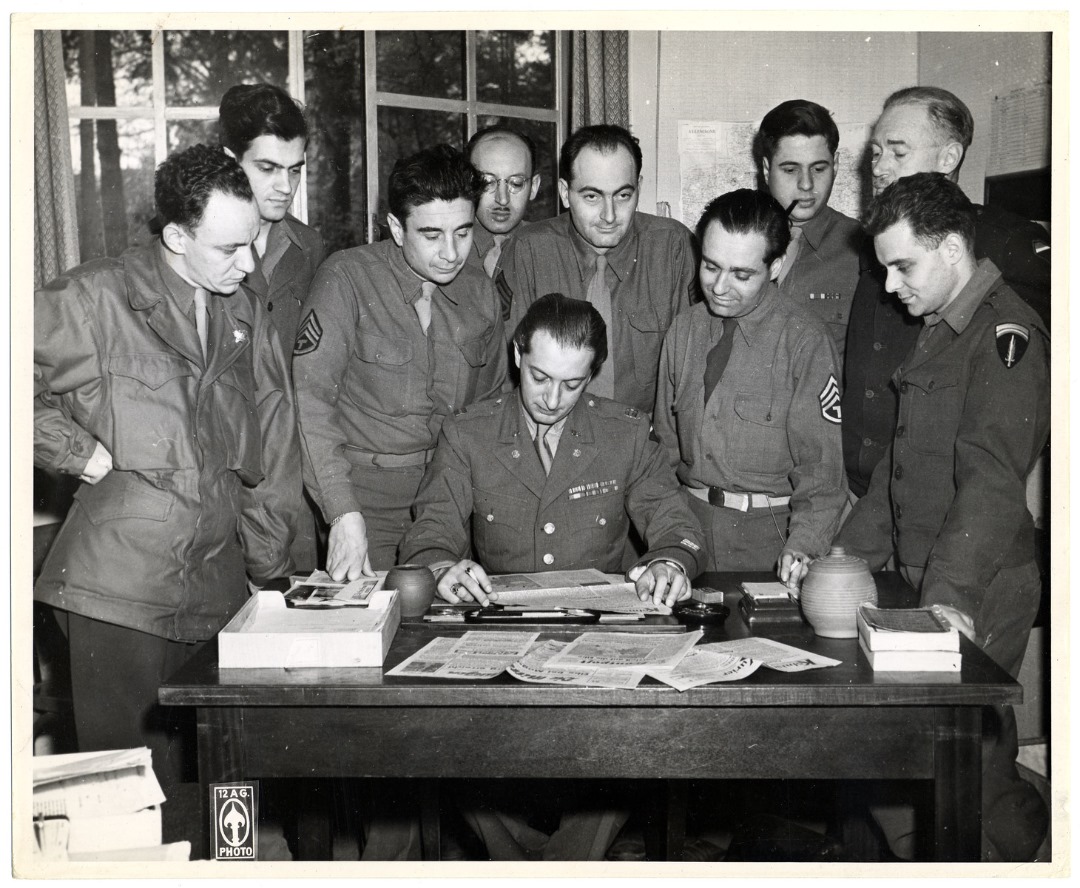 All the men identified in the pix are "Ritchie Boys." Seated - Hans Habe. Standing L-R - Unknown, Ernest Wynder, Konrad Kellen, unknown, Stefan Heym, Louis Atlas, Peter Weidenreich (last name later changed to Wyden), unknown, Joseph Eaton

Technical record[edit | edit source]
| Field | Imported value |
|---|---|
| MRBC2 | 2 |
| Approx Age at Death | 88 |
| Nara ASN | 32860259 |
| Nara Name | HEYM STEFAN |
| Nara State | 23 |
| Nara County | 61 |
| Nara POE | 2364 |
| Nara DOE | 110343 |
| Nara Grade Alpha | PVT8 |
| Nara Grade Code | 8 |
| Nara Branch Alpha | NO |
| Nara Branch Code | 2 |
| Branch | No branch assignment |
| Nara Term or Enlistment | 5 |
| Term of enlistment | Enlistment for the duration of the War or other emergency, plus six months, subject to the discretion of the President or otherwise according to law |
| Defer. Date | 0 |
| Nara Source | 0 |
| Nara Nativity | N1 |
| Nara Year of Birth | 13 |
| Nara Race | J |
| Nara Race Description | White not yet a citizen |
| Nara Education | 6 |
| Nara Civilian Occupation | 6 |
| Nara Marital Status | 6 |
| Nara Height (inches) | 20 |
| Nara Weight (lbs) | 138 |
| Class_ASN | 32860259 |
| Class_Name | HEYM, Stefan |
| match_method | asn_exact_name_exact |
| row_source | both |
Timeline[edit | edit source]
- Born 10 April 1913 in Germany (as Helmut Flieg) (Jewish).
- 21 June 1943 — Entered Class 9 (IPW Ge).
- 18 August 1943 — Graduated with Class 9 (Asst Interrogator; linguist, typist).
- 15 February 1944 — Promoted to T/3.
- 3 March 1944 — Promoted to T/Sgt.
- May 1943 — Assigned to Camp Ritchie. Languages German, French.
Sources[edit | edit source]
- Wikipedia: Stefan Heym
- Camp Ritchie Museum, Inc. (The Ritchie History Museum), Classes 1–31 roster data
- Dan Gross research spreadsheets, including original Excel timeline/roster work, combined with other research and records
- NARA World War II Army enlistment records (where a NARA ASN is present)
- 1940 U.S. Census (where a census match is present)
- Ritchie Boys of WWII Facebook page, post dated 2021-08-11 (1 post)
- Dan Gross, Timeline of Stefan Heym for Camp Ritchie (private research document; 1 source documents reviewed)
- Dan Gross, Timeline of Heym, Stefan for Camp Ritchie (private research files; selected non-private narrative findings; 1 source files: STEFAN HEYM.doc)