Soft launch: Soldier biographies and research notes vary in completeness. Prefer class-roster, NARA, newspapers, and other cited sources for contested facts — treat Research notes as leads, not settled history. Anyone can correct a page; contact us with questions.
Camp Ritchie: Difference between revisions
Link The Stories hub |
Link July 1943 Camp Ritchie naturalization Stories page |
||
| (17 intermediate revisions by the same user not shown) | |||
| Line 1: | Line 1: | ||
'''Camp Ritchie''' (the Military Intelligence Training Center, or MITC) was a U.S. Army intelligence school at Cascade in Washington County, Maryland, during World War II. From 1942 it trained interrogators, order-of-battle specialists, photo interpreters, and related personnel. Graduates are commonly called [[:Category:Soldiers|Ritchie Boys]]. | '''Camp Ritchie''' (the Military Intelligence Training Center, or MITC) was a U.S. Army intelligence school at Cascade in Washington County, Maryland, during World War II. From 1942 it trained interrogators, order-of-battle specialists, photo interpreters, and related personnel. Graduates are commonly called [[:Category:Soldiers|Ritchie Boys]]. | ||
== Overview == | |||
Located in Washington County, Maryland near the Pennsylvania border, the site began as a resort area in the late 1800s before becoming a Maryland National Guard training site in 1926. In 1942, during World War II, it was transformed into the U.S. Army’s Military Intelligence Training Center (MITC), formally activated on '''19 June 1942''' (cadre had begun arriving earlier). Soldiers trained there in interrogation, counterintelligence, investigation, and psychological warfare. | |||
Camp Ritchie is best known as the training ground for the “Ritchie Boys,” a specialized group of intelligence soldiers—many of them European immigrants and refugees—whose language skills and cultural knowledge made them invaluable in gathering intelligence and supporting Allied operations. The camp’s mission, reflected in its motto “Fas es ab hoste doceri” (“It is a duty to study the enemy”), centered on understanding and defeating enemy forces through intelligence. | |||
Today, Camp Ritchie is recognized for its critical role in shaping modern U.S. military intelligence and for preparing the Ritchie Boys, who contributed significantly to the Allied victory in World War II. | |||
== Photographs == | |||
<gallery mode="packed" heights="180px"> | |||
Camp_Ritchie_replica_German_village_training.jpg|For realism, some training took place in a replica of a German village | |||
Camp_Ritchie_panoramic_view_late_1944.jpg|Panoramic view of Camp Ritchie in late 1944 | |||
</gallery> | |||
Captions from the source filenames; archival credit not yet verified (see [[Photos#Camp Ritchie]]). | |||
== Who trained there == | |||
About '''20,000''' men and roughly '''2,000''' Women’s Army Corps (WAC) members trained for Army intelligence work at Camp Ritchie (about '''22,000''' in all). Many were assigned because they spoke German, French, Italian, Polish, or another language the Army needed. Some were German- or Austrian-born Jewish refugees who had fled Nazi persecution; others were U.S.-born soldiers whose language skills were discovered after they enlisted or were drafted and who arrived on secret orders. | |||
Training covered interrogation, counterintelligence, order of battle, psychological warfare, and related skills. Many graduates later served in the U.S. Counter Intelligence Corps (CIC). About '''900''' also received specialized training at '''Camp Sharpe''' near Gettysburg, Pennsylvania (often linked to Mobile Radio Broadcasting / psychological-warfare work — see [[Books]] and [[Ritchie Boy Programs]]). The '''3rd Mobile Radio Broadcasting Company''' was activated at Camp Ritchie on '''29 December 1943'''; specialized MRBC training commonly continued at Camp Sharpe. A Consolidated Roster from the '''1st Mobile Radio Broadcasting Company''' ''Unit History'' booklet is on [[1st Mobile Radio Broadcasting Company]]. | |||
== In the field == | |||
=== Europe === | |||
After the United States entered the war against Germany, many Ritchie Boys reached Europe beginning around D-Day (6 June 1944) and in the months that followed. Working near the front at corps and army levels, they interrogated prisoners and defectors, tracked German units and plans, and supported psychological-warfare efforts (leaflets, radio, and related means) meant to weaken resistance. | |||
A classified postwar U.S. Army assessment found that nearly '''60%''' of the credible intelligence gathered in the European theater came from the Ritchie Boys. After the war, many served as translators and interrogators at the Nuremberg trials. | |||
General Oscar Koch (Patton’s G-2) is among those who later acknowledged that advance warning of the German Ardennes offensive drew on information from Military Intelligence Service units — a theme developed at length on [[Secret Heroes/Battle of the Bulge]]. A contemporary G-2 ETOUSA organizational account (Lt. Col. Henry C. Settle, October 1944) likewise stresses peacetime neglect of intelligence training and describes plans to place Camp Ritchie graduates into division G-2 slots (including a '''29th Infantry Division''' staffing plan); see [[The Stories/Camp Ritchie Background|Camp Ritchie Background]] and [[Training materials#Featured: Early ETOUSA G-2 organization (Settle, 1944)|Training materials]]. | |||
=== Pacific === | |||
Camp Ritchie also trained more than '''500''' Nisei (second-generation Japanese American) soldiers for document work connected with the Pacific war, including PACMIRS (Pacific Military Intelligence Research Section). '''Nisei women''' in the Military Intelligence Service likewise completed rigorous Japanese military-language training and were often assigned to PACMIRS at Camp Ritchie to work captured Japanese documents. Captured Japanese materials were studied at the camp; one well-known episode involves [[Yamane, Kazuo E. (30101877)|Kazuo E. Yamane]] identifying Japanese armory meeting notes among crates of documents from Saipan, which helped the War Department locate and strike armories. (See also the 2017 film ''Proof of Loyalty: Kazuo Yamane and the Nisei Soldiers of Hawaii''.) A 1946 MISLS yearbook states that of '''35''' WAC graduates at the November 1945 commencement, '''21''' were transferred to Camp Ritchie (with remaining graduates following when the WAC Detachment deactivated in February 1946)—matching Wikipedia’s note that about twenty-one MISLS women translator graduates went to PACMIRS work there (see [[Nisei and Pacific#MISLS WAC Detachment and Camp Ritchie|Nisei and Pacific]]). In 1945 the camp also formed '''Mobile Intelligence Training Units''' (MITU) for Army Ground Forces redeployment training: small teams in which Nisei demonstrated Japanese squad tactics and took part in orientation plays (some teams included veterans of the 442nd Combat Team). See [[Nisei and Pacific#Mobile Intelligence Training Units (MITU), 1945|Nisei and Pacific]]. | |||
== Prisoners of war and the Hill Project == | |||
During the war years (into 1947) Camp Ritchie also housed prisoner-of-war compounds. Detainees included German and Italian prisoners, among them men taken in the North African campaign. | |||
After Germany’s surrender, the post hosted a classified effort known as the '''Hill Project''', in which selected German prisoners of war—including former Wehrmacht officers—worked with Allied personnel on research meant to improve military security in Europe, study German intelligence methods in detail, and (until Japan’s surrender) support the war against Japan. Only about '''150''' POWs worked directly on the project; by March 1946 more than '''1,500''' POWs were estimated to be at Ritchie, many connected in some way with that work. | |||
== After the war — Fort Ritchie and the museum == | |||
The post was later known as '''Fort Ritchie''' and closed in '''1998''' under the 1995 Base Realignment and Closure (BRAC) process. Following later redevelopment of the site, a museum and educational center opened on '''9 June 2023''' to commemorate the Ritchie Boys and the history of the post. See also [http://www.ritchiemuseum.org Ritchie History Museum] and [[Congressional Gold Medal]]. | |||
== Classes and teams on this wiki == | |||
The camp’s classes are listed as [[:Category:Class 1|Class 1]] through [[:Category:Class 31|Class 31]]. Individual soldier articles use those class numbers in the infobox. IPW and MII team codes are listed under [[:Category:Teams]]. | The camp’s classes are listed as [[:Category:Class 1|Class 1]] through [[:Category:Class 31|Class 31]]. Individual soldier articles use those class numbers in the infobox. IPW and MII team codes are listed under [[:Category:Teams]]. | ||
For founding history, the camp flag and coat-of-arms, and how the MITC was established, see [[The Stories/Camp Ritchie Background|Camp Ritchie Background]]. Trainee voices about everyday camp life are collected on [[The Stories/Life in Camp Ritchie|Life in Camp Ritchie]]. JWB/USO records of the spring 1945 first-night Seder are on [[The Stories/Passover at Camp Ritchie (1945)|Passover at Camp Ritchie (1945)]]. A July 1943 District Court naturalization of dozens of Camp Ritchie soldiers is summarized on [[The Stories/Camp Ritchie naturalization (July 1943)|Camp Ritchie naturalization (July 1943)]]. Early staff and faculty from Dan Gross’s working list are on [[Camp Ritchie Faculty]]. Camp-wide training manuals and related PDFs live on [[Training materials]]. A short Personnel Section sheet of ten intelligence directives ([[Training materials#Featured: List of Directives|List of Directives]], Pers. Sec. 214) is transcribed on [[Training materials]]. A Signal Section monograph on a typical Enemy Equipment Intelligence Service detachment (EEIS Det. 9), including its April 1944 Camp Ritchie course, is on [[Training materials#Featured: Enemy Equipment Intelligence Service (EEIS)|Training materials]]. | |||
== Sources == | |||
* [[:File:MISLS_WAC_grads_bus_to_Camp_Ritchie.jpg|WAC MIS grads leaving for Camp Ritchie]] (MISLS yearbook crop) | |||
* [https://www.fold3.com/image/704852256 Fold3 — MISLS WAC yearbook page 91] (21 WAC graduates to Camp Ritchie, Nov 1945) | |||
* [https://www.fold3.com/image/293236119 Fold3 — Settle Early G-2 Branch Organization (ETOUSA), 27 Oct 1944] / [[:File:Settle_Early_G2_Branch_Organization_ETOUSA_27_Oct_1944.pdf|PDF]] | |||
* [https://en.wikipedia.org/wiki/Nisei_women_translators_in_World_War_II English Wikipedia, ''Nisei women translators in World War II''] (MISLS graduates assigned to PACMIRS at Camp Ritchie) | |||
* [[Nisei and Pacific#Mobile Intelligence Training Units (MITU), 1945|Nisei and Pacific — Mobile Intelligence Training Units]] | |||
* [[:File:MID_908_1945-07-24_Bissell_Weckerling_JA_soldiers_in_training.pdf|MID 908 / MITU memos, July 1945 (Bissell–Weckerling; Camp Ritchie Section IX; WRA)]] (NARA via JAVA packet) | |||
* [https://www.fold3.com/image/291737678 Fold3 — A Typical Enemy Equipment Intelligence Service (EEIS Det. 9)] / [[:File:A_Typical_Enemy_Equipment_Intelligence_Service_EEIS_Det_9.pdf|PDF on this wiki]] | |||
* [[The Stories/Passover at Camp Ritchie (1945)|Passover at Camp Ritchie (1945)]] (Fold3 / National Jewish Welfare Board–USO) | |||
* [[:File:Washington_Post_85_Soldiers_Naturalized_21_Jul_1943.jpg|''Washington Post'', 21 July 1943 — 85 soldiers naturalized (almost all from Camp Ritchie)]] | |||
* [[:File:Camp_Ritchie_list_of_directives.jpg|Camp Ritchie List of Directives (Pers. Sec. 214)]] (source uncertain) | |||
* [[:File:Camp_Ritchie_panoramic_view_late_1944.jpg|Panoramic view of Camp Ritchie in late 1944]] (source uncertain) | |||
* [[:File:Camp_Ritchie_replica_German_village_training.jpg|For realism, some training took place in a replica of a German village]] (source uncertain) | |||
* [https://en.wikipedia.org/wiki/Fort_Ritchie#Camp_Ritchie English Wikipedia, ''Fort Ritchie'' — Camp Ritchie section] (POW compounds; Nisei women / PACMIRS; 3rd MRBC activation; Hill Project overview) | |||
* [https://www.javadc.org/japanese%20american%20women%20in%20wwii.htm Japanese American Veterans Association — Japanese American Women in World War II] (Nisei women MIS linguists / PACMIRS at Camp Ritchie) | |||
* Derek R. Mallett, “Western Allied Intelligence and the German Military Document Section, 1945–6,” ''Journal of Contemporary History'' 46, no. 2 (2011): 390–391 (Hill Project / German POWs at Camp Ritchie) | |||
* John Whiteclay Chambers II, “OSS Training Areas in the National Park Service” (footnote 121) — MITC formally activated 19 June 1942; cites trainee accounts including Richard Warren Seltzer, Sr., and Lewis Bloom | |||
Overview figures and field roles above draw in part on the English Wikipedia article [https://en.wikipedia.org/wiki/Ritchie_Boys Ritchie Boys] and the sources cited there (including Army intelligence histories and secondary works such as Bruce Henderson, ''Sons and Soldiers''). Roster counts and class structure on this wiki follow the Camp Ritchie class data described on [[About the data]] and [[By The Numbers]]. | |||
== See also == | == See also == | ||
| Line 8: | Line 68: | ||
* [[Introduction]] | * [[Introduction]] | ||
* [[The Stories]] | * [[The Stories]] | ||
* [[Nisei and Pacific]] | |||
* [[The Stories/Camp Ritchie Background|Camp Ritchie Background]] | * [[The Stories/Camp Ritchie Background|Camp Ritchie Background]] | ||
* [[The Stories/Life in Camp Ritchie|Life in Camp Ritchie]] | |||
* [[The Stories/Passover at Camp Ritchie (1945)|Passover at Camp Ritchie (1945)]] | |||
* [[The Stories/Camp Ritchie naturalization (July 1943)|Camp Ritchie naturalization (July 1943)]] | |||
* [[Secret Heroes/Battle of the Bulge]] | |||
* [[Camp Ritchie Faculty]] | |||
* [[1st Mobile Radio Broadcasting Company]] | |||
* [[Training materials]] | |||
* [[By The Numbers]] | |||
* [[Notable Ritchie Boys]] | |||
* [[:Category:Classes]] | * [[:Category:Classes]] | ||
* [[:Category:Teams]] | * [[:Category:Teams]] | ||
[[Category:Ritchie Boys Wiki]] | [[Category:Ritchie Boys Wiki]] | ||
Latest revision as of 04:39, 17 September 2026
Camp Ritchie (the Military Intelligence Training Center, or MITC) was a U.S. Army intelligence school at Cascade in Washington County, Maryland, during World War II. From 1942 it trained interrogators, order-of-battle specialists, photo interpreters, and related personnel. Graduates are commonly called Ritchie Boys.
Overview[edit | edit source]
Located in Washington County, Maryland near the Pennsylvania border, the site began as a resort area in the late 1800s before becoming a Maryland National Guard training site in 1926. In 1942, during World War II, it was transformed into the U.S. Army’s Military Intelligence Training Center (MITC), formally activated on 19 June 1942 (cadre had begun arriving earlier). Soldiers trained there in interrogation, counterintelligence, investigation, and psychological warfare.
Camp Ritchie is best known as the training ground for the “Ritchie Boys,” a specialized group of intelligence soldiers—many of them European immigrants and refugees—whose language skills and cultural knowledge made them invaluable in gathering intelligence and supporting Allied operations. The camp’s mission, reflected in its motto “Fas es ab hoste doceri” (“It is a duty to study the enemy”), centered on understanding and defeating enemy forces through intelligence.
Today, Camp Ritchie is recognized for its critical role in shaping modern U.S. military intelligence and for preparing the Ritchie Boys, who contributed significantly to the Allied victory in World War II.
Photographs[edit | edit source]
-
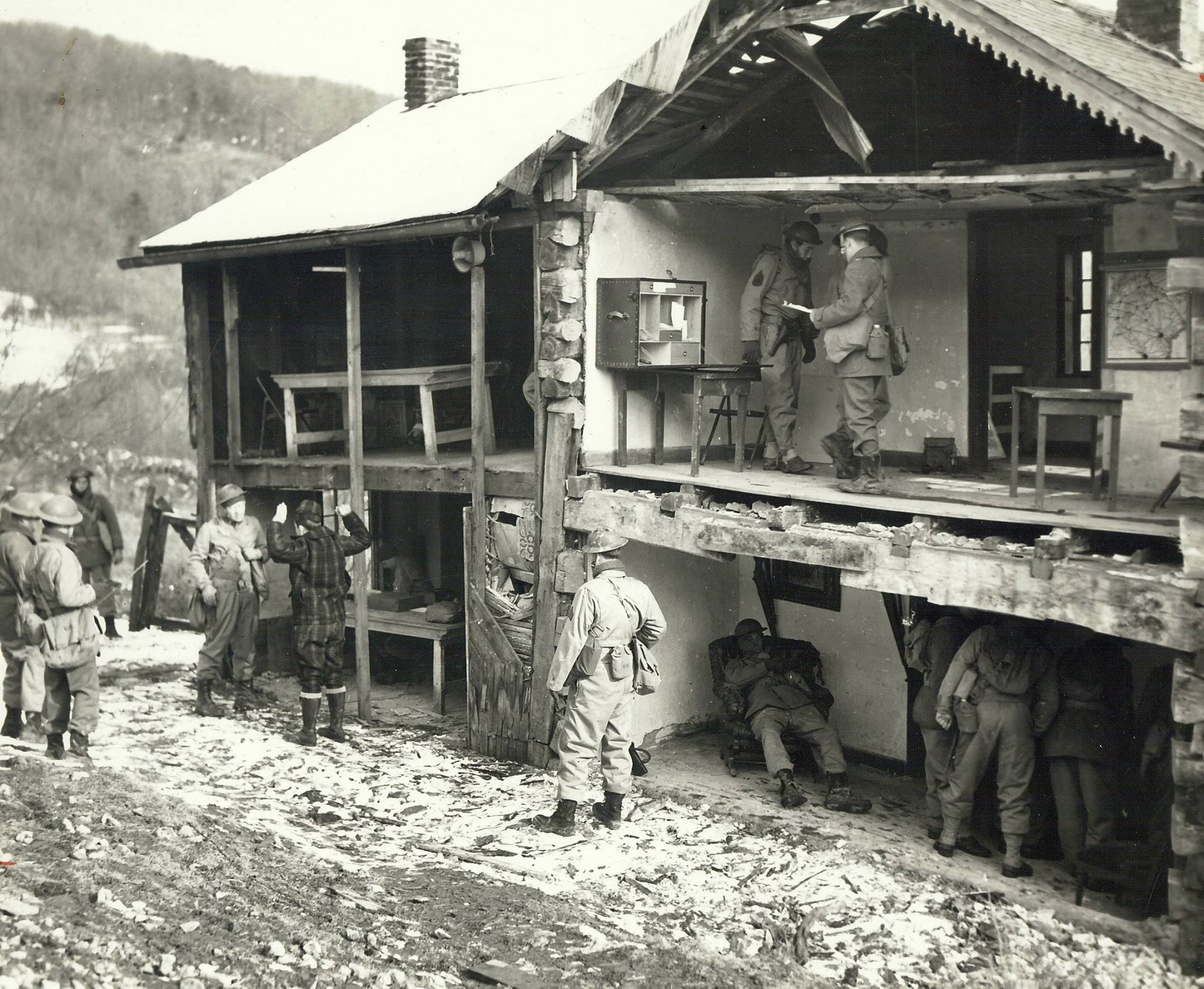 For realism, some training took place in a replica of a German village
 -
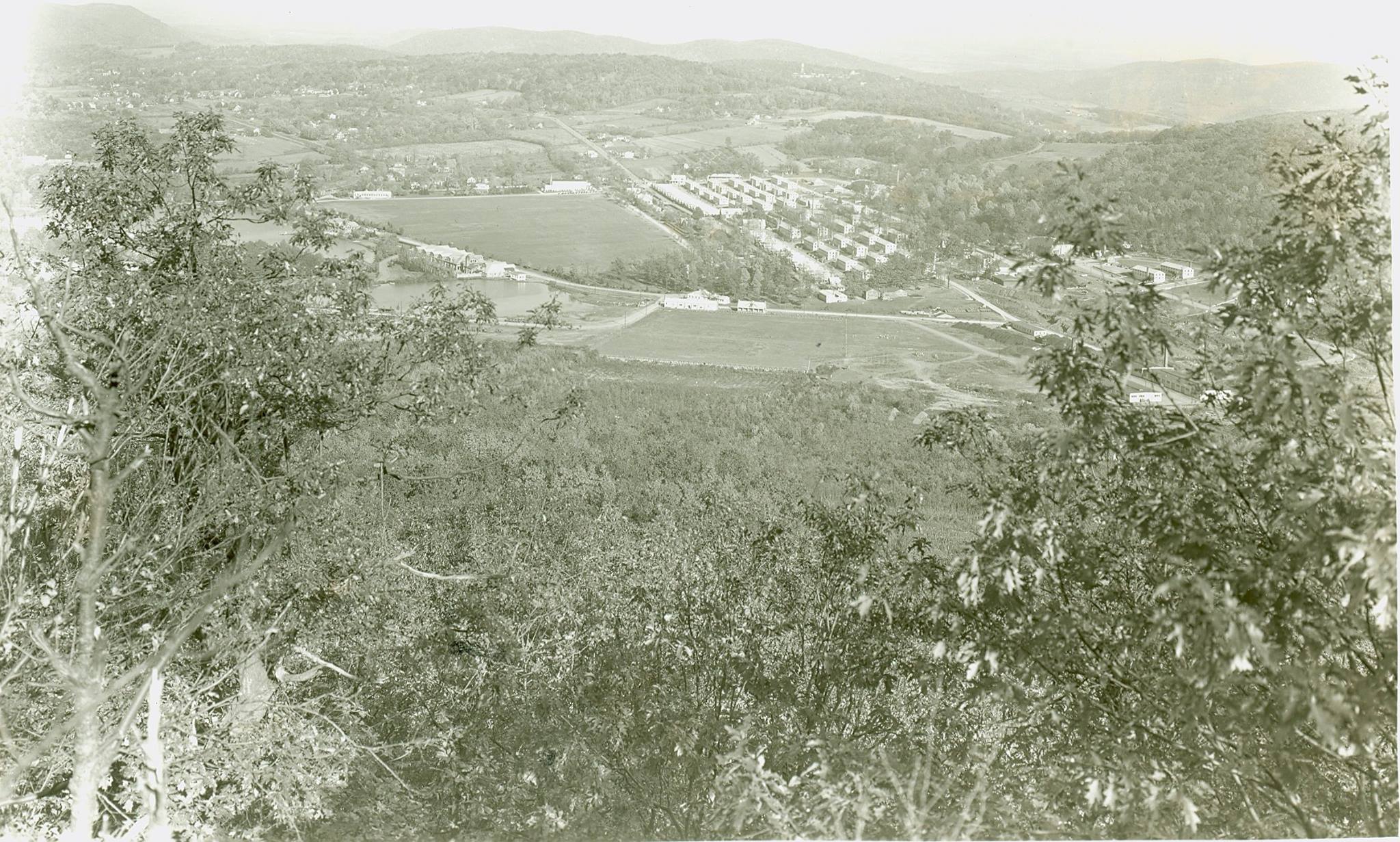 Panoramic view of Camp Ritchie in late 1944


Captions from the source filenames; archival credit not yet verified (see Photos#Camp Ritchie).
Who trained there[edit | edit source]
About 20,000 men and roughly 2,000 Women’s Army Corps (WAC) members trained for Army intelligence work at Camp Ritchie (about 22,000 in all). Many were assigned because they spoke German, French, Italian, Polish, or another language the Army needed. Some were German- or Austrian-born Jewish refugees who had fled Nazi persecution; others were U.S.-born soldiers whose language skills were discovered after they enlisted or were drafted and who arrived on secret orders.
Training covered interrogation, counterintelligence, order of battle, psychological warfare, and related skills. Many graduates later served in the U.S. Counter Intelligence Corps (CIC). About 900 also received specialized training at Camp Sharpe near Gettysburg, Pennsylvania (often linked to Mobile Radio Broadcasting / psychological-warfare work — see Books and Ritchie Boy Programs). The 3rd Mobile Radio Broadcasting Company was activated at Camp Ritchie on 29 December 1943; specialized MRBC training commonly continued at Camp Sharpe. A Consolidated Roster from the 1st Mobile Radio Broadcasting Company Unit History booklet is on 1st Mobile Radio Broadcasting Company.
In the field[edit | edit source]
Europe[edit | edit source]
After the United States entered the war against Germany, many Ritchie Boys reached Europe beginning around D-Day (6 June 1944) and in the months that followed. Working near the front at corps and army levels, they interrogated prisoners and defectors, tracked German units and plans, and supported psychological-warfare efforts (leaflets, radio, and related means) meant to weaken resistance.
A classified postwar U.S. Army assessment found that nearly 60% of the credible intelligence gathered in the European theater came from the Ritchie Boys. After the war, many served as translators and interrogators at the Nuremberg trials.
General Oscar Koch (Patton’s G-2) is among those who later acknowledged that advance warning of the German Ardennes offensive drew on information from Military Intelligence Service units — a theme developed at length on Secret Heroes/Battle of the Bulge. A contemporary G-2 ETOUSA organizational account (Lt. Col. Henry C. Settle, October 1944) likewise stresses peacetime neglect of intelligence training and describes plans to place Camp Ritchie graduates into division G-2 slots (including a 29th Infantry Division staffing plan); see Camp Ritchie Background and Training materials.
Pacific[edit | edit source]
Camp Ritchie also trained more than 500 Nisei (second-generation Japanese American) soldiers for document work connected with the Pacific war, including PACMIRS (Pacific Military Intelligence Research Section). Nisei women in the Military Intelligence Service likewise completed rigorous Japanese military-language training and were often assigned to PACMIRS at Camp Ritchie to work captured Japanese documents. Captured Japanese materials were studied at the camp; one well-known episode involves Kazuo E. Yamane identifying Japanese armory meeting notes among crates of documents from Saipan, which helped the War Department locate and strike armories. (See also the 2017 film Proof of Loyalty: Kazuo Yamane and the Nisei Soldiers of Hawaii.) A 1946 MISLS yearbook states that of 35 WAC graduates at the November 1945 commencement, 21 were transferred to Camp Ritchie (with remaining graduates following when the WAC Detachment deactivated in February 1946)—matching Wikipedia’s note that about twenty-one MISLS women translator graduates went to PACMIRS work there (see Nisei and Pacific). In 1945 the camp also formed Mobile Intelligence Training Units (MITU) for Army Ground Forces redeployment training: small teams in which Nisei demonstrated Japanese squad tactics and took part in orientation plays (some teams included veterans of the 442nd Combat Team). See Nisei and Pacific.
Prisoners of war and the Hill Project[edit | edit source]
During the war years (into 1947) Camp Ritchie also housed prisoner-of-war compounds. Detainees included German and Italian prisoners, among them men taken in the North African campaign.
After Germany’s surrender, the post hosted a classified effort known as the Hill Project, in which selected German prisoners of war—including former Wehrmacht officers—worked with Allied personnel on research meant to improve military security in Europe, study German intelligence methods in detail, and (until Japan’s surrender) support the war against Japan. Only about 150 POWs worked directly on the project; by March 1946 more than 1,500 POWs were estimated to be at Ritchie, many connected in some way with that work.
After the war — Fort Ritchie and the museum[edit | edit source]
The post was later known as Fort Ritchie and closed in 1998 under the 1995 Base Realignment and Closure (BRAC) process. Following later redevelopment of the site, a museum and educational center opened on 9 June 2023 to commemorate the Ritchie Boys and the history of the post. See also Ritchie History Museum and Congressional Gold Medal.
Classes and teams on this wiki[edit | edit source]
The camp’s classes are listed as Class 1 through Class 31. Individual soldier articles use those class numbers in the infobox. IPW and MII team codes are listed under Category:Teams.
For founding history, the camp flag and coat-of-arms, and how the MITC was established, see Camp Ritchie Background. Trainee voices about everyday camp life are collected on Life in Camp Ritchie. JWB/USO records of the spring 1945 first-night Seder are on Passover at Camp Ritchie (1945). A July 1943 District Court naturalization of dozens of Camp Ritchie soldiers is summarized on Camp Ritchie naturalization (July 1943). Early staff and faculty from Dan Gross’s working list are on Camp Ritchie Faculty. Camp-wide training manuals and related PDFs live on Training materials. A short Personnel Section sheet of ten intelligence directives (List of Directives, Pers. Sec. 214) is transcribed on Training materials. A Signal Section monograph on a typical Enemy Equipment Intelligence Service detachment (EEIS Det. 9), including its April 1944 Camp Ritchie course, is on Training materials.
Sources[edit | edit source]
- WAC MIS grads leaving for Camp Ritchie (MISLS yearbook crop)
- Fold3 — MISLS WAC yearbook page 91 (21 WAC graduates to Camp Ritchie, Nov 1945)
- Fold3 — Settle Early G-2 Branch Organization (ETOUSA), 27 Oct 1944 / PDF
- English Wikipedia, Nisei women translators in World War II (MISLS graduates assigned to PACMIRS at Camp Ritchie)
- Nisei and Pacific — Mobile Intelligence Training Units
- MID 908 / MITU memos, July 1945 (Bissell–Weckerling; Camp Ritchie Section IX; WRA) (NARA via JAVA packet)
- Fold3 — A Typical Enemy Equipment Intelligence Service (EEIS Det. 9) / PDF on this wiki
- Passover at Camp Ritchie (1945) (Fold3 / National Jewish Welfare Board–USO)
- Washington Post, 21 July 1943 — 85 soldiers naturalized (almost all from Camp Ritchie)
- Camp Ritchie List of Directives (Pers. Sec. 214) (source uncertain)
- Panoramic view of Camp Ritchie in late 1944 (source uncertain)
- For realism, some training took place in a replica of a German village (source uncertain)
- English Wikipedia, Fort Ritchie — Camp Ritchie section (POW compounds; Nisei women / PACMIRS; 3rd MRBC activation; Hill Project overview)
- Japanese American Veterans Association — Japanese American Women in World War II (Nisei women MIS linguists / PACMIRS at Camp Ritchie)
- Derek R. Mallett, “Western Allied Intelligence and the German Military Document Section, 1945–6,” Journal of Contemporary History 46, no. 2 (2011): 390–391 (Hill Project / German POWs at Camp Ritchie)
- John Whiteclay Chambers II, “OSS Training Areas in the National Park Service” (footnote 121) — MITC formally activated 19 June 1942; cites trainee accounts including Richard Warren Seltzer, Sr., and Lewis Bloom


Overview figures and field roles above draw in part on the English Wikipedia article Ritchie Boys and the sources cited there (including Army intelligence histories and secondary works such as Bruce Henderson, Sons and Soldiers). Roster counts and class structure on this wiki follow the Camp Ritchie class data described on About the data and By The Numbers.
See also[edit | edit source]
- Contents
- FAQ
- Introduction
- The Stories
- Nisei and Pacific
- Camp Ritchie Background
- Life in Camp Ritchie
- Passover at Camp Ritchie (1945)
- Camp Ritchie naturalization (July 1943)
- Secret Heroes/Battle of the Bulge
- Camp Ritchie Faculty
- 1st Mobile Radio Broadcasting Company
- Training materials
- By The Numbers
- Notable Ritchie Boys
- Category:Classes
- Category:Teams