Soft launch: Soldier biographies and research notes vary in completeness. Prefer class-roster, NARA, newspapers, and other cited sources for contested facts — treat Research notes as leads, not settled history. Anyone can correct a page; contact us with questions.
Wechsberg, Joseph (39716066): Difference between revisions
Add audited Dan Gross timeline enrichment |
Regenerate bio from Nation's Business Camp Ritchie essay + Ritchie Museum; fix vitals/timeline |
||
| (5 intermediate revisions by the same user not shown) | |||
| Line 16: | Line 16: | ||
|occupation=Authors editors and reporters | |occupation=Authors editors and reporters | ||
|marital=Married | |marital=Married | ||
|birth_place= | |birth_place=Ostrava, Austria-Hungary | ||
|rank_final= | |rank_final=T/Sgt | ||
|class_number=16 | |class_number=16 | ||
|class_display=16 | |class_display=16 | ||
|birth_date=29 August 1907 | |||
|death_date=10 April 1983 | |||
|death_place=Vienna, Austria | |||
}} | }} | ||
<div class="soldier-lead"> | <div class="soldier-lead"> | ||
'''Joseph Wechsberg''' (1907–1983) was a United States Army | '''Joseph Wechsberg''' (29 August 1907 – 10 April 1983) was a Czech-born United States Army technical sergeant, Ritchie Boy ([[Class 16]]), and later a prolific American journalist and ''New Yorker'' correspondent. | ||
</div> | </div> | ||
== Biography == | == Biography == | ||
'' | Joseph Wechsberg was born on 29 August 1907 in Ostrava (then Ostrau), Moravia, in Austria-Hungary. He studied music and law, worked as a shipboard musician and European journalist, and served as a lieutenant in the Czechoslovak army during the 1938 mobilization. He and his wife reached the United States as refugees; his mother was later murdered at Auschwitz. | ||
Wechsberg enlisted in the U.S. Army at Los Angeles on 4 November 1943 (ASN 39716066). His brother [[Wechsberg, Maximilian (01170243)|Maximilian Wechsberg]] had already trained at [[Camp Ritchie]] (Class 4). Joseph entered [[Class 16]] for interrogation of German prisoners of war, then continued psychological-warfare training at Camp Sharpe near Gettysburg. In a 1950 ''Nation's Business'' essay he still associated fatigue uniforms with early kitchen-police duty at Camp Ritchie. Overseas he served with a Mobile Radio Broadcasting / psychological-warfare unit (roster MRBC 4), rose to technical sergeant, and worked as a military correspondent, including a temporary assignment with ''Stars and Stripes'' and front-line duty during the Battle of the Bulge. | |||
After the war Wechsberg became a widely published American writer and longtime Europe correspondent for ''The New Yorker''. He died in Vienna on 10 April 1983. | |||
== Research notes == | == Research notes == | ||
* | * Roster MRBC 4 retained; expanded from placeholder "attached to ___" using Camp Sharpe / psychological-warfare Mobile Radio Broadcasting context (Ritchie History Museum essay + Nation's Business Camp Ritchie mention). | ||
* Brother [[Wechsberg, Maximilian (01170243)|Maximilian Wechsberg]] (Class 4 faculty) is a separate roster page. | |||
== Gallery == | == Gallery == | ||
<div class="soldier-gallery"> | |||
<gallery mode="packed" heights="140px"> | |||
Wechsberg_Joseph_39716066_Nations_Business_1950-08_author_bio.png|Contributor note on Joseph Wechsberg, ''Nation's Business'', August 1950 (Czech-born journalist; Czech army 1938; U.S. Army private to sergeant; Camp Ritchie context in article). | |||
Wechsberg_Joseph_39716066_Nations_Business_1950-08_p38_Ritchie.png|Wechsberg recalls early kitchen-police days at Camp Ritchie, Maryland (''Nation's Business'', August 1950, "The Corner Store Goes Abroad"). | |||
</gallery> | |||
</div> | |||
== Technical record == | == Technical record == | ||
| Line 98: | Line 111: | ||
<div class="mw-collapsible mw-collapsed soldier-timeline"> | <div class="mw-collapsible mw-collapsed soldier-timeline"> | ||
<div class="soldier-timeline-body"> | <div class="soldier-timeline-body"> | ||
* | * 29 August 1907 — Born in Ostrava (Ostrau), Moravia, Austria-Hungary. | ||
* | * 1938 — Served as a lieutenant in the Czechoslovak army during mobilization (Nation's Business contributor note, August 1950). | ||
* | * 1939 — Reached the United States as a refugee with his wife. | ||
* | * 4 November 1943 — Enlisted at Los Angeles, California, as Private (ASN 39716066). | ||
* | * Trained at Camp Ritchie in Class 16 (interrogation of German POWs); recalled early kitchen-police duty there (Nation's Business, August 1950). | ||
* Continued psychological-warfare training at Camp Sharpe, Gettysburg, Pennsylvania (Ritchie History Museum biographical essay). | |||
* Served overseas with MRBC 4 / psychological-warfare radio unit; promoted to technical sergeant; temporary Stars and Stripes work; Battle of the Bulge duty (December 1944). | |||
* Mustered out as a sergeant (Nation's Business, August 1950). | |||
* Postwar — American journalist and Europe correspondent for The New Yorker. | |||
* 10 April 1983 — Died in Vienna, Austria. | |||
</div> | </div> | ||
</div><div style="clear: both;"></div> | </div><div style="clear: both;"></div> | ||
== Sources == | == Sources == | ||
* [https://en.wikipedia.org/wiki/Joseph_Wechsberg Wikipedia: Joseph Wechsberg] (vitals cross-check) | |||
* [https://www.ritchiemuseum.org/post/joseph-wechsberg-epicurean-master-of-cultural-commentary Ritchie History Museum: Joseph Wechsberg — Epicurean Master of Cultural Commentary] (Class 16; Camp Sharpe; MRBC / psychological warfare; brother Max Class 4) | |||
* Joseph Wechsberg, "The Corner Store Goes Abroad," ''Nation's Business'', August 1950 (contributor note: Czech-born journalist; Czech army 1938; U.S. Army private to sergeant; article recalls Camp Ritchie kitchen-police duty) [[:File:Wechsberg_Joseph_39716066_Nations_Business_1950-08_author_bio.png|author note]]; [[:File:Wechsberg_Joseph_39716066_Nations_Business_1950-08_p38_Ritchie.png|Ritchie passage]] | |||
* Camp Ritchie Museum, Inc. (The Ritchie History Museum), Classes 1–31 roster data | * Camp Ritchie Museum, Inc. (The Ritchie History Museum), Classes 1–31 roster data | ||
* Dan Gross research spreadsheets, including original Excel timeline/roster work, combined with other research and records | * Dan Gross research spreadsheets, including original Excel timeline/roster work, combined with other research and records | ||
Latest revision as of 04:39, 18 September 2026
| Joseph Wechsberg | |
|---|---|
| Personal details | |
| Born | 29 August 1907 Ostrava, Austria-hungary |
| Died | 10 April 1983 Vienna, Austria |
| Nativity | Czechoslovakia |
| Religion | Jewish |
| Military service | |
| Allegiance |  United States United States |
| Branch |  United States Army United States Army |
| ASN | 39716066 |
| Rank | Technical Sergeant |
| Camp Ritchie | Class 16 (6 February – 5 April 1944) |
| Enlisted | Los Angeles, California |
{{Needs source}}, or explain disagreements on talk. Baseline import notes: About the data.
Joseph Wechsberg (29 August 1907 – 10 April 1983) was a Czech-born United States Army technical sergeant, Ritchie Boy (Class 16), and later a prolific American journalist and New Yorker correspondent.
Biography[edit | edit source]
Joseph Wechsberg was born on 29 August 1907 in Ostrava (then Ostrau), Moravia, in Austria-Hungary. He studied music and law, worked as a shipboard musician and European journalist, and served as a lieutenant in the Czechoslovak army during the 1938 mobilization. He and his wife reached the United States as refugees; his mother was later murdered at Auschwitz.
Wechsberg enlisted in the U.S. Army at Los Angeles on 4 November 1943 (ASN 39716066). His brother Maximilian Wechsberg had already trained at Camp Ritchie (Class 4). Joseph entered Class 16 for interrogation of German prisoners of war, then continued psychological-warfare training at Camp Sharpe near Gettysburg. In a 1950 Nation's Business essay he still associated fatigue uniforms with early kitchen-police duty at Camp Ritchie. Overseas he served with a Mobile Radio Broadcasting / psychological-warfare unit (roster MRBC 4), rose to technical sergeant, and worked as a military correspondent, including a temporary assignment with Stars and Stripes and front-line duty during the Battle of the Bulge.
After the war Wechsberg became a widely published American writer and longtime Europe correspondent for The New Yorker. He died in Vienna on 10 April 1983.
Research notes[edit | edit source]
- Roster MRBC 4 retained; expanded from placeholder "attached to ___" using Camp Sharpe / psychological-warfare Mobile Radio Broadcasting context (Ritchie History Museum essay + Nation's Business Camp Ritchie mention).
- Brother Maximilian Wechsberg (Class 4 faculty) is a separate roster page.
Gallery[edit | edit source]
-
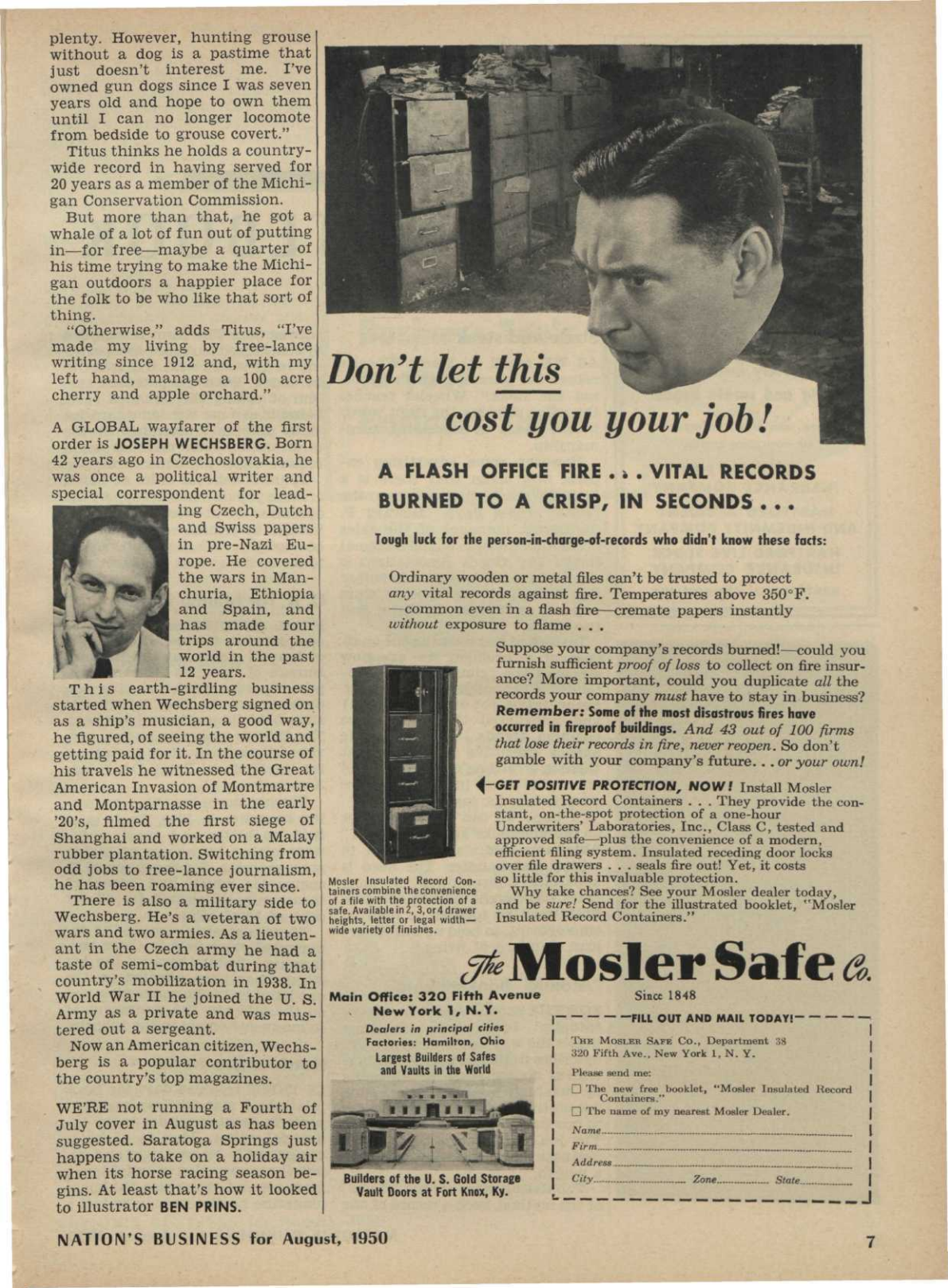 Contributor note on Joseph Wechsberg, Nation's Business, August 1950 (Czech-born journalist; Czech army 1938; U.S. Army private to sergeant; Camp Ritchie context in article).
 -
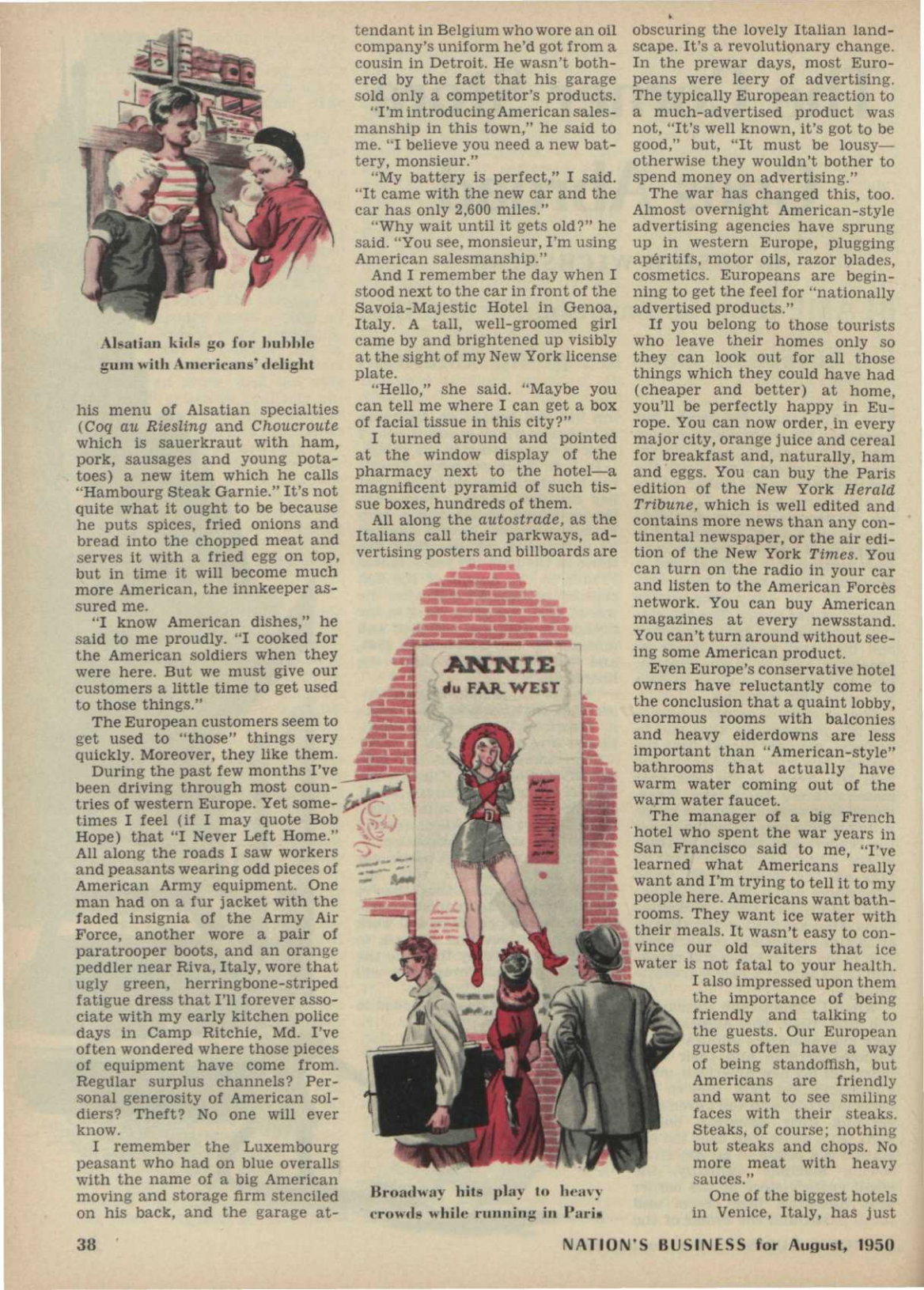 Wechsberg recalls early kitchen-police days at Camp Ritchie, Maryland (Nation's Business, August 1950, "The Corner Store Goes Abroad").


Technical record[edit | edit source]
| Field | Imported value |
|---|---|
| MRBC4 | 4 |
| Approx Age at Death | 76 |
| Nara ASN | 39716066 |
| Nara Name | WACHSBERG JOSEPH |
| Nara State | 91 |
| Nara County | 37 |
| Nara POE | 9141 |
| Nara DOE | 41143 |
| Nara Grade Alpha | PVT |
| Nara Grade Code | 8 |
| Nara Branch Alpha | NO |
| Nara Branch Code | 2 |
| Branch | No branch assignment |
| Nara Term or Enlistment | 5 |
| Term of enlistment | Enlistment for the duration of the War or other emergency, plus six months, subject to the discretion of the President or otherwise according to law |
| Defer. Date | 0 |
| Nara Source | 0 |
| Nara Nativity | N4 |
| Nara Year of Birth | 7 |
| Nara Race | J |
| Nara Race Description | White not yet a citizen |
| Nara Education | 9 |
| Nara Civilian Occupation | 6 |
| Nara Marital Status | 2 |
| Nara Height (inches) | 80 |
| Nara Weight (lbs) | 990 |
| row_source | demographics |
Timeline[edit | edit source]
- 29 August 1907 — Born in Ostrava (Ostrau), Moravia, Austria-Hungary.
- 1938 — Served as a lieutenant in the Czechoslovak army during mobilization (Nation's Business contributor note, August 1950).
- 1939 — Reached the United States as a refugee with his wife.
- 4 November 1943 — Enlisted at Los Angeles, California, as Private (ASN 39716066).
- Trained at Camp Ritchie in Class 16 (interrogation of German POWs); recalled early kitchen-police duty there (Nation's Business, August 1950).
- Continued psychological-warfare training at Camp Sharpe, Gettysburg, Pennsylvania (Ritchie History Museum biographical essay).
- Served overseas with MRBC 4 / psychological-warfare radio unit; promoted to technical sergeant; temporary Stars and Stripes work; Battle of the Bulge duty (December 1944).
- Mustered out as a sergeant (Nation's Business, August 1950).
- Postwar — American journalist and Europe correspondent for The New Yorker.
- 10 April 1983 — Died in Vienna, Austria.
Sources[edit | edit source]
- Wikipedia: Joseph Wechsberg (vitals cross-check)
- Ritchie History Museum: Joseph Wechsberg — Epicurean Master of Cultural Commentary (Class 16; Camp Sharpe; MRBC / psychological warfare; brother Max Class 4)
- Joseph Wechsberg, "The Corner Store Goes Abroad," Nation's Business, August 1950 (contributor note: Czech-born journalist; Czech army 1938; U.S. Army private to sergeant; article recalls Camp Ritchie kitchen-police duty) author note; Ritchie passage
- Camp Ritchie Museum, Inc. (The Ritchie History Museum), Classes 1–31 roster data
- Dan Gross research spreadsheets, including original Excel timeline/roster work, combined with other research and records
- NARA World War II Army enlistment records (where a NARA ASN is present)
- 1940 U.S. Census (where a census match is present)
- Dan Gross, Timeline of Joseph Wechsberg for Camp Ritchie (private research document; 1 source documents reviewed)
- Dan Gross, Timeline of Wechsberg, Joseph for Camp Ritchie (private research files; selected non-private narrative findings; 1 source files: JOSEPH WECHSBERG.doc)