Soft launch: Soldier biographies and research notes vary in completeness. Prefer class-roster, NARA, newspapers, and other cited sources for contested facts — treat Research notes as leads, not settled history. Anyone can correct a page; contact us with questions.
Wynder, Ernest Ludwig (32926486): Difference between revisions
Refresh Facebook post enrichment (bio/captions/sources) |
Expand documented full name in infobox and lead |
||
| (21 intermediate revisions by the same user not shown) | |||
| Line 4: | Line 4: | ||
|surname=Wynder | |surname=Wynder | ||
|first=Ernest | |first=Ernest | ||
|middle= | |middle=Ludwig | ||
|alias=Ernst | |alias=Ernst Ludwig Wynder | ||
|birth_year=1922 | |birth_year=1922 | ||
|death_year=1999 | |death_year=1999 | ||
|nativity= | |nativity=Germany | ||
|religion= | |religion=Jewish | ||
|enlistment_place= | |enlistment_place=Newark New Jersey | ||
|state= | |state=New Jersey | ||
|certificate=D | |certificate=D | ||
|education= | |education=New York University; Washington University School of Medicine (B.S., M.D., 1950) | ||
|marital=Single without dependents | |marital=Single without dependents | ||
| | |occupation=Physician, educator, health researcher | ||
| | |birth_date=30 April 1922 | ||
|birth_place=Herford, Westphalia | |||
|death_date=14 July 1999 | |||
|death_place=Manhattan, New York | |||
|known_for=Linking smoking with lung cancer | |||
|awards=Robert Koch Prize (Gold, 1990) | |||
|rank_final=Pvt | |||
|class_number=17 | |||
|class_display=17 | |||
}} | }} | ||
<div class="soldier-lead"> | <div class="soldier-lead"> | ||
'''Ernest | '''Ernest Ludwig Wynder''' (30 April 1922 – 14 July 1999), born Ernst Ludwig Wynder in Herford, Germany, was a Jewish Ritchie Boy and later an American epidemiologist and public-health researcher. With Evarts A. Graham he published the landmark 1950 ''Journal of the American Medical Association'' study that helped identify smoking as a contributory cause of lung cancer—work that shaped decades of cancer prevention research. | ||
</div> | </div> | ||
== Biography == | == Biography == | ||
Ernst Ludwig Wynder was born on 30 April 1922 in Herford, Westphalia, to Jewish parents. In 1938 his family | Ernst Ludwig Wynder was born on 30 April 1922 in Herford, Westphalia, to Jewish parents; he was a cousin of Robert Weinberg. In 1938 his family escaped Nazi Germany for the United States, where he enrolled at New York University. | ||
Roster and enlistment records list him as Ernest L Wynder (ASN 32926486), a German-born Jewish trainee; he enlisted as a private at Newark, New Jersey, on 7 June 1943, with four years of college noted on his service record. He was at Camp Ritchie with [[:Category:Class 17|Class 17]] but did not graduate, being dropped and assigned to the 5th Mobile Radio Broadcasting Company. He became a U.S. citizen during the war, and as a German speaker served in psychological warfare, monitoring German newscasts. He appears in a wartime group photograph of Ritchie Boys with [[Habe-Bekessy, Hans (32719455)|Hans Habe]], [[Kellen, Konrad (39701828)|Konrad Kellen]], [[Heym, Stefan (32860259)|Stefan Heym]], [[Atlas, Louis (32258804)|Louis Atlas]], [[Weidenreich, Peter H. (32791342)|Peter Weidenreich]] (later Wyden), and [[Eaton, Joseph W. (32498461)|Joseph Eaton]]. | |||
After the war Wynder studied medicine at Washington University in St. Louis, receiving both a Bachelor of Science and an M.D. in 1950. | After the war Wynder studied medicine at Washington University in St. Louis, receiving both a Bachelor of Science and an M.D. in 1950. In the summer of 1946 he had studied the smoking habits of 146 lung cancer patients in New York City, and from 1947, as a medical student, he worked with the thoracic surgeon Evarts A. Graham, collecting data on 604 lung cancer patients in hospitals across the country and comparing them with a cancer-free control group. Their paper, "Tobacco Smoking as a Possible Etiologic Factor in Bronchiogenic Carcinoma: A Study of 684 Proved Cases", published in the ''Journal of the American Medical Association'' on 27 May 1950, was one of the first major scientific studies to identify smoking as a contributory cause of lung cancer. Follow-up laboratory work begun with Graham in 1950 showed that cigarette tar produced cancers in 44 percent of exposed mice, and Wynder identified carcinogens such as benzopyrenes and arsenic in tobacco tar. | ||
Through the 1950s and 1960s Wynder worked at the Sloan-Kettering Institute for Cancer Research. A physician, researcher, educator, and activist devoted to the prevention of cancer and chronic disease, he published nearly 800 papers, chiefly on lung and breast cancer but also on cancers of the bladder, larynx, colon, stomach, ovary, prostate, pancreas, and kidney, including a major 1960 study of the epidemiology of breast cancer. He founded the American Health Foundation in 1969 and in 1972 founded the journal ''Preventive Medicine'', serving as its founding editor. He received the Robert Koch Prize (Gold) in 1990. Wynder died of thyroid cancer on 14 July 1999. | |||
== Gallery == | == Gallery == | ||
<div class="soldier-gallery"> | <div class="soldier-gallery"> | ||
<gallery mode="packed" heights="140px"> | <gallery mode="packed" heights="140px"> | ||
4448187125203174.jpg| | 4448187125203174.jpg|All the men identified in the pix are "Ritchie Boys." Seated - [[Habe-Bekessy, Hans (32719455)|Hans Habe]]. Standing L-R - Unknown, [[Wynder, Ernest Ludwig (32926486)|Ernest Wynder]], [[Kellen, Konrad (39701828)|Konrad Kellen]], unknown, [[Heym, Stefan (32860259)|Stefan Heym]], [[Atlas, Louis (32258804)|Louis Atlas]], [[Weidenreich, Peter H. (32791342)|Peter Weidenreich]] (last name later changed to Wyden), unknown, [[Eaton, Joseph W. (32498461)|Joseph Eaton]] | ||
</gallery> | </gallery> | ||
</div> | </div> | ||
| Line 99: | Line 104: | ||
| row_source || demographics | | row_source || demographics | ||
|} | |} | ||
== Timeline == | |||
<div class="mw-collapsible mw-collapsed soldier-timeline"> | |||
<div class="soldier-timeline-body"> | |||
* 7 June 1943 — Enlisted in Army at Newark, NJ as Pvt (ASN: 32926486). | |||
* Summer 1946 — Studied smoking habits of lung cancer patients in New York City. | |||
* 1950 — B.S. and M.D., Washington University in St. Louis. | |||
* 27 May 1950 — Wynder–Graham smoking and lung cancer study published in JAMA. | |||
* 1969 — Founded the American Health Foundation. | |||
* 1972 — Founded the journal ''Preventive Medicine''. | |||
* 14 July 1999 — Died. | |||
* Non-graduate of Class 17 (‘dropped’ and assigned to MRBC5). | |||
</div> | |||
</div><div style="clear: both;"></div> | |||
== Sources == | == Sources == | ||
* Camp Ritchie | * Camp Ritchie Museum, Inc. (The Ritchie History Museum), Classes 1–31 roster data | ||
* Dan Gross research spreadsheets, including original Excel timeline/roster work, combined with other research and records | |||
* NARA World War II Army enlistment records (where a NARA ASN is present) | * NARA World War II Army enlistment records (where a NARA ASN is present) | ||
* 1940 U.S. Census (where a census match is present) | * 1940 U.S. Census (where a census match is present) | ||
* Ritchie Boys of WWII Facebook page, post dated 2021-08-11 (1 post) | * Ritchie Boys of WWII Facebook page, post dated 2021-08-11 (1 post) | ||
* [https://en.wikipedia.org/wiki/Ernst_Wynder Wikipedia: Ernst Wynder] | * [https://en.wikipedia.org/wiki/Ernst_Wynder Wikipedia: Ernst Wynder] | ||
* Dan Gross, ''Timeline of Ernest L Wynder for Camp Ritchie'' (private research document; 1 source documents reviewed) | |||
* Dan Gross, ''Timeline of Wynder, Ernest L for Camp Ritchie'' (private research files; selected non-private narrative findings; 1 source files: ERNEST WYNDER.docx) | |||
Latest revision as of 03:53, 25 September 2026
| Ernest Ludwig Wynder | |
|---|---|
| Personal details | |
| Birth name | Ernst Ludwig Wynder |
| Born | 30 April 1922 Herford, Westphalia |
| Died | 14 July 1999 Manhattan, New York |
| Nativity | Germany |
| Religion | Jewish |
| Known for | Linking smoking with lung cancer |
| Awards | Robert Koch Prize (gold, 1990) |
| Military service | |
| Allegiance |  United States United States |
| Branch |  United States Army United States Army |
| ASN | 32926486 |
| Rank | Private |
| Camp Ritchie | Class 17 (11 March – 8 May 1944) |
| Enlisted | Newark, New Jersey |
- Robert Koch Prize (Gold, 1990)
{{Needs source}}, or explain disagreements on talk. Baseline import notes: About the data.
Ernest Ludwig Wynder (30 April 1922 – 14 July 1999), born Ernst Ludwig Wynder in Herford, Germany, was a Jewish Ritchie Boy and later an American epidemiologist and public-health researcher. With Evarts A. Graham he published the landmark 1950 Journal of the American Medical Association study that helped identify smoking as a contributory cause of lung cancer—work that shaped decades of cancer prevention research.
Biography[edit | edit source]
Ernst Ludwig Wynder was born on 30 April 1922 in Herford, Westphalia, to Jewish parents; he was a cousin of Robert Weinberg. In 1938 his family escaped Nazi Germany for the United States, where he enrolled at New York University.
Roster and enlistment records list him as Ernest L Wynder (ASN 32926486), a German-born Jewish trainee; he enlisted as a private at Newark, New Jersey, on 7 June 1943, with four years of college noted on his service record. He was at Camp Ritchie with Class 17 but did not graduate, being dropped and assigned to the 5th Mobile Radio Broadcasting Company. He became a U.S. citizen during the war, and as a German speaker served in psychological warfare, monitoring German newscasts. He appears in a wartime group photograph of Ritchie Boys with Hans Habe, Konrad Kellen, Stefan Heym, Louis Atlas, Peter Weidenreich (later Wyden), and Joseph Eaton.
After the war Wynder studied medicine at Washington University in St. Louis, receiving both a Bachelor of Science and an M.D. in 1950. In the summer of 1946 he had studied the smoking habits of 146 lung cancer patients in New York City, and from 1947, as a medical student, he worked with the thoracic surgeon Evarts A. Graham, collecting data on 604 lung cancer patients in hospitals across the country and comparing them with a cancer-free control group. Their paper, "Tobacco Smoking as a Possible Etiologic Factor in Bronchiogenic Carcinoma: A Study of 684 Proved Cases", published in the Journal of the American Medical Association on 27 May 1950, was one of the first major scientific studies to identify smoking as a contributory cause of lung cancer. Follow-up laboratory work begun with Graham in 1950 showed that cigarette tar produced cancers in 44 percent of exposed mice, and Wynder identified carcinogens such as benzopyrenes and arsenic in tobacco tar.
Through the 1950s and 1960s Wynder worked at the Sloan-Kettering Institute for Cancer Research. A physician, researcher, educator, and activist devoted to the prevention of cancer and chronic disease, he published nearly 800 papers, chiefly on lung and breast cancer but also on cancers of the bladder, larynx, colon, stomach, ovary, prostate, pancreas, and kidney, including a major 1960 study of the epidemiology of breast cancer. He founded the American Health Foundation in 1969 and in 1972 founded the journal Preventive Medicine, serving as its founding editor. He received the Robert Koch Prize (Gold) in 1990. Wynder died of thyroid cancer on 14 July 1999.
Gallery[edit | edit source]
-
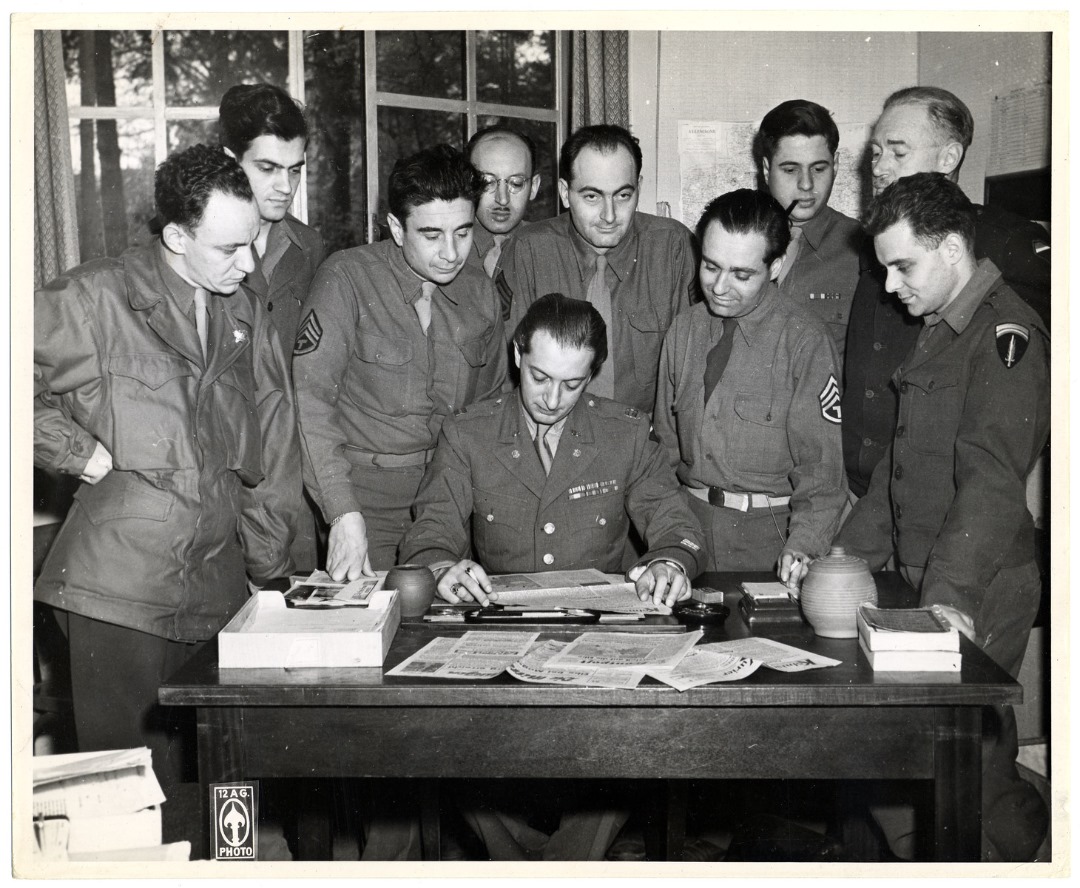 All the men identified in the pix are "Ritchie Boys." Seated - Hans Habe. Standing L-R - Unknown, Ernest Wynder, Konrad Kellen, unknown, Stefan Heym, Louis Atlas, Peter Weidenreich (last name later changed to Wyden), unknown, Joseph Eaton

Technical record[edit | edit source]
| Field | Imported value |
|---|---|
| Approx Age at Death | 77 |
| Nara ASN | 32926486 |
| Nara Name | WYNDER ERNEST |
| Nara State | 22 |
| Nara County | 13 |
| Nara POE | 2252 |
| Nara DOE | 70643 |
| Nara Grade Alpha | PVT |
| Nara Grade Code | 8 |
| Nara Branch Alpha | NO |
| Nara Branch Code | 2 |
| Branch | No branch assignment |
| Nara Term or Enlistment | 5 |
| Term of enlistment | Enlistment for the duration of the War or other emergency, plus six months, subject to the discretion of the President or otherwise according to law |
| Defer. Date | 0 |
| Nara Source | 0 |
| Nara Nativity | N1 |
| Nara Year of Birth | 22 |
| Nara Race | J |
| Nara Race Description | White not yet a citizen |
| Nara Education | 8 |
| Nara Civilian Occupation | 992 |
| Nara Marital Status | 6 |
| Nara Height (inches) | 43 |
| Nara Weight (lbs) | 444 |
| row_source | demographics |
Timeline[edit | edit source]
- 7 June 1943 — Enlisted in Army at Newark, NJ as Pvt (ASN: 32926486).
- Summer 1946 — Studied smoking habits of lung cancer patients in New York City.
- 1950 — B.S. and M.D., Washington University in St. Louis.
- 27 May 1950 — Wynder–Graham smoking and lung cancer study published in JAMA.
- 1969 — Founded the American Health Foundation.
- 1972 — Founded the journal Preventive Medicine.
- 14 July 1999 — Died.
- Non-graduate of Class 17 (‘dropped’ and assigned to MRBC5).
Sources[edit | edit source]
- Camp Ritchie Museum, Inc. (The Ritchie History Museum), Classes 1–31 roster data
- Dan Gross research spreadsheets, including original Excel timeline/roster work, combined with other research and records
- NARA World War II Army enlistment records (where a NARA ASN is present)
- 1940 U.S. Census (where a census match is present)
- Ritchie Boys of WWII Facebook page, post dated 2021-08-11 (1 post)
- Wikipedia: Ernst Wynder
- Dan Gross, Timeline of Ernest L Wynder for Camp Ritchie (private research document; 1 source documents reviewed)
- Dan Gross, Timeline of Wynder, Ernest L for Camp Ritchie (private research files; selected non-private narrative findings; 1 source files: ERNEST WYNDER.docx)