Soft launch: Soldier biographies and research notes vary in completeness. Prefer class-roster, NARA, newspapers, and other cited sources for contested facts — treat Research notes as leads, not settled history. Anyone can correct a page; contact us with questions.
Blake, Peter J. (0929736): Difference between revisions
Expand exact roster rank codes (rank_final: Pfc -> Private First Class; class_rank: Pfc -> Private First Class) |
RB Archive batch-11 curated media |
||
| (One intermediate revision by the same user not shown) | |||
| Line 17: | Line 17: | ||
|class_number=23 | |class_number=23 | ||
|class_display=23 | |class_display=23 | ||
|birth_place=Berlin, Germany | |birth_place=Berlin, Germany | ||
|death_date=5 December 2006 | |death_date=5 December 2006 | ||
|teams=MII 440-G | |teams=MII 440-G | ||
|death_place=Branford, Connecticut | |||
}} | }} | ||
| Line 27: | Line 28: | ||
== Biography == | == Biography == | ||
Peter Jost Blake (born Peter Jost Blach | Peter Jost Blake (born Peter Jost Blach) was born in 1920 in Berlin, Germany, to a prosperous Jewish family. After the Nazi seizure of power in 1933 he was sent to England, studied mathematics at the University of London, and entered the Regent Street Polytechnic School of Architecture in 1939. He immigrated to the United States in 1940, studied architecture at the University of Pennsylvania under Louis Kahn, and later completed architecture degrees at Pennsylvania (1941) and Pratt Institute (1949). | ||
In | In 1944 Blake became a naturalized citizen, changed his surname from Blach to Blake, and enlisted. He trained as an intelligence officer at Camp Ritchie (Class 23) and served in Europe with MII Team 440-G, among the first U.S. troops into Berlin after Hitler’s death. He remained in the Army until 1947. | ||
Blake headed MoMA’s architecture and design department in 1948, edited ''Architectural Forum'' (1950–1972), practiced as an architect, and wrote widely on modernism, including ''The Master Builders'' and ''God’s Own Junkyard''. He chaired architecture at Catholic University from 1979 until retiring in 1991, then continued writing from Connecticut. He died of complications from a respiratory infection on 5 December 2006 at Connecticut Hospice in Branford. | |||
He died on 5 December 2006. | |||
== Research notes == | == Research notes == | ||
* OSS | * OSS | ||
* Noted architect | * Noted architect | ||
* Fixed malformed live birth_place text. No full birth day is in the packet. No military decoration is asserted. | |||
== Gallery == | |||
<div class="soldier-gallery"> | |||
<gallery mode="packed" heights="140px"> | |||
Blake_Peter_J_0929736_Washington_Post_obituary.jpg|Washington Post obituary page for architect and author Peter Blake (RB Archive) | |||
</gallery> | |||
</div> | |||
== Technical record == | == Technical record == | ||
| Line 64: | Line 61: | ||
| row_source || both | | row_source || both | ||
|} | |} | ||
== Timeline == | |||
<div class="mw-collapsible mw-collapsed soldier-timeline"> | |||
<div class="soldier-timeline-body"> | |||
* 1920 — Born Peter Jost Blach in Berlin, Germany. | |||
* 1933 — Sent to England after the Nazi rise to power. | |||
* 1938–1939 — Studied at the University of London and the Regent Street Polytechnic School of Architecture. | |||
* 1940 — Immigrated to the United States; studied architecture at the University of Pennsylvania. | |||
* 1944 — Naturalized, changed surname to Blake, enlisted, and trained at Camp Ritchie (Class 23). | |||
* 1945–1947 — Served in Europe with MII Team 440-G; among early U.S. troops into Berlin; remained in the Army until 1947. | |||
* 1948 — Named curator of architecture and design at the Museum of Modern Art. | |||
* 1950–1972 — Writer and later editor of ''Architectural Forum''. | |||
* 1979–1991 — Chairman / faculty, Department of Architecture and Planning, Catholic University. | |||
* 5 December 2006 — Died in Branford, Connecticut. | |||
</div> | |||
</div><div style="clear: both;"></div> | |||
== Sources == | == Sources == | ||
* [[:File:Blake_Peter_J_0929736_Washington_Post_obituary.jpg|Washington Post obituary page for architect and author Peter Blake (RB Archive)]] | |||
* [https://libraries.catholic.edu/special-collections/archives/collections/finding-aids/finding-aids.html?file=blake Catholic University archives finding aid — Peter Blake papers] | |||
* [https://www.washingtonpost.com/archive/local/2006/12/07/architect-and-author-peter-blake-86/2e33381d-b382-4a00-a0fb-a0f7a96b322a/ ''Washington Post'', 7 December 2006 — Peter Blake obituary (RB Archive copy)] | |||
* Camp Ritchie Museum, Inc. (The Ritchie History Museum), Classes 1–31 roster data | * Camp Ritchie Museum, Inc. (The Ritchie History Museum), Classes 1–31 roster data | ||
* Dan Gross research spreadsheets, including original Excel timeline/roster work, combined with other research and records | * Dan Gross research spreadsheets, including original Excel timeline/roster work, combined with other research and records | ||
Latest revision as of 23:25, 16 September 2026
| Peter Jost Blake | |
|---|---|
| Personal details | |
| Born | 1920 Berlin, Germany |
| Died | 5 December 2006 Branford, Connecticut |
| Nativity | Germany |
| Religion | Jewish |
| Military service | |
| Allegiance |  United States United States |
| Branch |  United States Army United States Army |
| ASN | 0929736 |
| Rank | Private First Class |
| Camp Ritchie | Class 23 (25 September – 23 November 1944) |
| Section | 5A |
| Team | MII 440-G |
{{Needs source}}, or explain disagreements on talk. Baseline import notes: About the data.
Peter Jost Blake (1920–2006) was a Ritchie Boy (from Germany; Jewish) who trained at Camp Ritchie in class 23.
Biography[edit | edit source]
Peter Jost Blake (born Peter Jost Blach) was born in 1920 in Berlin, Germany, to a prosperous Jewish family. After the Nazi seizure of power in 1933 he was sent to England, studied mathematics at the University of London, and entered the Regent Street Polytechnic School of Architecture in 1939. He immigrated to the United States in 1940, studied architecture at the University of Pennsylvania under Louis Kahn, and later completed architecture degrees at Pennsylvania (1941) and Pratt Institute (1949).
In 1944 Blake became a naturalized citizen, changed his surname from Blach to Blake, and enlisted. He trained as an intelligence officer at Camp Ritchie (Class 23) and served in Europe with MII Team 440-G, among the first U.S. troops into Berlin after Hitler’s death. He remained in the Army until 1947.
Blake headed MoMA’s architecture and design department in 1948, edited Architectural Forum (1950–1972), practiced as an architect, and wrote widely on modernism, including The Master Builders and God’s Own Junkyard. He chaired architecture at Catholic University from 1979 until retiring in 1991, then continued writing from Connecticut. He died of complications from a respiratory infection on 5 December 2006 at Connecticut Hospice in Branford.
Research notes[edit | edit source]
- OSS
- Noted architect
- Fixed malformed live birth_place text. No full birth day is in the packet. No military decoration is asserted.
Gallery[edit | edit source]
-
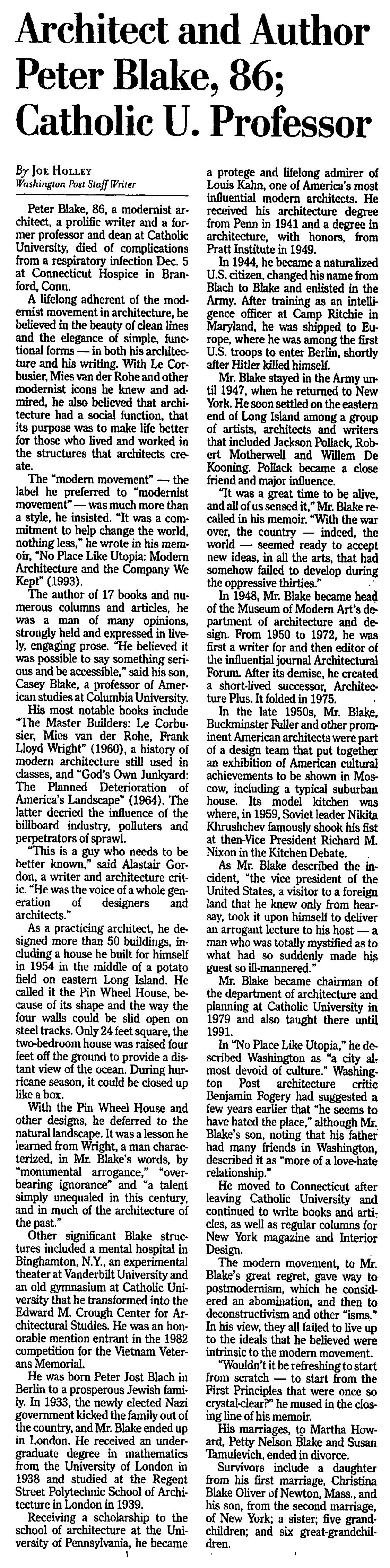 Washington Post obituary page for architect and author Peter Blake (RB Archive)

Technical record[edit | edit source]
| Field | Imported value |
|---|---|
| Approx Age at Death | 86 |
| Class_ASN | 32996525 |
| Class_Name | BLAKE, Peter J. |
| match_method | pass2_unique_name |
| row_source | both |
Timeline[edit | edit source]
- 1920 — Born Peter Jost Blach in Berlin, Germany.
- 1933 — Sent to England after the Nazi rise to power.
- 1938–1939 — Studied at the University of London and the Regent Street Polytechnic School of Architecture.
- 1940 — Immigrated to the United States; studied architecture at the University of Pennsylvania.
- 1944 — Naturalized, changed surname to Blake, enlisted, and trained at Camp Ritchie (Class 23).
- 1945–1947 — Served in Europe with MII Team 440-G; among early U.S. troops into Berlin; remained in the Army until 1947.
- 1948 — Named curator of architecture and design at the Museum of Modern Art.
- 1950–1972 — Writer and later editor of Architectural Forum.
- 1979–1991 — Chairman / faculty, Department of Architecture and Planning, Catholic University.
- 5 December 2006 — Died in Branford, Connecticut.
Sources[edit | edit source]
- Washington Post obituary page for architect and author Peter Blake (RB Archive)
- Catholic University archives finding aid — Peter Blake papers
- Washington Post, 7 December 2006 — Peter Blake obituary (RB Archive copy)
- Camp Ritchie Museum, Inc. (The Ritchie History Museum), Classes 1–31 roster data
- Dan Gross research spreadsheets, including original Excel timeline/roster work, combined with other research and records
- NARA World War II Army enlistment records (where a NARA ASN is present)
- 1940 U.S. Census (where a census match is present)
- Ritchie Boys of WWII Facebook page, post dated 2022-12-09 (1 post)