Soft launch: Soldier biographies and research notes vary in completeness. Prefer class-roster, NARA, newspapers, and other cited sources for contested facts — treat Research notes as leads, not settled history. Anyone can correct a page; contact us with questions.
Mayer, Arno Joseph (42139253): Difference between revisions
Remove redundant Notable Ritchie Boys slides research note |
Sort Timeline bullets chronologically |
||
| (5 intermediate revisions by the same user not shown) | |||
| Line 10: | Line 10: | ||
|religion=Jewish | |religion=Jewish | ||
|enlistment_place=New York City New York | |enlistment_place=New York City New York | ||
|photo=Wikipedia_Arno_J_Mayer_IEIS_Conference_Arno_J_Mayer_cropped.jpg | |photo=Wikipedia_Arno_J_Mayer_IEIS_Conference_Arno_J_Mayer_cropped.jpg | ||
|overseas=N | |overseas=N | ||
| Line 22: | Line 18: | ||
|birth_place=Luxembourg City, Luxembourg | |birth_place=Luxembourg City, Luxembourg | ||
|death_place=Princeton, New Jersey | |death_place=Princeton, New Jersey | ||
| | |class_display=29 | ||
}} | }} | ||
<div class="soldier-lead"> | <div class="soldier-lead"> | ||
''' | '''Arno Joseph Mayer''' (19 June 1926–18 December 2023) was a Luxembourg-born U.S. Army soldier who trained at [[Camp Ritchie]] with [[:Category:Class 29|Class 29]]. He later served at [[P.O. Box 1142]] and, after the war, became a historian of modern Europe and the Holocaust and the Dayton-Stockton Professor of History at Princeton University. | ||
</div> | </div> | ||
== Biography == | == Biography == | ||
Arno Joseph Mayer | Arno Joseph Mayer was born on 19 June 1926 in Luxembourg City, in a small, overwhelmingly Catholic country with a tiny, largely assimilated Jewish minority. His father, politically shaped by left-wing Zionist circles from university days in Heidelberg, helped many German Jews find temporary refuge in Luxembourg before they moved on. By the late 1930s insults and hostility rose, especially toward refugee children. Between 1938 and 1940 the family fled Luxembourg five times on invasion scares; in February 1940 they even moved briefly to Brussels before returning so Mayer and his sister Ruth could take school exams. | ||
On 10 May 1940, after a warning from French intelligence contacts, the family left Luxembourg at 1:00 a.m. Border guards at first refused passage; Mayer’s grandfather’s German passport marked with a large “J” drew suspicion until confirmation of German airborne landings nearby, and the Grand Duchess herself arrived at the border and verified the invasion before crossing. Near Verdun, French soldiers detained the grandfather as an enemy alien until an officer recognized the “J” as Juif and granted a laissez-passer; Mayer tore up the passport as they drove on. | |||
A six-month refugee odyssey followed. A Spain route failed after the French armistice—Spain barred men of military age, and the elderly grandfather could not cross the Pyrenees on foot. Via Marseille they reached Oran and then Morocco, were held at Oujda for lacking visas, and eventually reached Rabat and Casablanca. There the grandfather recalled a distant cousin in Mobile, Alabama, who intervened with U.S. Congressman Frank Boykin to expedite visas. From Casablanca they went through Spanish Morocco and Tangier to Lisbon, then sailed on the ''Serpa Pinto'' to New York. Mayer and his father arrived in January 1941; the rest of the family followed in February. | |||
They settled in Washington Heights among German-speaking Jewish refugees. Mayer spoke no English at first, briefly attended a Bronx school for foreign students, then transferred himself to George Washington High School, where refugee classmates included Henry Kissinger and Alan Greenspan. He excelled in French and German placement; a teacher, Mrs. Orock, later wrote in support of an OSS candidacy, though he ultimately served at P.O. Box 1142 instead. He graduated from high school in 1943, worked as an office clerk, and took night classes at City College of New York until he was drafted in 1944 while still awaiting the five-year wait for citizenship. | |||
After tank training at Fort Knox, Kentucky, Mayer was naturalized as a United States citizen in Louisville so he could be sent overseas under then-current law. Selected for military intelligence—his languages and an OCS interview likely flagged his dossier—he was sent to [[Camp Ritchie]], where he trained with [[:Category:Class 29|Class 29]] among European refugees (French, German, and Luxembourgish). He was at Ritchie when President Roosevelt died in April 1945. In June 1945 he was assigned to temporary duty at Fort Hunt’s secret installation, [[P.O. Box 1142]]. He was not an interrogator. Designated a “morale officer” for high-value German prisoners—scientists and officers, among them Wernher von Braun—he brought newspapers, magazines, and other comforts and engaged them in conversation meant to put them at ease rather than extract information. He later recalled that others at 1142 did the interrogations and document work while he formed close, non-interrogation relationships with his charges. He believed he was mustered out at Fort Dix, New Jersey. | |||
After the war Mayer studied at City College of New York, the Graduate Institute of International Studies, and Yale, writing his dissertation “The Politics of Allied War Aims” under Hajo Holborn. He taught at Wesleyan (1952–53), Brandeis (1954–58), and Harvard (1958–61), then at Princeton University from 1961 as the Dayton-Stockton Professor of History, specializing in modern Europe, diplomatic history, and the Holocaust (including ''Why Did the Heavens Not Darken?''). He died in Princeton, New Jersey, on 18 December 2023, at 97. | |||
== Research notes == | == Research notes == | ||
* | * Fort Hunt / [[P.O. Box 1142]] — morale officer for high-value German prisoners (NPS oral history, 16 September 2008). | ||
* Professor Emeritus, Princeton; author of ''Why Did the Heavens Not Darken?'' and related modern European / Holocaust history. | |||
* Professor Emeritus, Princeton | |||
== Gallery == | == Gallery == | ||
| Line 79: | Line 80: | ||
<div class="mw-collapsible mw-collapsed soldier-timeline"> | <div class="mw-collapsible mw-collapsed soldier-timeline"> | ||
<div class="soldier-timeline-body"> | <div class="soldier-timeline-body"> | ||
* | * 19 June 1926 — Born in Luxembourg City, Luxembourg. | ||
* | * 1938–1940 — Family fled Luxembourg five times on invasion scares; brief stay in Brussels (Feb 1940). | ||
* March 1945 — Assigned to Camp Ritchie | * 1940 — Failed Spain route after French armistice; Marseille → Oran → Morocco (Oujda detention; Rabat/Casablanca); U.S. visas via Congressman Frank Boykin. | ||
* 10 May 1940 — Fled Luxembourg at 1:00 a.m. after French intelligence warning; escape via France (Verdun laissez-passer). | |||
* 1941–1943 — George Washington High School (NYC); classmates included Henry Kissinger and Alan Greenspan; graduated 1943. | |||
* January 1941 — Arrived New York on the ''Serpa Pinto'' with his father; rest of family followed in February; settled in Washington Heights. | |||
* 1943–1944 — Office clerk; night classes at CCNY until drafted (1944). | |||
* c. 1944–1945 — Tank training at Fort Knox, Kentucky; OCS interview; selected for Camp Ritchie. | |||
* c. 1945–1946 — Mustering out believed at Fort Dix, New Jersey. | |||
* March 1945 — Assigned to Camp Ritchie (Class 29); languages French, German, Luxembourgish. | |||
* 9 June 1945 — Temporary duty (X-1482) at Fort Hunt / P.O. Box 1142 as morale officer for high-value German prisoners (including scientists such as Wernher von Braun); not an interrogator. | |||
* 1952–53 — Taught at Wesleyan University. | |||
* 1954–58 — Brandeis University. | |||
* 1958–61 — Harvard University. | |||
* 1961 onward — Princeton University; Dayton-Stockton Professor of History. | |||
* 18 December 2023 — Died in Princeton, New Jersey, at 97. | |||
</div> | </div> | ||
</div><div style="clear: both;"></div> | </div><div style="clear: both;"></div> | ||
== Sources == | == Sources == | ||
* [[:File:FOHU_POBox1142_Mayer_Arno.pdf|NPS Fort Hunt Oral History — Arno Mayer interview transcript (Brandon Bies and Vincent Santucci, Princeton, 16 September 2008)]] (P.O. Box 1142 morale officer; formerly published on the NPS Fort Hunt oral-history exhibit) | |||
* Camp Ritchie Museum, Inc. (The Ritchie History Museum), Classes 1–31 roster data | * Camp Ritchie Museum, Inc. (The Ritchie History Museum), Classes 1–31 roster data | ||
* Dan Gross research spreadsheets, including original Excel timeline/roster work, combined with other research and records | * Dan Gross research spreadsheets, including original Excel timeline/roster work, combined with other research and records | ||
Latest revision as of 04:21, 23 September 2026
| Arno Joseph Mayer | |
|---|---|
 | |
| Personal details | |
| Born | 19 June 1926 Luxembourg City, Luxembourg |
| Died | 18 December 2023 Princeton, New Jersey |
| Nativity | Luxembourg |
| Religion | Jewish |
| Military service | |
| Allegiance |  United States United States |
| Branch |  United States Army United States Army |
| ASN | 42139253 |
| Camp Ritchie | Class 29 (13 April – 12 June 1945) |
| Enlisted | New York City, New York |
{{Needs source}}, or explain disagreements on talk. Baseline import notes: About the data.
Arno Joseph Mayer (19 June 1926–18 December 2023) was a Luxembourg-born U.S. Army soldier who trained at Camp Ritchie with Class 29. He later served at P.O. Box 1142 and, after the war, became a historian of modern Europe and the Holocaust and the Dayton-Stockton Professor of History at Princeton University.
Biography[edit | edit source]
Arno Joseph Mayer was born on 19 June 1926 in Luxembourg City, in a small, overwhelmingly Catholic country with a tiny, largely assimilated Jewish minority. His father, politically shaped by left-wing Zionist circles from university days in Heidelberg, helped many German Jews find temporary refuge in Luxembourg before they moved on. By the late 1930s insults and hostility rose, especially toward refugee children. Between 1938 and 1940 the family fled Luxembourg five times on invasion scares; in February 1940 they even moved briefly to Brussels before returning so Mayer and his sister Ruth could take school exams.
On 10 May 1940, after a warning from French intelligence contacts, the family left Luxembourg at 1:00 a.m. Border guards at first refused passage; Mayer’s grandfather’s German passport marked with a large “J” drew suspicion until confirmation of German airborne landings nearby, and the Grand Duchess herself arrived at the border and verified the invasion before crossing. Near Verdun, French soldiers detained the grandfather as an enemy alien until an officer recognized the “J” as Juif and granted a laissez-passer; Mayer tore up the passport as they drove on.
A six-month refugee odyssey followed. A Spain route failed after the French armistice—Spain barred men of military age, and the elderly grandfather could not cross the Pyrenees on foot. Via Marseille they reached Oran and then Morocco, were held at Oujda for lacking visas, and eventually reached Rabat and Casablanca. There the grandfather recalled a distant cousin in Mobile, Alabama, who intervened with U.S. Congressman Frank Boykin to expedite visas. From Casablanca they went through Spanish Morocco and Tangier to Lisbon, then sailed on the Serpa Pinto to New York. Mayer and his father arrived in January 1941; the rest of the family followed in February.
They settled in Washington Heights among German-speaking Jewish refugees. Mayer spoke no English at first, briefly attended a Bronx school for foreign students, then transferred himself to George Washington High School, where refugee classmates included Henry Kissinger and Alan Greenspan. He excelled in French and German placement; a teacher, Mrs. Orock, later wrote in support of an OSS candidacy, though he ultimately served at P.O. Box 1142 instead. He graduated from high school in 1943, worked as an office clerk, and took night classes at City College of New York until he was drafted in 1944 while still awaiting the five-year wait for citizenship.
After tank training at Fort Knox, Kentucky, Mayer was naturalized as a United States citizen in Louisville so he could be sent overseas under then-current law. Selected for military intelligence—his languages and an OCS interview likely flagged his dossier—he was sent to Camp Ritchie, where he trained with Class 29 among European refugees (French, German, and Luxembourgish). He was at Ritchie when President Roosevelt died in April 1945. In June 1945 he was assigned to temporary duty at Fort Hunt’s secret installation, P.O. Box 1142. He was not an interrogator. Designated a “morale officer” for high-value German prisoners—scientists and officers, among them Wernher von Braun—he brought newspapers, magazines, and other comforts and engaged them in conversation meant to put them at ease rather than extract information. He later recalled that others at 1142 did the interrogations and document work while he formed close, non-interrogation relationships with his charges. He believed he was mustered out at Fort Dix, New Jersey.
After the war Mayer studied at City College of New York, the Graduate Institute of International Studies, and Yale, writing his dissertation “The Politics of Allied War Aims” under Hajo Holborn. He taught at Wesleyan (1952–53), Brandeis (1954–58), and Harvard (1958–61), then at Princeton University from 1961 as the Dayton-Stockton Professor of History, specializing in modern Europe, diplomatic history, and the Holocaust (including Why Did the Heavens Not Darken?). He died in Princeton, New Jersey, on 18 December 2023, at 97.
Research notes[edit | edit source]
- Fort Hunt / P.O. Box 1142 — morale officer for high-value German prisoners (NPS oral history, 16 September 2008).
- Professor Emeritus, Princeton; author of Why Did the Heavens Not Darken? and related modern European / Holocaust history.
Gallery[edit | edit source]
-
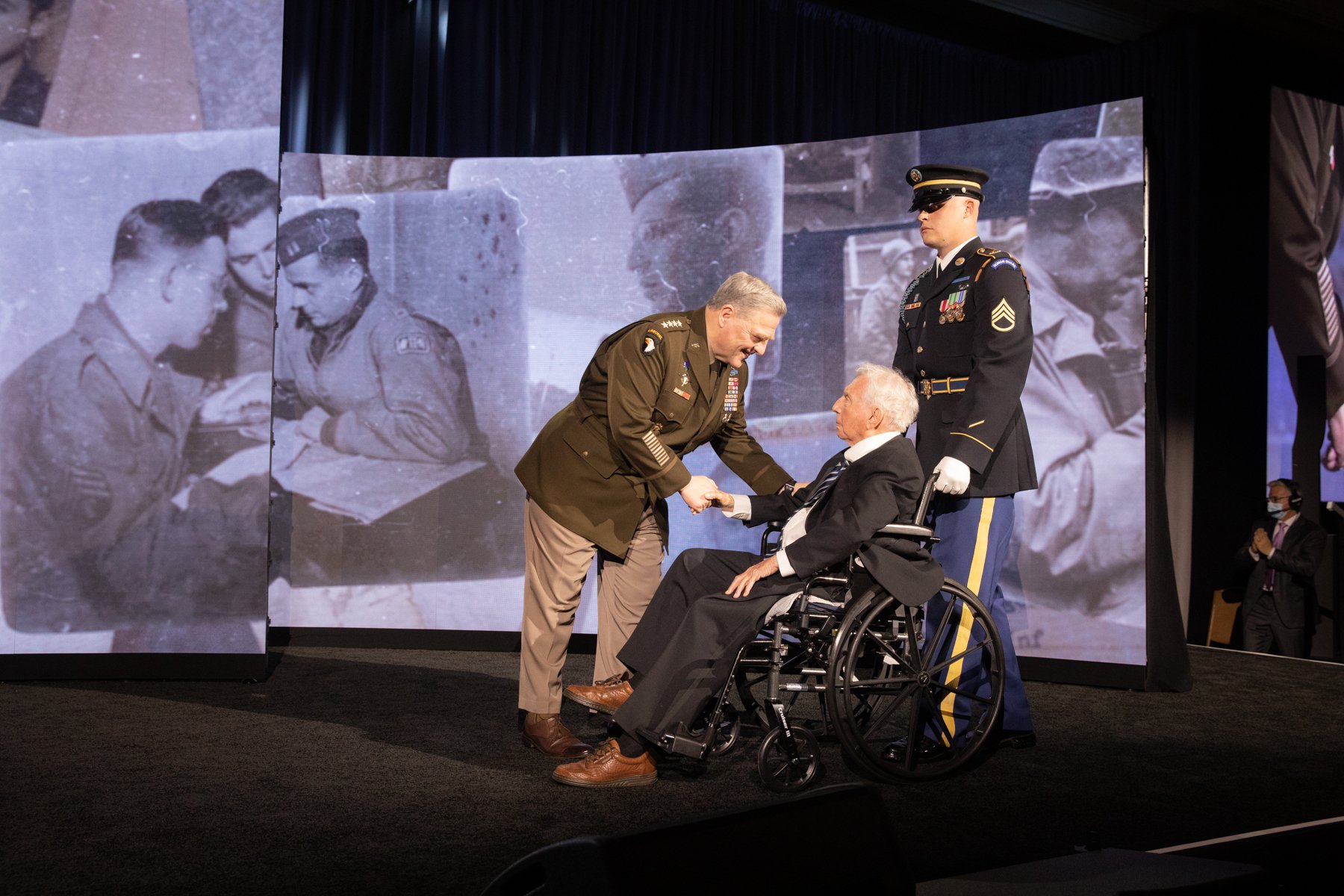 the United States Holocaust Memorial Museum's May 2, 2022 National Tribute Dinner, which honored the Ritchie Boys
 -
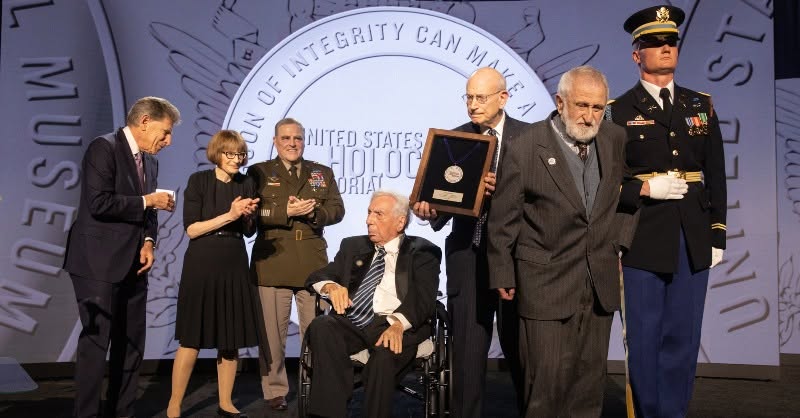 the United States Holocaust Memorial Museum's May 2, 2022 National Tribute Dinner, which honored the Ritchie Boys
 -
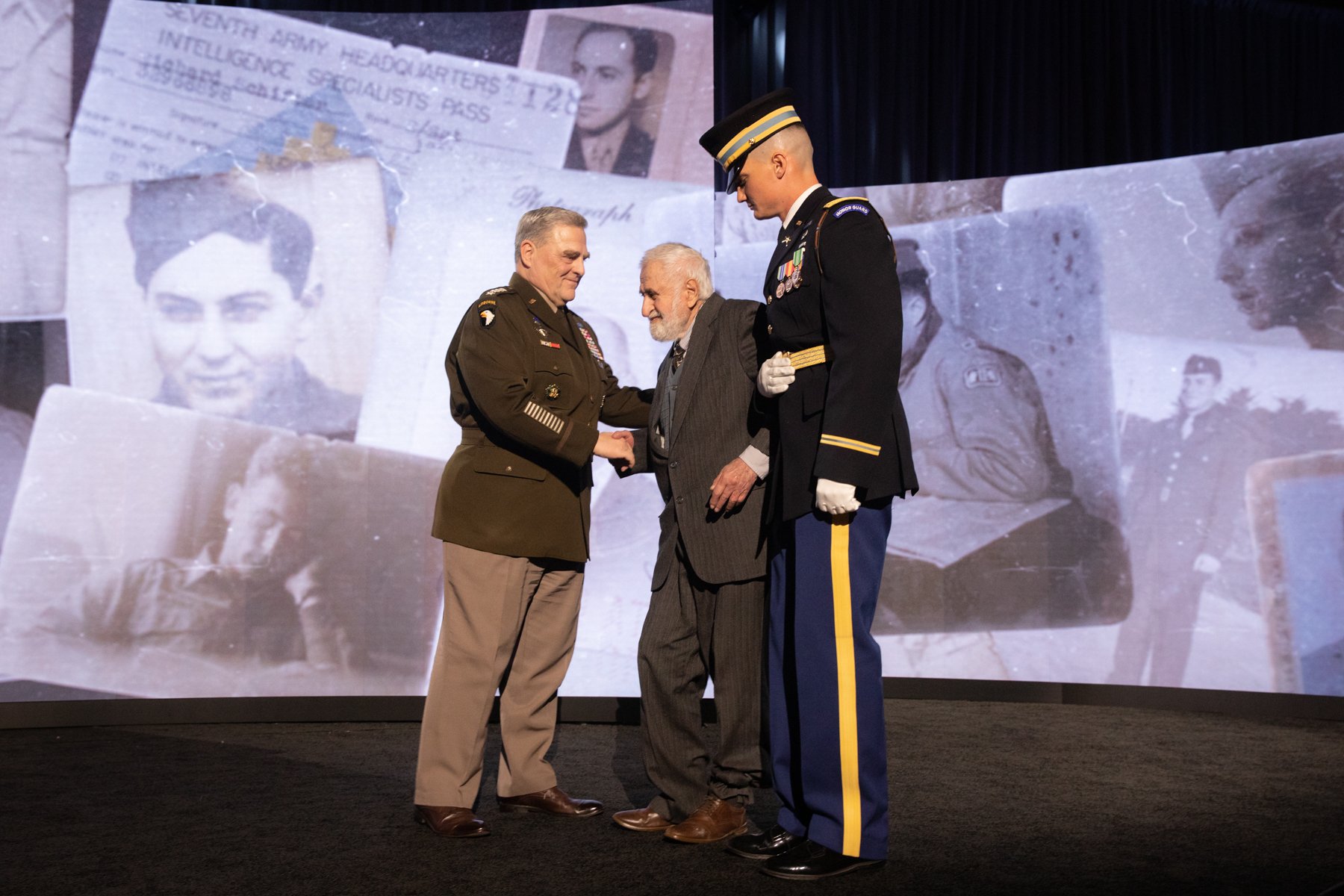 the United States Holocaust Memorial Museum's May 2, 2022 National Tribute Dinner, which honored the Ritchie Boys


Technical record[edit | edit source]
| Field | Imported value |
|---|---|
| Nara ASN | 42139253 |
| Nara Name | MAYER ARNO J |
| Nara State | 23 |
| Nara County | 061 |
| Nara POE | 2364 |
| Nara DOE | 311044 |
| Nara Grade Alpha | PVT |
| Nara Race | 1 |
| Nara Race Description | White citizen |
| row_source | demographics |
Timeline[edit | edit source]
- 19 June 1926 — Born in Luxembourg City, Luxembourg.
- 1938–1940 — Family fled Luxembourg five times on invasion scares; brief stay in Brussels (Feb 1940).
- 1940 — Failed Spain route after French armistice; Marseille → Oran → Morocco (Oujda detention; Rabat/Casablanca); U.S. visas via Congressman Frank Boykin.
- 10 May 1940 — Fled Luxembourg at 1:00 a.m. after French intelligence warning; escape via France (Verdun laissez-passer).
- 1941–1943 — George Washington High School (NYC); classmates included Henry Kissinger and Alan Greenspan; graduated 1943.
- January 1941 — Arrived New York on the Serpa Pinto with his father; rest of family followed in February; settled in Washington Heights.
- 1943–1944 — Office clerk; night classes at CCNY until drafted (1944).
- c. 1944–1945 — Tank training at Fort Knox, Kentucky; OCS interview; selected for Camp Ritchie.
- c. 1945–1946 — Mustering out believed at Fort Dix, New Jersey.
- March 1945 — Assigned to Camp Ritchie (Class 29); languages French, German, Luxembourgish.
- 9 June 1945 — Temporary duty (X-1482) at Fort Hunt / P.O. Box 1142 as morale officer for high-value German prisoners (including scientists such as Wernher von Braun); not an interrogator.
- 1952–53 — Taught at Wesleyan University.
- 1954–58 — Brandeis University.
- 1958–61 — Harvard University.
- 1961 onward — Princeton University; Dayton-Stockton Professor of History.
- 18 December 2023 — Died in Princeton, New Jersey, at 97.
Sources[edit | edit source]
- NPS Fort Hunt Oral History — Arno Mayer interview transcript (Brandon Bies and Vincent Santucci, Princeton, 16 September 2008) (P.O. Box 1142 morale officer; formerly published on the NPS Fort Hunt oral-history exhibit)
- Camp Ritchie Museum, Inc. (The Ritchie History Museum), Classes 1–31 roster data
- Dan Gross research spreadsheets, including original Excel timeline/roster work, combined with other research and records
- NARA World War II Army enlistment records (where a NARA ASN is present)
- 1940 U.S. Census (where a census match is present)
- Ritchie Boys of WWII Facebook page, post dated 2022-05-30 (1 post)
- Wikipedia: Arno J. Mayer
- Dan Gross, Timeline of Arno J. Mayer for Camp Ritchie (private research document; 1 source documents reviewed)
- Dan Gross, Timeline of Mayer, Arno J. for Camp Ritchie (private research files; selected non-private narrative findings; 1 source files: ARNO J. MAYER (2022).doc)