Soft launch: Soldier biographies and research notes vary in completeness. Prefer class-roster, NARA, newspapers, and other cited sources for contested facts — treat Research notes as leads, not settled history. Anyone can correct a page; contact us with questions.
Nisei and Pacific: Difference between revisions
Incorporate Wikipedia Nisei women translators; merge Sugi into Hurt card |
Add MISLS WAC yearbook photos and Camp Ritchie transfer counts |
||
| (One intermediate revision by the same user not shown) | |||
| Line 123: | Line 123: | ||
</ul> | </ul> | ||
</div></div> | </div></div> | ||
</div> | |||
== MISLS WAC Detachment and Camp Ritchie == | |||
A 1946 Military Intelligence Service Language School (MISLS) yearbook page (Fort Snelling era; Fold3 scans from a Facebook/RB Archive packet) records the WAC Detachment’s path into Camp Ritchie document work: | |||
* Seven WACs—the first in the school’s history—arrived in '''November 1944'''; the detachment later grew to '''51''' WACs (among them three Caucasians and one Chinese American). After brief clerical assignments they entered the academic translator program. | |||
* In '''November 1945''' the first WAC commencement graduated '''35''' enlisted women; '''21''' were transferred to '''Camp Ritchie''', and three remained as MISLS instructors. | |||
* In '''January 1946''' the last large graduate group left for overseas assignment; in '''February 1946''' the WAC Detachment was deactivated after the remaining graduates transferred to Camp Ritchie. | |||
Capt. '''Marian E. Nestor''' (WAC), Director of Personnel Procurement and at one time Commanding Officer of the WAC Detachment, appears in the yearbook (portrait below). Yearbook captions also show the first WACs at MISLS and WAC graduates boarding a bus “for Camp Ritchie, Maryland.” Individuals in the group photos are '''not''' identified by name here—do not treat crops as confirmed portraits of [[Hurt, Haruko (WAC)|Haruko Hurt]], [[Kato, Sue (WAC)|Sue Kato]], or other roster WACs without further evidence. | |||
This primary caption set supports the Wikipedia note that about twenty-one MISLS women translator graduates went to PACMIRS / Camp Ritchie (see intro above). | |||
<div class="photos-featured"> | |||
<gallery mode="packed" heights="180px"> | |||
MISLS_WAC_Capt_Marian_E_Nestor.jpg|Capt. Marian E. Nestor, WAC — Director of Personnel Procurement / CO, WAC Detachment (MISLS yearbook) | |||
MISLS_WAC_first_twelve_MISLS_steps.jpg|First WACs to MISLS with Capt. Nestor (yearbook caption) | |||
MISLS_WAC_grads_bus_to_Camp_Ritchie.jpg|WAC MIS grads leaving for Camp Ritchie, Maryland (yearbook caption) | |||
MISLS_WAC_first_group_Japan_ATC.jpg|First MISLS WACs ready for Trans-Pacific flight to Japan (yearbook caption) | |||
MISLS_WAC_yearbook_page90.jpg|Full yearbook page 90 | |||
MISLS_WAC_yearbook_page91.jpg|Full yearbook page 91 (21 transferred to Camp Ritchie) | |||
</gallery> | |||
</div> | </div> | ||
== Mobile Intelligence Training Units (MITU), 1945 == | == Mobile Intelligence Training Units (MITU), 1945 == | ||
In mid-1945 the War Department also used Camp Ritchie to form '''Mobile Intelligence Training Units''' for Army Ground Forces '''redeployment''' training (troops being prepared for the Pacific). July 1945 G-2 memoranda (MID 908) state that '''29''' MITUs were being organized, trained, and equipped at the Military Intelligence Training Center. Each unit was described as two Caucasian officers, two Caucasian enlisted men, and about '''thirteen''' enlisted Americans of Japanese ancestry (an earlier draft of the same memo said fifteen). | In mid-1945 the War Department also used Camp Ritchie to form '''Mobile Intelligence Training Units''' for Army Ground Forces '''redeployment''' training (troops being prepared for the Pacific). (Distinct from earlier European-theater Mobile Intelligence Training Units that demonstrated captured '''German''' equipment under Colonel Elyachar—see [[Training materials#Featured: Early ETOUSA G-2 organization (Settle, 1944)|Settle’s 1944 G-2 account]].) July 1945 G-2 memoranda (MID 908) state that '''29''' MITUs were being organized, trained, and equipped at the Military Intelligence Training Center. Each unit was described as two Caucasian officers, two Caucasian enlisted men, and about '''thirteen''' enlisted Americans of Japanese ancestry (an earlier draft of the same memo said fifteen). | ||
MITU demonstrations presented Japanese squad tactics (Nisei in Japanese uniforms with Japanese weapons) and an orientation play (''A Scrap of Paper'') in which Nisei played Japanese roles and an American Nisei interrogator—explicitly framed as showing that Nisei in the U.S. Army were Americans like soldiers of any other ancestry. As of late July 1945, '''six''' units were already in the field and '''ten''' more were expected to finish training by '''15 August 1945'''. Some former members of the '''442nd Combat Team''' were among those training with the teams. Camp Ritchie Section IX policy (Maj. Robert B. Noack, 23 July 1945) stressed that Nisei were not kept on a team against their wishes; of the then-current ten teams, two Nisei enlisted men had been released for refusing to wear a Japanese uniform. | MITU demonstrations presented Japanese squad tactics (Nisei in Japanese uniforms with Japanese weapons) and an orientation play (''A Scrap of Paper'') in which Nisei played Japanese roles and an American Nisei interrogator—explicitly framed as showing that Nisei in the U.S. Army were Americans like soldiers of any other ancestry. As of late July 1945, '''six''' units were already in the field and '''ten''' more were expected to finish training by '''15 August 1945'''. Some former members of the '''442nd Combat Team''' were among those training with the teams. Camp Ritchie Section IX policy (Maj. Robert B. Noack, 23 July 1945) stressed that Nisei were not kept on a team against their wishes; of the then-current ten teams, two Nisei enlisted men had been released for refusing to wear a Japanese uniform. | ||
| Line 134: | Line 157: | ||
== Sources == | == Sources == | ||
* [https://www.fold3.com/image/704852256 Fold3 — MISLS WAC yearbook page 91] / [[:File:MISLS_WAC_yearbook_page91.jpg|page scan]] (21 graduates to Camp Ritchie, Nov 1945; remaining Feb 1946) | |||
* [https://www.fold3.com/image/704852335 Fold3 — MISLS WAC yearbook page 90] / [[:File:MISLS_WAC_yearbook_page90.jpg|page scan]] | |||
* [https://en.wikipedia.org/wiki/Nisei_women_translators_in_World_War_II English Wikipedia, ''Nisei women translators in World War II''] (MISLS → PACMIRS at Camp Ritchie; Hurt and Kato biographies) | * [https://en.wikipedia.org/wiki/Nisei_women_translators_in_World_War_II English Wikipedia, ''Nisei women translators in World War II''] (MISLS → PACMIRS at Camp Ritchie; Hurt and Kato biographies) | ||
* [[:File:MID_908_1945-07-24_Bissell_Weckerling_JA_soldiers_in_training.pdf|MID 908 file, 24 July 1945 (Bissell / Weckerling) and related Camp Ritchie / WRA papers]] — MITU organization, Section IX policy, WRA concerns (NARA RG 107; JAVA packet) | * [[:File:MID_908_1945-07-24_Bissell_Weckerling_JA_soldiers_in_training.pdf|MID 908 file, 24 July 1945 (Bissell / Weckerling) and related Camp Ritchie / WRA papers]] — MITU organization, Section IX policy, WRA concerns (NARA RG 107; JAVA packet) | ||
Latest revision as of 03:38, 17 September 2026
Nisei and Pacific gathers Japanese American (Nisei) soldiers and WACs tied on this wiki to Pacific document work, PACMIRS, or related Military Intelligence Service language training at Camp Ritchie — a story often missing from the popular “European interrogator” picture of the Ritchie Boys. English Wikipedia’s overview of Nisei women translators in World War II notes that the top twenty-one Japanese American women translator graduates from the Military Intelligence Service Language School (MISLS) were assigned to translate captured documents in the Pacific Military Intelligence Research Section (PACMIRS) at Camp Ritchie.
This is not a complete roster. Names appear when soldier pages on this wiki document the connection; more will be added as sources grow.
MISLS WAC Detachment and Camp Ritchie[edit | edit source]
A 1946 Military Intelligence Service Language School (MISLS) yearbook page (Fort Snelling era; Fold3 scans from a Facebook/RB Archive packet) records the WAC Detachment’s path into Camp Ritchie document work:
- Seven WACs—the first in the school’s history—arrived in November 1944; the detachment later grew to 51 WACs (among them three Caucasians and one Chinese American). After brief clerical assignments they entered the academic translator program.
- In November 1945 the first WAC commencement graduated 35 enlisted women; 21 were transferred to Camp Ritchie, and three remained as MISLS instructors.
- In January 1946 the last large graduate group left for overseas assignment; in February 1946 the WAC Detachment was deactivated after the remaining graduates transferred to Camp Ritchie.
Capt. Marian E. Nestor (WAC), Director of Personnel Procurement and at one time Commanding Officer of the WAC Detachment, appears in the yearbook (portrait below). Yearbook captions also show the first WACs at MISLS and WAC graduates boarding a bus “for Camp Ritchie, Maryland.” Individuals in the group photos are not identified by name here—do not treat crops as confirmed portraits of Haruko Hurt, Sue Kato, or other roster WACs without further evidence.
This primary caption set supports the Wikipedia note that about twenty-one MISLS women translator graduates went to PACMIRS / Camp Ritchie (see intro above).
-
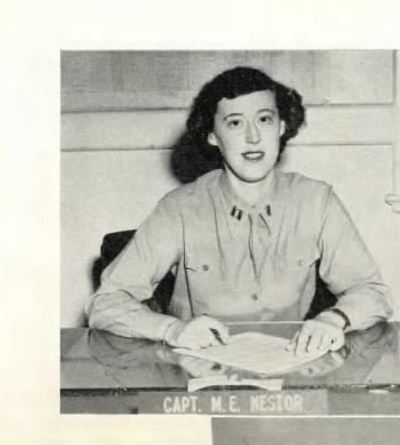 Capt. Marian E. Nestor, WAC — Director of Personnel Procurement / CO, WAC Detachment (MISLS yearbook)
 -
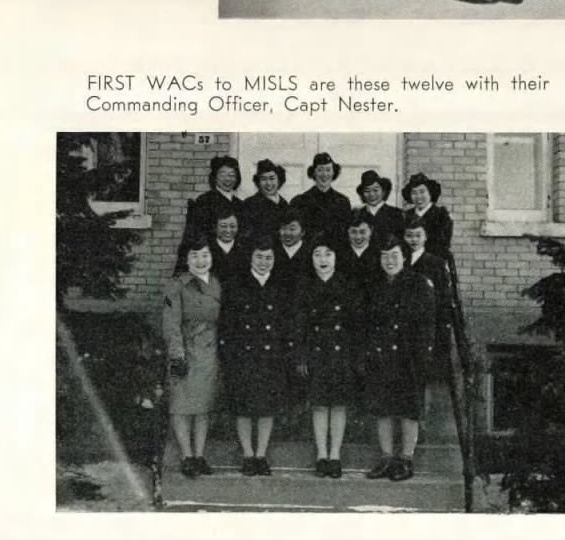 First WACs to MISLS with Capt. Nestor (yearbook caption)
 -
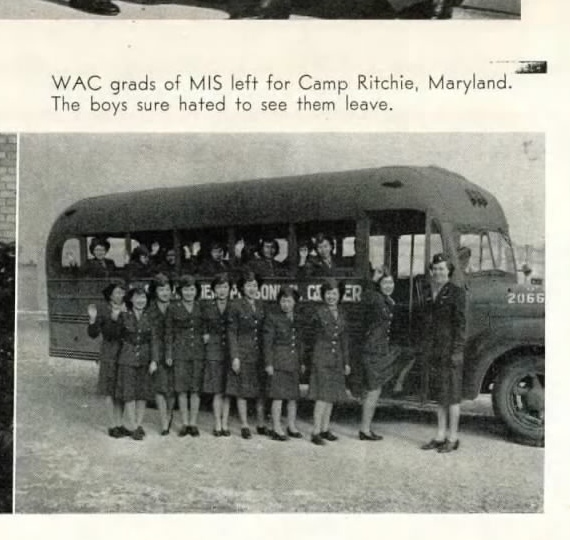 WAC MIS grads leaving for Camp Ritchie, Maryland (yearbook caption)
 -
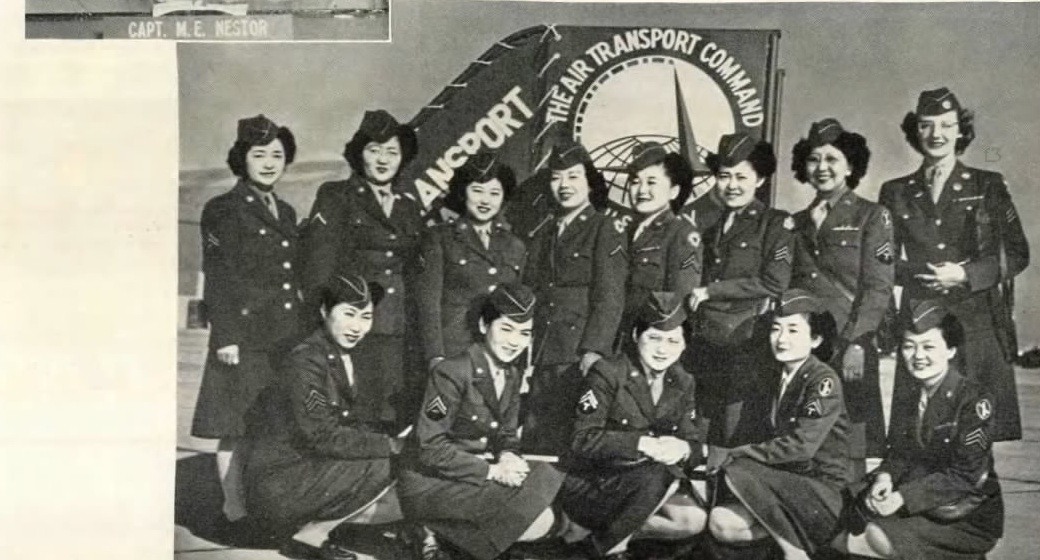 First MISLS WACs ready for Trans-Pacific flight to Japan (yearbook caption)
 -
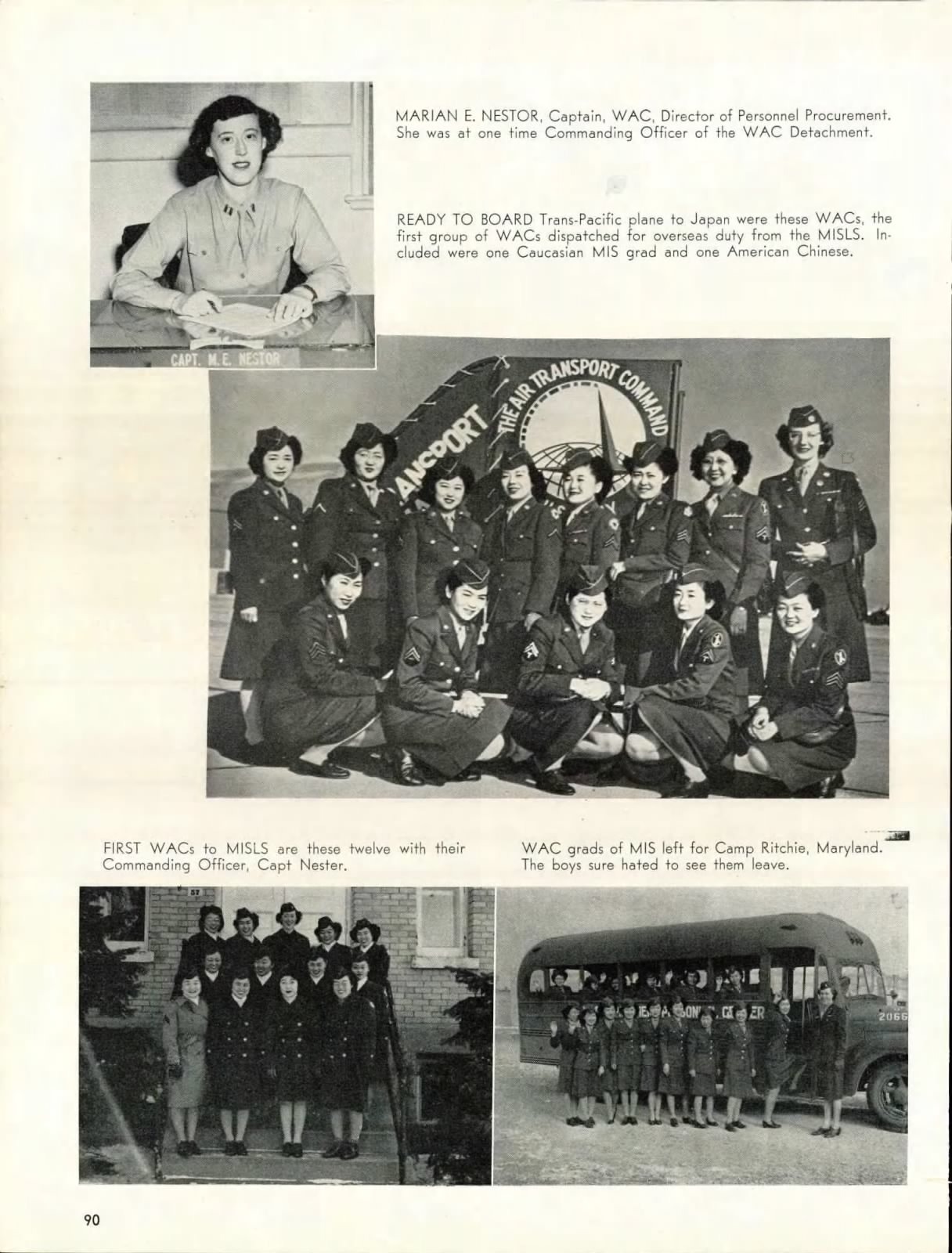 Full yearbook page 90
 -
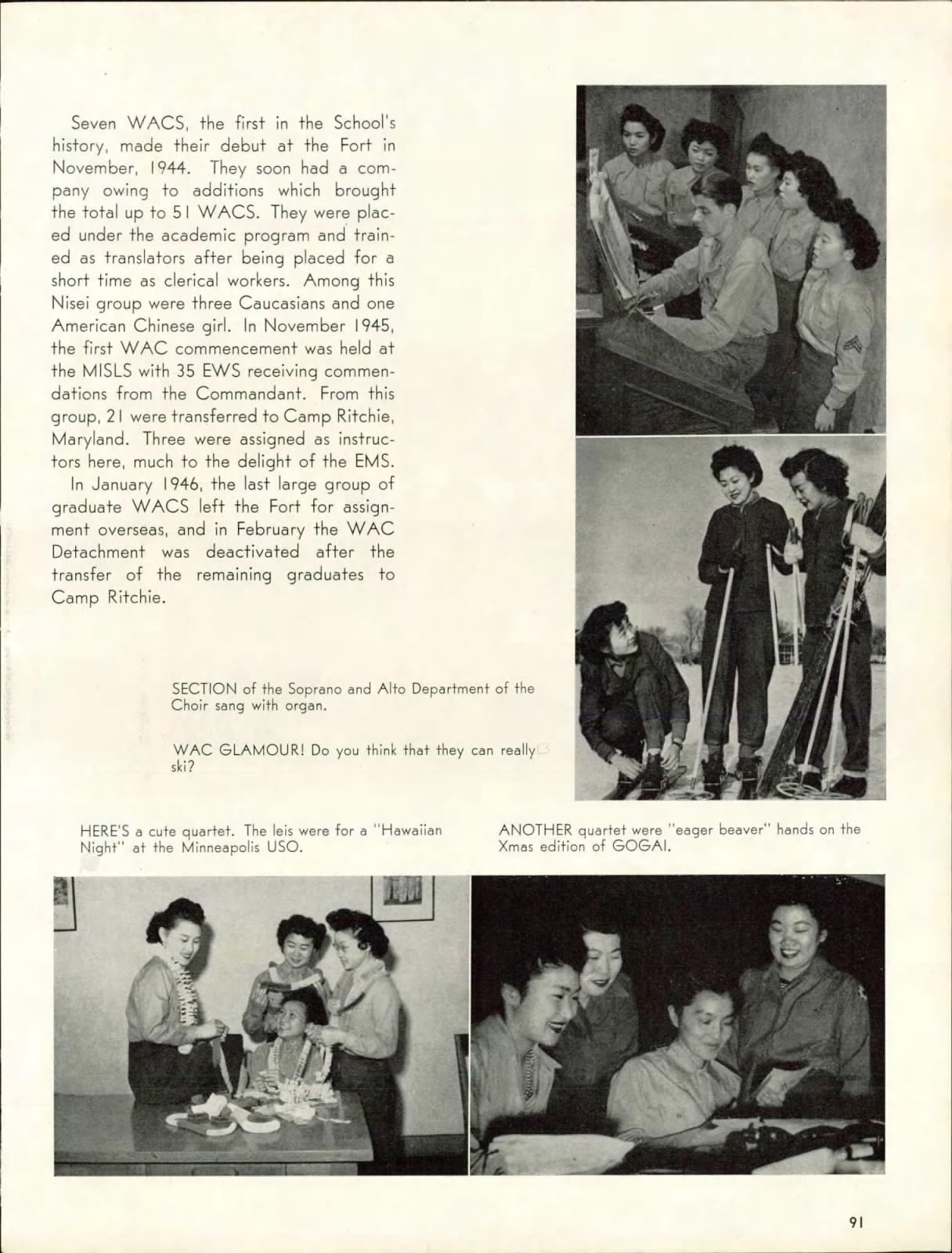 Full yearbook page 91 (21 transferred to Camp Ritchie)


Mobile Intelligence Training Units (MITU), 1945[edit | edit source]
In mid-1945 the War Department also used Camp Ritchie to form Mobile Intelligence Training Units for Army Ground Forces redeployment training (troops being prepared for the Pacific). (Distinct from earlier European-theater Mobile Intelligence Training Units that demonstrated captured German equipment under Colonel Elyachar—see Settle’s 1944 G-2 account.) July 1945 G-2 memoranda (MID 908) state that 29 MITUs were being organized, trained, and equipped at the Military Intelligence Training Center. Each unit was described as two Caucasian officers, two Caucasian enlisted men, and about thirteen enlisted Americans of Japanese ancestry (an earlier draft of the same memo said fifteen).
MITU demonstrations presented Japanese squad tactics (Nisei in Japanese uniforms with Japanese weapons) and an orientation play (A Scrap of Paper) in which Nisei played Japanese roles and an American Nisei interrogator—explicitly framed as showing that Nisei in the U.S. Army were Americans like soldiers of any other ancestry. As of late July 1945, six units were already in the field and ten more were expected to finish training by 15 August 1945. Some former members of the 442nd Combat Team were among those training with the teams. Camp Ritchie Section IX policy (Maj. Robert B. Noack, 23 July 1945) stressed that Nisei were not kept on a team against their wishes; of the then-current ten teams, two Nisei enlisted men had been released for refusing to wear a Japanese uniform.
War Relocation Authority director D. S. Myer had forwarded concerns from 442nd circles that using Nisei as “enemy” stand-ins could increase racial antagonism; G-2 replied that the MITU “Japanese squad” was a demonstration team, not the opposing force in maneuvers. Japan’s surrender ended the need to deploy the full MITU program. Site course counts list 18 MITU courses (1 September 1944 – 15 August 1945) with 306 graduates—see By The Numbers/Student Numbers - All Classes—a different tally from the “29 units being organized” language in the July memos.
Sources[edit | edit source]
- Fold3 — MISLS WAC yearbook page 91 / page scan (21 graduates to Camp Ritchie, Nov 1945; remaining Feb 1946)
- Fold3 — MISLS WAC yearbook page 90 / page scan
- English Wikipedia, Nisei women translators in World War II (MISLS → PACMIRS at Camp Ritchie; Hurt and Kato biographies)
- MID 908 file, 24 July 1945 (Bissell / Weckerling) and related Camp Ritchie / WRA papers — MITU organization, Section IX policy, WRA concerns (NARA RG 107; JAVA packet)
- MID 908 memorandum, 21 July 1945 (Bissell) — earlier draft wording on MITU / Nisei demonstration teams (NARA RG 165; JAVA packet)
- By The Numbers/Student Numbers - All Classes — MITU course/graduate counts from the Camp Ritchie student-numbers spreadsheet