Soft launch: Soldier biographies and research notes vary in completeness. Prefer class-roster, NARA, newspapers, and other cited sources for contested facts — treat Research notes as leads, not settled history. Anyone can correct a page; contact us with questions.
Gumpertz, Werner Herbert (42033526): Difference between revisions
Drop research-framing from MFIU-5 sentence |
Update links to expanded middle-name soldier titles |
||
| (4 intermediate revisions by the same user not shown) | |||
| Line 15: | Line 15: | ||
|class_number=25 | |class_number=25 | ||
|class_display=25 | |class_display=25 | ||
|photo= | |photo=Gumpertz_Werner_Herbert_42033526_army_portrait.jpg | ||
|death_date=1 December 2017 | |death_date=1 December 2017 | ||
|birth_place=Berlin, Germany | |birth_place=Berlin, Germany | ||
| Line 21: | Line 21: | ||
|birth_date=26 December 1917 | |birth_date=26 December 1917 | ||
|death_place=West Newton, Massachusetts | |death_place=West Newton, Massachusetts | ||
|division=Seventh Army | |||
}} | }} | ||
<div class="soldier-lead"> | <div class="soldier-lead"> | ||
'''Werner Herbert Gumpertz''' (26 December 1917–1 December 2017) was a Berlin-born U.S. Army interrogator | '''Werner Herbert Gumpertz''' (26 December 1917–1 December 2017) was a Berlin-born U.S. Army interrogator and Ritchie Boy who trained at [[Camp Ritchie]] with [[:Category:Class 25|Class 25]], served with Seventh Army in Europe, handled military-government publications in Karlsruhe, and after the war co-founded the engineering firm Simpson Gumpertz and Heger. | ||
</div> | </div> | ||
== Biography == | == Biography == | ||
Werner Herbert Gumpertz was born on 26 December 1917 in Berlin, Germany, the son of Richard and Olga Gumpertz. He wanted to be an engineer from childhood. In 1936 he went to Zurich to study at the Swiss Federal Institute of Technology. In the summer of 1939 he was in Amsterdam on volunteer engineering work when the war blocked his return to finish the course. After Kristallnacht his father was sent to Dachau; his mother secured | Werner Herbert Gumpertz was born on 26 December 1917 in Berlin, Germany, the son of Richard and Olga Gumpertz and older brother of Gerard (“Gerry”) Gumpertz. The family ran a boys’ clothing firm; as a child he sometimes modeled for the catalog. He wanted to be an engineer from childhood. In 1936 he went to Zurich to study at the Swiss Federal Institute of Technology (ETH). In the summer of 1939 he was in Amsterdam on volunteer engineering work when the war blocked his return to finish the course. After Kristallnacht his father was sent to Dachau; his mother secured Richard’s release and Richard joined Werner in Holland. The two arrived in New York City on 12 March 1940 on the Red Star Line ship ''Westernland''. Olga and Werner’s younger brother followed in 1941. | ||
In the United States he worked as a junior engineer and surveyor in New York and on defense housing in Newport News, Virginia. Drafted on 27 August 1943, he trained at the Engineering Replacement Training Center at Fort Belvoir, Virginia, served in Pennsylvania, and returned to Belvoir as a supervisory noncommissioned officer. On a free day he went to the Pentagon, told an intelligence officer he wanted the work, and within a week was sent to [[Camp Ritchie]]. | In the United States he worked as a junior engineer and surveyor in New York and on defense housing in Newport News, Virginia. Drafted on 27 August 1943, he trained at the Engineering Replacement Training Center at Fort Belvoir, Virginia, served in Pennsylvania, and returned to Belvoir as a supervisory noncommissioned officer. On a free day he went to the Pentagon, told an intelligence officer he wanted the work, and within a week was sent to [[Camp Ritchie]]. | ||
Gumpertz trained as an interrogator with [[:Category:Class 25|Class 25]] (30 November 1944 – 29 January 1945). He later recalled | Gumpertz trained as an interrogator with [[:Category:Class 25|Class 25]] (30 November 1944 – 29 January 1945)—interrogation, intelligence analysis, and document exploitation. He later recalled piecing together German order of battle from unrelated scraps (laundry tickets, speeding citations, and the like), a night drop near Gettysburg with a map printed only in Japanese, and other field exercises. He went overseas on a British liner (sleeping under a table rather than in a hammock), to England, then across the Channel and into Germany with Seventh Army. He interrogated German prisoners in a former Nazi girls’ camp and was assigned to MFIU-5 at Jugenheim, attached to Seventh Army; the unit ended the war in Augsburg. Once, traveling without the daily password, he was nearly shot. He later said he once had a short conversation with Hermann Göring, and that when the small intelligence section needed a doctor it brought in a captured German air-force medical officer whose father-in-law, a Protestant bishop in Heidelberg, had refused to yield to the Nazis; Gumpertz later corresponded with that bishop from Frankfurt. | ||
After the fighting he joined United States military government in Karlsruhe as agent in charge of publications, covering periodicals and books. Discharged in early 1946, he spent a year as an engineer with the Army Corps of Engineers in Frankfurt, then used the GI Bill at the Massachusetts Institute of Technology, earning | After the fighting he joined United States military government in Karlsruhe as agent in charge of publications, covering periodicals and books. Discharged in early 1946, he spent a year as an engineer with the Army Corps of Engineers in Frankfurt doing design work, then used the GI Bill at the Massachusetts Institute of Technology, earning bachelor’s, master’s, and advanced engineering degrees and teaching in the Department of Building Engineering and Construction. With Howard Simpson and Frank Heger—colleagues from MIT—he formed Simpson Gumpertz and Heger (SGH). He married Elizabeth (“Betty”) Lewit in 1949; they bought a two-family house in West Newton in 1951 that remained his home for the rest of his life, and they had two children, Richard and Ruth. Betty died in 1999. In 2000 he married Susan Connors. He supported local history work in Newton, including Historic Newton’s Durant-Kenrick House project. He died in West Newton on 1 December 2017, at 99, and was buried at Newton Cemetery. | ||
== Research notes == | == Research notes == | ||
* Joint NPS Fort Hunt oral history with [[Gans, Werner Joachim (31457356)|Werner Gans]] and [[Schwab, Henry (32681038)|Henry Schwab]]. | |||
* MFIU-5 | * MFIU-5 | ||
* see CR notes | * see CR notes | ||
| Line 103: | Line 105: | ||
| row_source || both | | row_source || both | ||
|} | |} | ||
== Gallery == | |||
<div class="soldier-gallery"> | |||
<gallery mode="packed" heights="220px"> | |||
Gumpertz_Werner_Herbert_42033526_obituary.jpg|Werner Herbert Gumpertz, from his 2017 Brezniak Funeral Directors obituary | |||
Gumpertz_Werner_Herbert_42033526_bio_card.png|Biographical card with wartime portrait and service summary (source of graphic unknown) | |||
</gallery> | |||
</div> | |||
== Timeline == | == Timeline == | ||
| Line 108: | Line 118: | ||
<div class="soldier-timeline-body"> | <div class="soldier-timeline-body"> | ||
* 26 December 1917 — Born in Berlin, Germany. | * 26 December 1917 — Born in Berlin, Germany. | ||
* 1936 — Began engineering | * 1936 — Began engineering studies at ETH Zurich. | ||
* Summer 1939 — Stranded in Amsterdam by the outbreak of war; father later joined him after Dachau release. | |||
* Summer 1939 — | * 12 March 1940 — Arrived New York on ''Westernland'' with his father; mother and brother followed in 1941. | ||
* 12 March 1940 — Arrived | * 27 August 1943 — Drafted; Fort Belvoir engineer training; sought transfer at the Pentagon; sent to Camp Ritchie. | ||
* 30 November 1944 – 29 January 1945 — Class 25 interrogator training (document OB exercises; Japanese-map / Gettysburg night work). | |||
* 27 August 1943 — Drafted; Fort Belvoir | * 1945 — England, then Seventh Army in France/Germany (MFIU-5, Jugenheim; Augsburg); interrogations including at a former Nazi girls’ camp; Karlsruhe military-government publications. | ||
* Early 1946 — Discharged; Corps of Engineers design work in Frankfurt; then MIT and Simpson Gumpertz and Heger. | |||
* 30 November 1944 – 29 January 1945 — | * 1 December 2017 — Died in West Newton, Massachusetts. | ||
* 1945 — Seventh Army | |||
* | |||
* 1 December 2017 — Died in West Newton, Massachusetts | |||
</div> | </div> | ||
</div><div style="clear: both;"></div> | </div><div style="clear: both;"></div> | ||
== Sources == | == Sources == | ||
* [https://www.brezniakrodman.com/obituary-archive/werner-gumpertz/ Brezniak Funeral Directors — Werner Gumpertz full obituary archive] | |||
* [https://www.legacy.com/us/obituaries/bostonglobe/name/werner-gumpertz-obituary?id=31532087 Boston Globe / Legacy — Werner H. Gumpertz obituary (published 3–4 December 2017)] | |||
* [[:File:FOHU_POBox1142_Gans_Gumpertz_Schwab.pdf|NPS Fort Hunt Oral History — joint interview with Werner Gans, Werner Gumpertz, and Henry Schwab]] (formerly published on the NPS Fort Hunt oral-history exhibit) | |||
* [[:File:Gumpertz_Werner_Herbert_42033526_obituary.jpg|Obituary portrait used as profile photo]] | |||
* [https://newton.minlib.net/Record/.b36239951 Newton Talks oral history with Werner Gumpertz — original catalog record (Newton Free Library / Minuteman Library Network)] | |||
* [[Ritchie Boy Interviews#Werner Gumpertz|Newton Talks interview (watchlist card)]] | * [[Ritchie Boy Interviews#Werner Gumpertz|Newton Talks interview (watchlist card)]] | ||
* [https://brezniakfuneraldirectors.com/obituary-archive/werner-gumpertz/ Brezniak Funeral Directors obituary for Werner H. Gumpertz (granddaughter Beckie Moses)] | * [https://brezniakfuneraldirectors.com/obituary-archive/werner-gumpertz/ Brezniak Funeral Directors obituary for Werner H. Gumpertz (granddaughter Beckie Moses)] | ||
Latest revision as of 05:25, 22 September 2026
| Werner Herbert Gumpertz | |
|---|---|
 | |
| Personal details | |
| Born | 26 December 1917 Berlin, Germany |
| Died | 1 December 2017 West Newton, Massachusetts |
| Nativity | Germany |
| Religion | Jewish |
| Military service | |
| Allegiance |  United States United States |
| Branch |  United States Army United States Army |
| ASN | 42033526 |
| Rank | Captain |
| Rank at Ritchie | Corporal |
| Camp Ritchie | Class 25 (30 November 1944 – 29 January 1945) |
| Section | 5A |
| Unit / division | Seventh Army |
{{Needs source}}, or explain disagreements on talk. Baseline import notes: About the data.
Werner Herbert Gumpertz (26 December 1917–1 December 2017) was a Berlin-born U.S. Army interrogator and Ritchie Boy who trained at Camp Ritchie with Class 25, served with Seventh Army in Europe, handled military-government publications in Karlsruhe, and after the war co-founded the engineering firm Simpson Gumpertz and Heger.
Biography[edit | edit source]
Werner Herbert Gumpertz was born on 26 December 1917 in Berlin, Germany, the son of Richard and Olga Gumpertz and older brother of Gerard (“Gerry”) Gumpertz. The family ran a boys’ clothing firm; as a child he sometimes modeled for the catalog. He wanted to be an engineer from childhood. In 1936 he went to Zurich to study at the Swiss Federal Institute of Technology (ETH). In the summer of 1939 he was in Amsterdam on volunteer engineering work when the war blocked his return to finish the course. After Kristallnacht his father was sent to Dachau; his mother secured Richard’s release and Richard joined Werner in Holland. The two arrived in New York City on 12 March 1940 on the Red Star Line ship Westernland. Olga and Werner’s younger brother followed in 1941.
In the United States he worked as a junior engineer and surveyor in New York and on defense housing in Newport News, Virginia. Drafted on 27 August 1943, he trained at the Engineering Replacement Training Center at Fort Belvoir, Virginia, served in Pennsylvania, and returned to Belvoir as a supervisory noncommissioned officer. On a free day he went to the Pentagon, told an intelligence officer he wanted the work, and within a week was sent to Camp Ritchie.
Gumpertz trained as an interrogator with Class 25 (30 November 1944 – 29 January 1945)—interrogation, intelligence analysis, and document exploitation. He later recalled piecing together German order of battle from unrelated scraps (laundry tickets, speeding citations, and the like), a night drop near Gettysburg with a map printed only in Japanese, and other field exercises. He went overseas on a British liner (sleeping under a table rather than in a hammock), to England, then across the Channel and into Germany with Seventh Army. He interrogated German prisoners in a former Nazi girls’ camp and was assigned to MFIU-5 at Jugenheim, attached to Seventh Army; the unit ended the war in Augsburg. Once, traveling without the daily password, he was nearly shot. He later said he once had a short conversation with Hermann Göring, and that when the small intelligence section needed a doctor it brought in a captured German air-force medical officer whose father-in-law, a Protestant bishop in Heidelberg, had refused to yield to the Nazis; Gumpertz later corresponded with that bishop from Frankfurt.
After the fighting he joined United States military government in Karlsruhe as agent in charge of publications, covering periodicals and books. Discharged in early 1946, he spent a year as an engineer with the Army Corps of Engineers in Frankfurt doing design work, then used the GI Bill at the Massachusetts Institute of Technology, earning bachelor’s, master’s, and advanced engineering degrees and teaching in the Department of Building Engineering and Construction. With Howard Simpson and Frank Heger—colleagues from MIT—he formed Simpson Gumpertz and Heger (SGH). He married Elizabeth (“Betty”) Lewit in 1949; they bought a two-family house in West Newton in 1951 that remained his home for the rest of his life, and they had two children, Richard and Ruth. Betty died in 1999. In 2000 he married Susan Connors. He supported local history work in Newton, including Historic Newton’s Durant-Kenrick House project. He died in West Newton on 1 December 2017, at 99, and was buried at Newton Cemetery.
Research notes[edit | edit source]
- Joint NPS Fort Hunt oral history with Werner Gans and Henry Schwab.
- MFIU-5
- see CR notes
Technical record[edit | edit source]
| Field | Imported value |
|---|---|
| Approx Age at Death | 100 |
| Nara ASN | 42033526 |
| Nara Name | GUMPERTZ WERNER H |
| Nara State | 97 |
| Nara County | 11 |
| Nara POE | 2364 |
| Nara DOE | 270843 |
| Nara Grade Alpha | PVT |
| Nara Grade Code | 8 |
| Nara Branch Alpha | NO |
| Nara Branch Code | 2 |
| Branch | No branch assignment |
| Nara Term or Enlistment | 5 |
| Term of enlistment | Enlistment for the duration of the War or other emergency, plus six months, subject to the discretion of the President or otherwise according to law |
| Defer. Date | 0 |
| Nara Source | 0 |
| Nara Nativity | N1 |
| Nara Year of Birth | 17 |
| Nara Race | J |
| Nara Race Description | White not yet a citizen |
| Nara Education | 7 |
| Nara Civilian Occupation | 48 |
| Nara Marital Status | 1 |
| Nara Height (inches) | 0 |
| Nara Weight (lbs) | 0 |
| Class_ASN | 42033526 |
| Class_Name | GUMPERTZ, Werner H. |
| match_method | asn_exact_name_exact |
| row_source | both |
Gallery[edit | edit source]
-
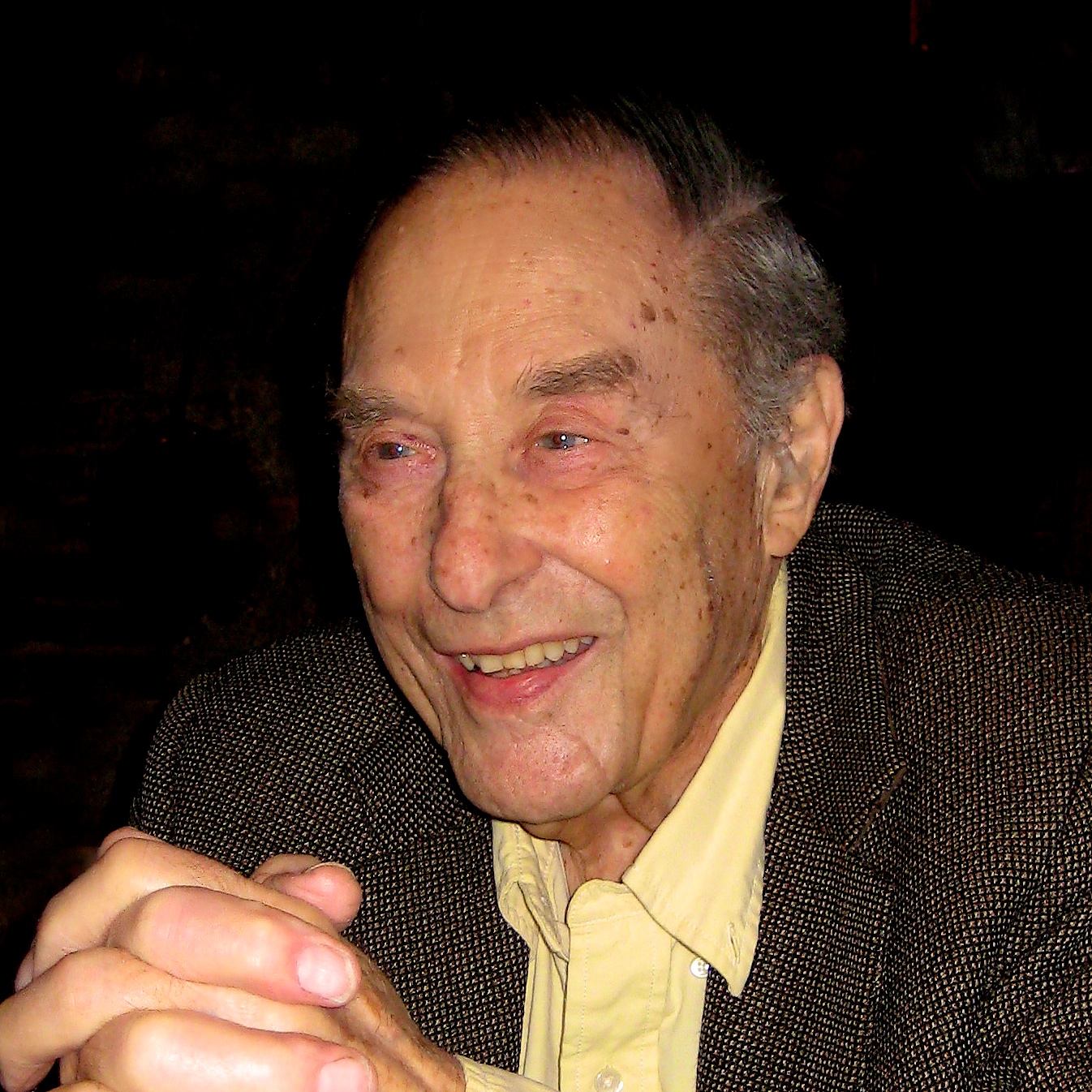 Werner Herbert Gumpertz, from his 2017 Brezniak Funeral Directors obituary
 -
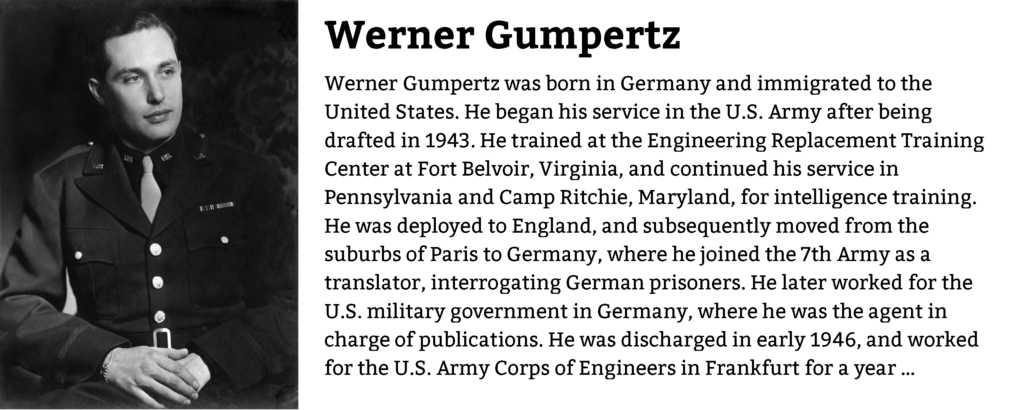 Biographical card with wartime portrait and service summary (source of graphic unknown)


Timeline[edit | edit source]
- 26 December 1917 — Born in Berlin, Germany.
- 1936 — Began engineering studies at ETH Zurich.
- Summer 1939 — Stranded in Amsterdam by the outbreak of war; father later joined him after Dachau release.
- 12 March 1940 — Arrived New York on Westernland with his father; mother and brother followed in 1941.
- 27 August 1943 — Drafted; Fort Belvoir engineer training; sought transfer at the Pentagon; sent to Camp Ritchie.
- 30 November 1944 – 29 January 1945 — Class 25 interrogator training (document OB exercises; Japanese-map / Gettysburg night work).
- 1945 — England, then Seventh Army in France/Germany (MFIU-5, Jugenheim; Augsburg); interrogations including at a former Nazi girls’ camp; Karlsruhe military-government publications.
- Early 1946 — Discharged; Corps of Engineers design work in Frankfurt; then MIT and Simpson Gumpertz and Heger.
- 1 December 2017 — Died in West Newton, Massachusetts.
Sources[edit | edit source]
- Brezniak Funeral Directors — Werner Gumpertz full obituary archive
- Boston Globe / Legacy — Werner H. Gumpertz obituary (published 3–4 December 2017)
- NPS Fort Hunt Oral History — joint interview with Werner Gans, Werner Gumpertz, and Henry Schwab (formerly published on the NPS Fort Hunt oral-history exhibit)
- Obituary portrait used as profile photo
- Newton Talks oral history with Werner Gumpertz — original catalog record (Newton Free Library / Minuteman Library Network)
- Newton Talks interview (watchlist card)
- Brezniak Funeral Directors obituary for Werner H. Gumpertz (granddaughter Beckie Moses)
- Newton Talks oral history project (Newton Free Library)
- Newton Talks oral history with Werner Gumpertz (7 July 2016) — transcript on Internet Archive
- Newton Free Library interview with Werner Gumpertz on YouTube
- Camp Ritchie Museum, Inc. (The Ritchie History Museum), Classes 1–31 roster data
- Dan Gross research spreadsheets, including original Excel timeline/roster work, combined with other research and records
- NARA World War II Army enlistment records (where a NARA ASN is present)
- 1940 U.S. Census (where a census match is present)
- Ritchie Boys of WWII Facebook page, post dated 2017-12-10 (1 post)
- Dan Gross, Timeline of Werner H. Gumpertz for Camp Ritchie (private research document; 1 source documents reviewed)
- Dan Gross, Timeline of Gumpertz, Werner H. for Camp Ritchie (private research files; selected non-private narrative findings; 1 source files: WERNER H. GUMPERTZ.doc)