Soft launch: Soldier biographies and research notes vary in completeness. Prefer class-roster, NARA, newspapers, and other cited sources for contested facts — treat Research notes as leads, not settled history. Anyone can correct a page; contact us with questions.
Rosenthal, Frederick John (32860017): Difference between revisions
Remove invalid assignment field |
Rosenthal: add field orientation + Ritchie Boys Elie Wiesel Award (group) from Grove interview |
||
| (8 intermediate revisions by the same user not shown) | |||
| Line 1: | Line 1: | ||
{{Soldier | {{Soldier | ||
|lede_on_page=1 | |||
|asn=32860017 | |asn=32860017 | ||
|surname=Rosenthal | |surname=Rosenthal | ||
|first= | |first=Frederick | ||
|middle= | |middle=John | ||
|birth_year=1923 | |birth_year=1923 | ||
|death_year= | |death_year= | ||
|nativity= | |nativity=Germany | ||
|religion= | |religion=Jewish | ||
|enlistment_place=NEW YORK CITY NEW YORK | |enlistment_place=NEW YORK CITY NEW YORK | ||
|state=NEW YORK | |state=NEW YORK | ||
| Line 15: | Line 16: | ||
|occupation=Skilled occupations in production of confections | |occupation=Skilled occupations in production of confections | ||
|marital=Single without dependents | |marital=Single without dependents | ||
|alias=Fred J. Rosenthal | |||
Fred Rosenthal | |||
John Rosenthal | |||
|rank_final=Private First Class | |||
|death_date= | |||
|death_place= | |||
|class_number=15 | |||
|photo=Rosenthal_Frederick_John_32860017_portrait_PFC.jpg | |||
|birth_place=Cologne, Germany | |||
}} | }} | ||
<div class="soldier-lead"> | |||
'''Frederick John Rosenthal''' (born 1923) was a Cologne-born Jewish refugee and U.S. Army private first class who arrived at [[Camp Ritchie]] on 24 November 1943 with [[:Category:Class 15|Class 15]] (alerted overseas before completing the course) and later served in Antwerp tracking V-weapons and collaboration cases. | |||
</div> | |||
== Biography == | == Biography == | ||
Frederick John Rosenthal (also Fred or John) was born in 1923 in Cologne, Germany, to a Jewish family. As antisemitism intensified, his parents sent him for a time to relatives in Holland and Belgium; with help from a family friend in New York the Rosenthals secured visas and fled to the United States before the Holocaust intensified. In New York he adapted as a young refugee, including learning American idioms. | |||
Despite a childhood history of polio that might have barred him, Rosenthal volunteered for the U.S. Army. After basic infantry training in South Carolina—where he again faced antisemitic harassment—his German and Dutch led to selection for the Military Intelligence Training Center at [[Camp Ritchie]]. After the Army Specialized Training Program (ASTP) he was promoted to private first class; following a two-day train trip he arrived at Camp Ritchie on 24 November 1943, writing later that he wanted a “more active and positive role in this war against tyranny.” He was a member of [[:Category:Class 15|Class 15]] and trained in map making, photo interpretation, and field orientation, but as he later told Ritchie History Museum director Landon Grove, he did not complete the course before being alerted for overseas assignment (administrative pressures under Colonel Banfield cut his stay short). In Antwerp, Belgium, his intelligence work included monitoring local media, interrogating civilians about collaboration, and tracking V-1 and V-2 rocket patterns. Research notes also record a later transfer toward Signal Corps work (SIG). | |||
After the war Rosenthal used the G.I. Bill to earn multiple degrees from Columbia University. He spent about thirty years as a librarian in federal service, eventually serving as an assistant chief at the Library of Congress. In about 2023 he recorded a video interview with Grove about his wartime experiences and the Ritchie Boys’ legacy, including later public recognition such as the U.S. Holocaust Memorial Museum’s Elie Wiesel Award to the Ritchie Boys. | |||
== Research notes == | == Research notes == | ||
* ASTP; transferred to SIG | * ASTP; transferred to SIG | ||
* | * ASTP; transferred to SIG (prior research note; retained). | ||
* Title expanded from Fred J. to Frederick John per family/user naming and memoir voice; ASN 32860017 unchanged. | |||
* Death year 1991 previously on the roster page was incorrect — interviewed by Landon Grove c. 2023; death fields cleared pending a reliable date. | |||
* Cologne / Holland–Belgium refuge / Antwerp V-weapons / Columbia / Library of Congress career from Landon Grove interview summary (user-supplied transcript summary). | |||
* Elie Wiesel Award reference is to the Ritchie Boys as a group (USHMM), not a personal decoration for Rosenthal (Grove interview summary). | |||
== Gallery == | == Gallery == | ||
<div class="soldier-gallery"> | |||
<gallery mode="packed" heights="220px"> | |||
Rosenthal_Frederick_John_32860017_portrait_PFC.jpg|PFC Frederick John Rosenthal in service uniform (wartime portrait). | |||
Rosenthal_Frederick_John_32860017_memoir_Camp_Ritchie_arrival.jpg|Memoir: ASTP → PFC; arrives [[Camp Ritchie]] 24 November 1943. | |||
</gallery> | |||
</div> | |||
== Technical record == | == Technical record == | ||
| Line 84: | Line 111: | ||
| row_source || demographics | | row_source || demographics | ||
|} | |} | ||
== Timeline == | |||
<div class="mw-collapsible mw-collapsed soldier-timeline"> | |||
<div class="soldier-timeline-body"> | |||
* 1923 — Born in Cologne, Germany (Jewish family). | |||
* Sent for a time to relatives in Holland and Belgium; family flees to New York with visas arranged through a family friend (before the Holocaust intensified). | |||
* Volunteers for U.S. Army despite childhood polio; basic infantry training in South Carolina. | |||
* ASTP (Army Specialized Training Program); promoted to PFC. | |||
* 24 November 1943 — Arrives Camp Ritchie, Maryland (memoir). | |||
* Class 15 — Map making / photo interpretation / field orientation; alerted overseas before completing the course (per interview with Landon Grove; Col. Banfield). | |||
* Antwerp, Belgium — Media monitoring; civilian collaboration interrogations; V-1 / V-2 rocket tracking. | |||
* Later — Research notes: transferred toward Signal (SIG). | |||
* Postwar — G.I. Bill; multiple degrees, Columbia University; ~30-year federal library career, including assistant chief, Library of Congress. | |||
* c. 2023 — Video interview with Landon Grove, Ritchie History Museum. | |||
</div> | |||
</div><div style="clear: both;"></div> | |||
== Sources == | == Sources == | ||
* Camp Ritchie | * [[Ritchie Boy Interviews#Frederick John Rosenthal|Ritchie Boy Interviews — conversation with Landon Grove]] ([https://www.youtube.com/watch?v=J011zqZWUiQ YouTube]) | ||
* [[:File:Rosenthal_Frederick_John_32860017_portrait_PFC.jpg|Wartime PFC portrait]] | |||
* [[:File:Rosenthal_Frederick_John_32860017_memoir_Camp_Ritchie_arrival.jpg|Memoir excerpt — Camp Ritchie arrival 24 November 1943]] | |||
* Personal memoir excerpt (Camp Ritchie arrival 24 November 1943; RB Archive / family) | |||
* Camp Ritchie Museum, Inc. (The Ritchie History Museum), Classes 1–31 roster data | |||
* Dan Gross research spreadsheets, including original Excel timeline/roster work, combined with other research and records | |||
* NARA World War II Army enlistment records (where a NARA ASN is present) | * NARA World War II Army enlistment records (where a NARA ASN is present) | ||
* 1940 U.S. Census (where a census match is present) | * 1940 U.S. Census (where a census match is present) | ||
Latest revision as of 04:18, 19 September 2026
| Frederick John Rosenthal | |
|---|---|
 | |
| Personal details | |
| Birth name | Fred J. Rosenthal Fred Rosenthal John Rosenthal |
| Born | 1923 Cologne, Germany |
| Nativity | Germany |
| Religion | Jewish |
| Military service | |
| Allegiance |  United States United States |
| Branch |  United States Army United States Army |
| ASN | 32860017 |
| Rank | Private First Class |
| Camp Ritchie | Class 15 (4 January – 3 March 1944) |
| Enlisted | New York City, New York |
{{Needs source}}, or explain disagreements on talk. Baseline import notes: About the data.
Frederick John Rosenthal (born 1923) was a Cologne-born Jewish refugee and U.S. Army private first class who arrived at Camp Ritchie on 24 November 1943 with Class 15 (alerted overseas before completing the course) and later served in Antwerp tracking V-weapons and collaboration cases.
Biography[edit | edit source]
Frederick John Rosenthal (also Fred or John) was born in 1923 in Cologne, Germany, to a Jewish family. As antisemitism intensified, his parents sent him for a time to relatives in Holland and Belgium; with help from a family friend in New York the Rosenthals secured visas and fled to the United States before the Holocaust intensified. In New York he adapted as a young refugee, including learning American idioms.
Despite a childhood history of polio that might have barred him, Rosenthal volunteered for the U.S. Army. After basic infantry training in South Carolina—where he again faced antisemitic harassment—his German and Dutch led to selection for the Military Intelligence Training Center at Camp Ritchie. After the Army Specialized Training Program (ASTP) he was promoted to private first class; following a two-day train trip he arrived at Camp Ritchie on 24 November 1943, writing later that he wanted a “more active and positive role in this war against tyranny.” He was a member of Class 15 and trained in map making, photo interpretation, and field orientation, but as he later told Ritchie History Museum director Landon Grove, he did not complete the course before being alerted for overseas assignment (administrative pressures under Colonel Banfield cut his stay short). In Antwerp, Belgium, his intelligence work included monitoring local media, interrogating civilians about collaboration, and tracking V-1 and V-2 rocket patterns. Research notes also record a later transfer toward Signal Corps work (SIG).
After the war Rosenthal used the G.I. Bill to earn multiple degrees from Columbia University. He spent about thirty years as a librarian in federal service, eventually serving as an assistant chief at the Library of Congress. In about 2023 he recorded a video interview with Grove about his wartime experiences and the Ritchie Boys’ legacy, including later public recognition such as the U.S. Holocaust Memorial Museum’s Elie Wiesel Award to the Ritchie Boys.
Research notes[edit | edit source]
- ASTP; transferred to SIG
- ASTP; transferred to SIG (prior research note; retained).
- Title expanded from Fred J. to Frederick John per family/user naming and memoir voice; ASN 32860017 unchanged.
- Death year 1991 previously on the roster page was incorrect — interviewed by Landon Grove c. 2023; death fields cleared pending a reliable date.
- Cologne / Holland–Belgium refuge / Antwerp V-weapons / Columbia / Library of Congress career from Landon Grove interview summary (user-supplied transcript summary).
- Elie Wiesel Award reference is to the Ritchie Boys as a group (USHMM), not a personal decoration for Rosenthal (Grove interview summary).
Gallery[edit | edit source]
-
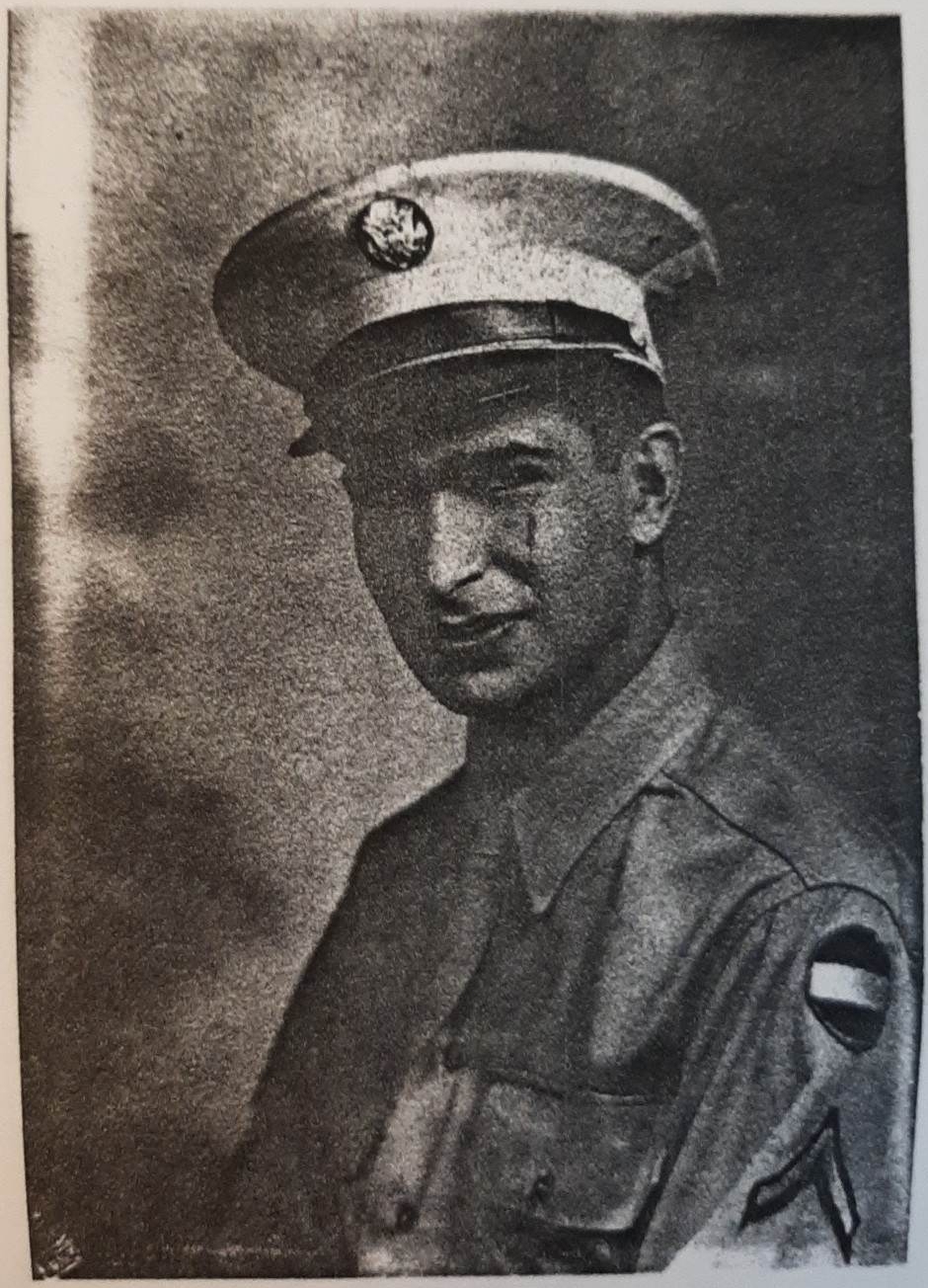 PFC Frederick John Rosenthal in service uniform (wartime portrait).
 -
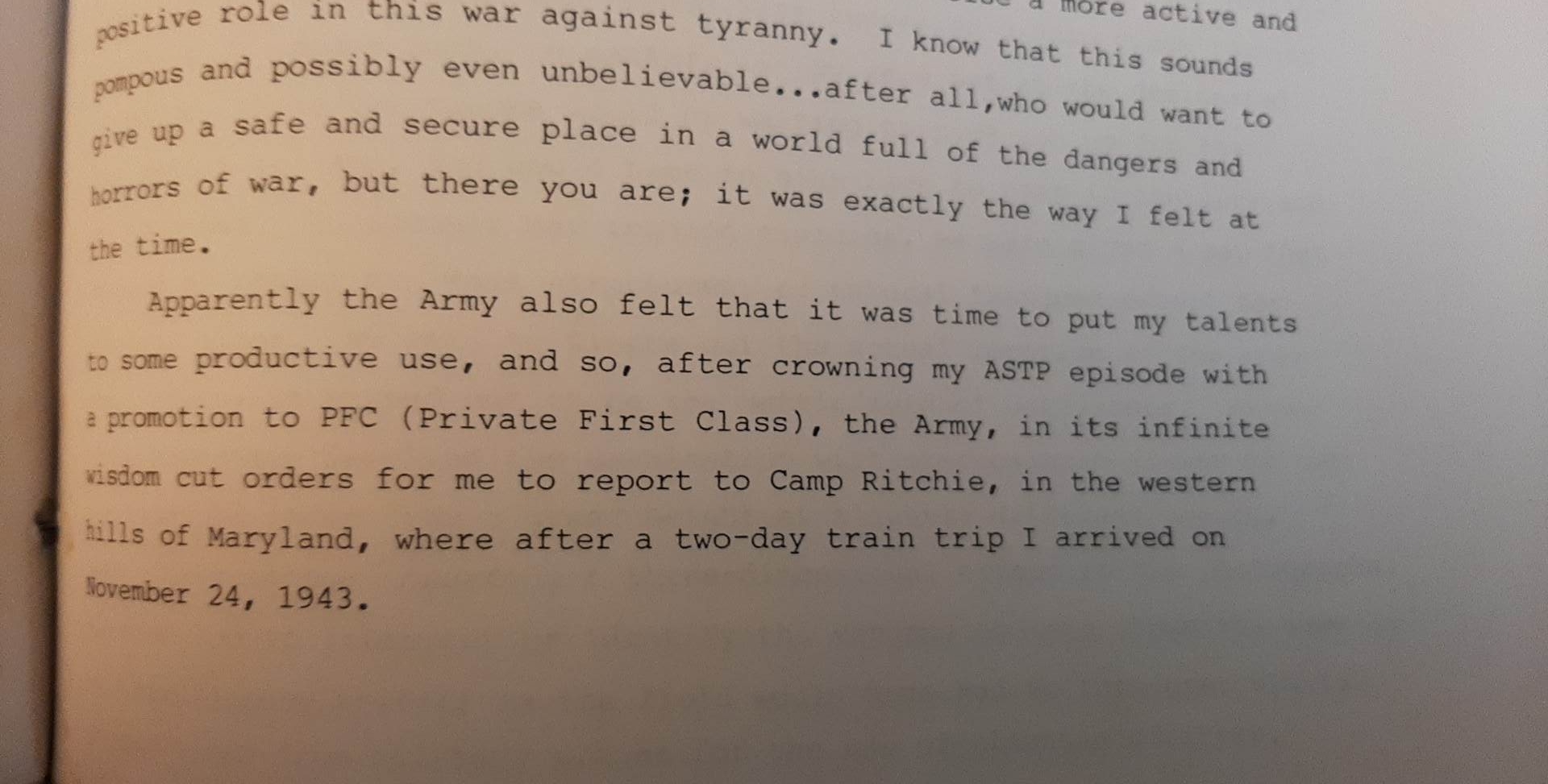 Memoir: ASTP → PFC; arrives Camp Ritchie 24 November 1943.

Technical record[edit | edit source]
| Field | Imported value |
|---|---|
| Approx Age at Death | 68 |
| Nara ASN | 32860017 |
| Nara Name | ROSENTHAL FRED J |
| Nara State | 23 |
| Nara County | 61 |
| Nara POE | 2364 |
| Nara DOE | 110343 |
| Nara Grade Alpha | PVT |
| Nara Grade Code | 8 |
| Nara Branch Alpha | NO |
| Nara Branch Code | 2 |
| Branch | No branch assignment |
| Nara Term or Enlistment | 5 |
| Term of enlistment | Enlistment for the duration of the War or other emergency, plus six months, subject to the discretion of the President or otherwise according to law |
| Defer. Date | 0 |
| Nara Source | 0 |
| Nara Nativity | N1 |
| Nara Year of Birth | 23 |
| Nara Race | J |
| Nara Race Description | White not yet a citizen |
| Nara Education | 7 |
| Nara Civilian Occupation | 405 |
| Nara Marital Status | 6 |
| Nara Height (inches) | 33 |
| Nara Weight (lbs) | 129 |
| row_source | demographics |
Timeline[edit | edit source]
- 1923 — Born in Cologne, Germany (Jewish family).
- Sent for a time to relatives in Holland and Belgium; family flees to New York with visas arranged through a family friend (before the Holocaust intensified).
- Volunteers for U.S. Army despite childhood polio; basic infantry training in South Carolina.
- ASTP (Army Specialized Training Program); promoted to PFC.
- 24 November 1943 — Arrives Camp Ritchie, Maryland (memoir).
- Class 15 — Map making / photo interpretation / field orientation; alerted overseas before completing the course (per interview with Landon Grove; Col. Banfield).
- Antwerp, Belgium — Media monitoring; civilian collaboration interrogations; V-1 / V-2 rocket tracking.
- Later — Research notes: transferred toward Signal (SIG).
- Postwar — G.I. Bill; multiple degrees, Columbia University; ~30-year federal library career, including assistant chief, Library of Congress.
- c. 2023 — Video interview with Landon Grove, Ritchie History Museum.
Sources[edit | edit source]
- Ritchie Boy Interviews — conversation with Landon Grove (YouTube)
- Wartime PFC portrait
- Memoir excerpt — Camp Ritchie arrival 24 November 1943
- Personal memoir excerpt (Camp Ritchie arrival 24 November 1943; RB Archive / family)
- Camp Ritchie Museum, Inc. (The Ritchie History Museum), Classes 1–31 roster data
- Dan Gross research spreadsheets, including original Excel timeline/roster work, combined with other research and records
- NARA World War II Army enlistment records (where a NARA ASN is present)
- 1940 U.S. Census (where a census match is present)