Soft launch: Soldier biographies and research notes vary in completeness. Prefer class-roster, NARA, newspapers, and other cited sources for contested facts — treat Research notes as leads, not settled history. Anyone can correct a page; contact us with questions.
Charles Yawkey Banfill
| Charles Yawkey Banfill | |
|---|---|
| Personal details | |
| Born | 5 September 1897 Bonifay, Florida |
| Died | 13 March 1965 |
| Nativity | United States |
| Military service | |
| Allegiance |  United States United States |
| Branch |  United States Air Force United States Air Force |
| ASN | 153A |
| Rank | Brigadier General |
{{Needs source}}, or explain disagreements on talk. Baseline import notes: About the data.
Charles Yawkey Banfill (5 September 1897–13 March 1965) was a United States Air Force Brigadier General who commanded the Military Intelligence Training Center at Camp Ritchie, Maryland.
Biography
Charles Yawkey Banfill was born on 5 September 1897 in Bonifay, Florida. From July 1916 to February 1917 he served as a private in the First Field Artillery, Louisiana National Guard. Mustered into federal service again in June 1917, he served as an enlisted man with that regiment, the 141st Field Artillery, and the 114th Trench Mortar Battalion. In November 1917 he entered the School of Military Aeronautics at the University of Texas, finished the course the following January, and trained in pursuit flying at Kelly Field, Texas. Appointed a second lieutenant in the Signal Reserve in March 1918, he instructed at Camp Dick, Texas, and a month later at Gorstner Field, Louisiana. From September 1918 to July 1919 he was an instructor at Carlstrom Field, Florida, then joined the Fourth Aero Squadron at Mitchel Field, New York.
In January 1920 he went to Hawaii with the Fourth Observation Squadron at Luke Field. That October he joined the 21st Balloon Company at Fort Kamehameha, and in June 1922 he became assistant to the Hawaiian Department officer. On 1 July 1920 he received a Regular Army commission as a second lieutenant in the Air Service and was promoted to first lieutenant the same day. He entered the Air Corps Technical School at Chanute Field, Illinois, in March 1923, graduated that November, and joined the 24th Photo Section at Brooks Field, Texas, where he later became a flying instructor. From July 1927 to May 1928 he was at Duncan Field, Texas, in charge of filming the motion picture Flying Cadet, then returned to Brooks Field. Two months later he went to Logan Field, Maryland, as an instructor of air units for the 29th Division of the Maryland National Guard. He was promoted to captain on 1 October 1931.
He entered the Air Corps Tactical School at Maxwell Field, Alabama, in August 1934 and graduated in June 1935. A year later he graduated from the Command and General Staff School at Fort Leavenworth, Kansas, and was ordered to Washington for duty with the Operations Section, Office of the Chief of Air Corps, on photo-mapping. He was promoted to major, temporary, on 16 June 1936, and to major on 15 August 1939. In August 1938 he took part in the Army flight to Colombia. He entered the Army War College in September 1939, graduated in June 1940, and was assigned to the Office of the Chief of Air Corps. In July 1940 he became the Air Corps representative to the Engineer Board at Fort Belvoir, Virginia, and that October and November attended a course in assault-operation technique at the Engineer School there.
He was promoted to lieutenant colonel, temporary, on 30 December 1940; to lieutenant colonel in the Army of the United States on 18 April 1941; and to lieutenant colonel on 18 December 1941. In January 1941 he became chief of the Geographic Section, Military Intelligence Division, War Department General Staff. Promoted to colonel, temporary, on 5 January 1942, and to colonel in the Army of the United States on 1 February 1942, he was appointed commandant of the Military Intelligence Training Center in June 1942. Camp Ritchie was activated on 19 June 1942 under his command. As of 28 November 1942 he was stationed there. On 30 April 1943, as commandant, he listed twenty-five projects in work or under consideration. He was promoted to brigadier general in the Army of the United States on 22 February 1944 and remained commandant until January 1945.
From 17 to 22 January 1945 he commanded the 325th Photographic Wing in the United Kingdom. From January to August 1945 he was director of intelligence of the Eighth Air Force, then served with the Office of the Assistant Chief of Staff for Intelligence at Army Air Forces headquarters until February 1946, and with United States Air Forces in Europe until November 1947. He transferred to the United States Air Force when it became a separate service in 1947. That November he was appointed commandant of the Armed Forces Staff College at Norfolk, Virginia. He was promoted to colonel on 2 April 1948.
In July 1950 he was chief of staff of the 20th Air Force at Kadena Air Force Base, Okinawa, and the following month deputy chief of staff for intelligence at Far East Air Forces headquarters in Tokyo. He was awarded the Silver Star for gallantry in that duty during operations in Korea in 1950. The award was cited in Headquarters, Far East Air Forces, General Orders No. 135 (14 December 1950). He was hospitalized in January and February 1953, including about a month as a patient at Walter Reed Army Hospital in Washington, D.C. In February 1953 he was named special assistant to the director of intelligence at Air Force headquarters, and in May he became director of intelligence, serving until July. He was awarded the Legion of Merit for World War II service and the Air Force Distinguished Service Medal, the latter cited in Department of the Air Force General Orders No. 1 (13 January 1953), for service described as culminating in those 1953 intelligence duties. He was rated a command pilot, combat observer, and aircraft observer. He retired as a brigadier general on 31 July 1953.
Banfill died on 13 March 1965 and is buried at Arlington National Cemetery in Arlington, Virginia.
Gallery
-
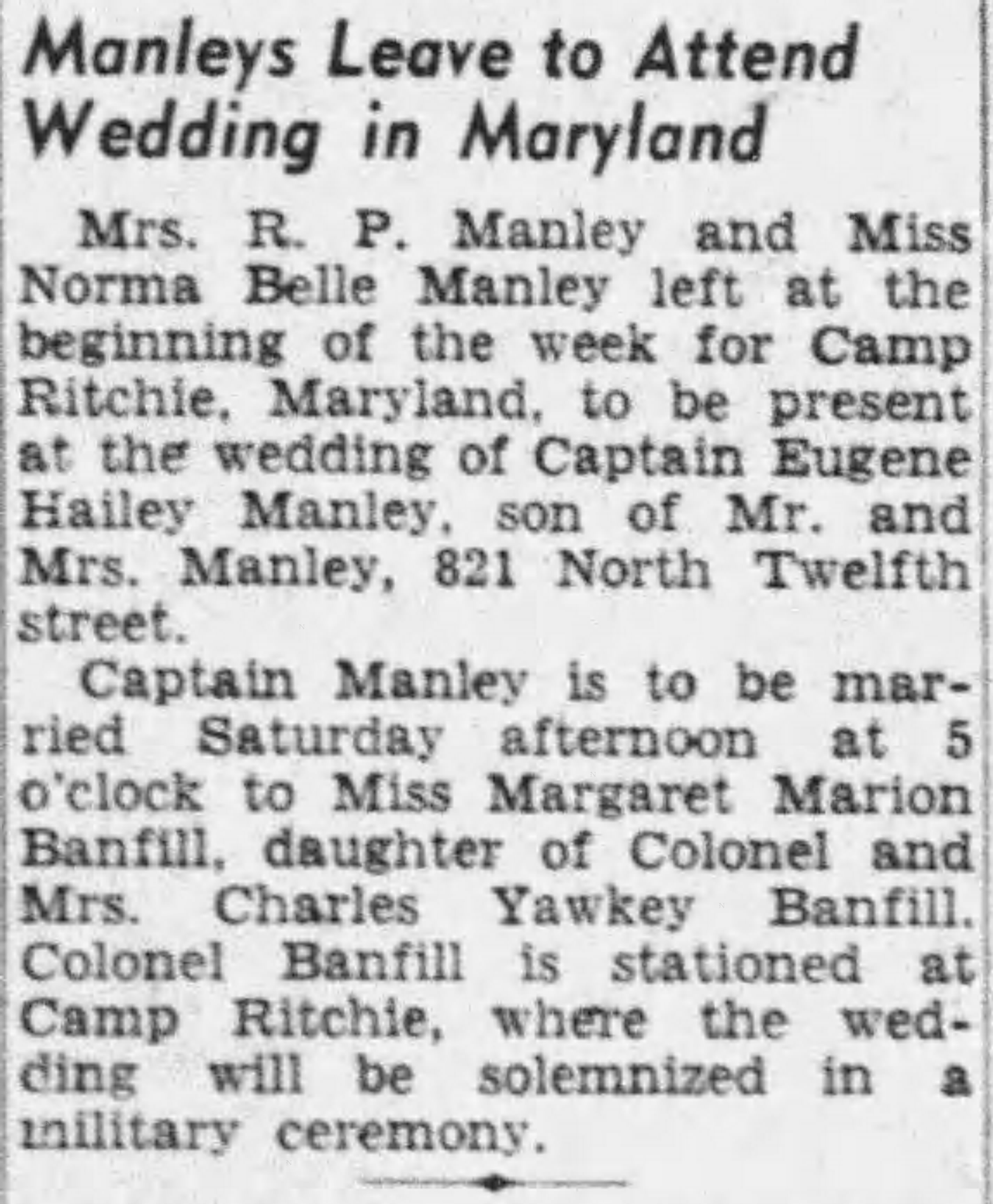 Southwest American, 28 November 1942, p. 5. Colonel Charles Yawkey Banfill, stationed at Camp Ritchie.

Sources
- Charles Y. Banfill, official biography, United States Air Force (accessed 4 October 2026)
- Charles Yawkey Banfill, generals.dk (accessed 4 October 2026)
- Charles Yawkey Banfill, Military Times Hall of Valor (accessed 4 October 2026). Air Force serial number 153A.
- Southwest American, 28 November 1942, p. 5
- Camp Ritchie (commandant's projects memo, 30 April 1943)
- The Stories/Camp Ritchie Background (activation on 19 June 1942 under his command)