| Eric Waldman | |
|---|---|
 | |
| Personal details | |
| Birth name | Erich Waldmann |
| Born | 1914 Vienna |
| Died | 2007 |
| Nativity | Austria |
| Religion | Catholic |
| Military service | |
| Allegiance |  United States United States |
| Branch |  United States Army United States Army |
| Arm / service | Field Artillery |
| ASN | 01182990 |
| Rank | Colonel |
| Rank at Ritchie | Second Lieutenant |
| Camp Ritchie | Class 10 (23 July – 20 September 1943) |
| Section | 5A |
| Specialty | Military intelligence; German tactics |
| Unit / division | War Department G-2; Fort Hunt / Gehlen group |
{{Needs source}}, or explain disagreements on talk. Baseline import notes: About the data.
Eric Waldman (1914–2007), born Erich Waldmann in Vienna, was an Austrian American marine biologist, artillery officer, and military intelligence specialist. After training and teaching at Camp Ritchie, he worked on German tactics for War Department G-2 and helped direct the Gehlen organization at Fort Hunt and in occupied Germany.
Biography
Eric Waldman was born Erich Waldmann on September 21, 1914, at Franzensbrueckenstrasse 19 in Vienna. His father, Leo Waldmann, had served as an Austrian officer in the First World War. Waldman studied marine biology at the University of Vienna and completed a doctorate before Nazi Germany annexed Austria in 1938.
The Anschluss made remaining in Vienna untenable for the Jewish family. Waldman escaped in 1938 by traveling through Yugoslavia to Trieste, where he boarded the SS Vulcania for the United States. His parents did not survive the Holocaust: the Gestapo killed his father in 1939, and his mother was later murdered at the Chełmno extermination camp.
In the United States, Waldman entered the Army and attended Field Artillery Officer Candidate School. He became a naturalized citizen in 1943 and changed his name from Erich Waldmann to Eric Waldman. Assigned to the Military Intelligence Training Center, he graduated with Camp Ritchie Class 10 and remained as an instructor, putting his native German, academic training, and knowledge of Europe to use for the Army.
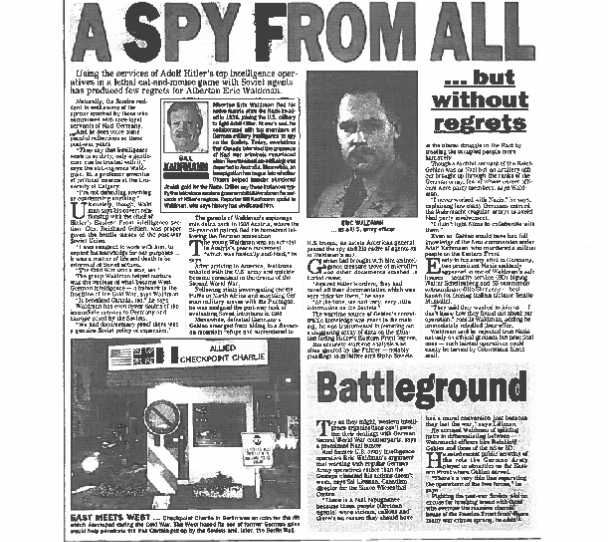
Waldman subsequently joined War Department G-2, where his work centered on German tactics and military organization. Near the end of the war he was assigned to the secret prisoner-of-war installation at Fort Hunt, Virginia, known as P.O. Box 1142. There he worked with the German officers associated with Reinhard Gehlen and the Fremde Heere Ost intelligence apparatus under the Bolero program, using the cover names Captain Brown and Mr. Ericson.
From 1946 to 1949 Waldman continued intelligence work at Oberursel and elsewhere in occupied Germany. He helped organize the Gehlen group as it became an important postwar intelligence partner of the United States and later a foundation of West Germany's Federal Intelligence Service, the BND. His work bridged wartime interrogation, analysis of the Soviet Union, and the emerging intelligence requirements of the Cold War.
Waldman left G-2 in 1949 and returned to academic life. He taught and wrote about European politics, international affairs, and NATO, drawing on both his scholarly training and his government service. He died in 2007.
Eric attended University of Vienna (PhD Biology).
In 1960, Waldman attended Published article on German Socialist movement based on PhD.
Research notes
No notes were in the source row. Add what you know.
Gallery
-
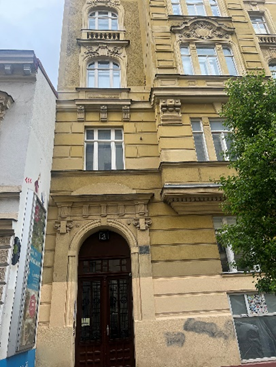 Building where the Waldmann family home was located in Vienna. The building is still standing
 -
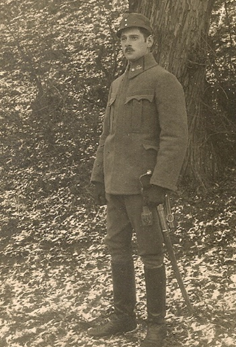 Jakob Lewi Leo Waldmann
 -
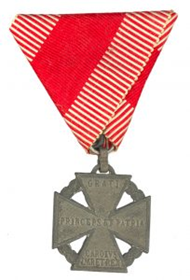 Signum Laudis with swords, Military Merit Medal (Austria Hungary)
 -
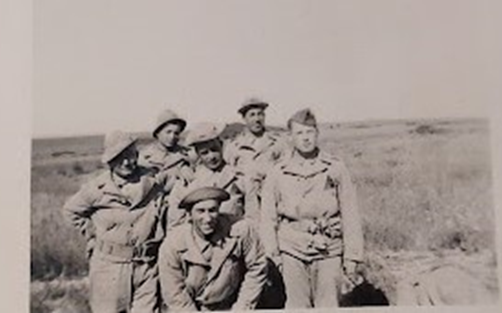 Eric Waldman in the Mohave Dessert with some of his Army buddies
 -
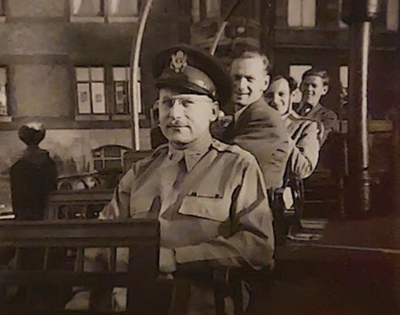 Eric Waldman attending military training
 -
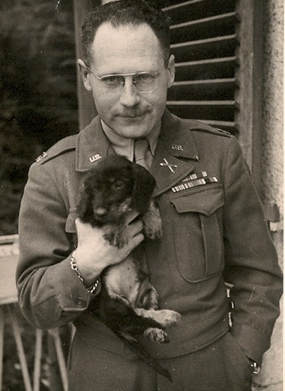 Captain Eric Waldman and his Dachhund, Peter
 -
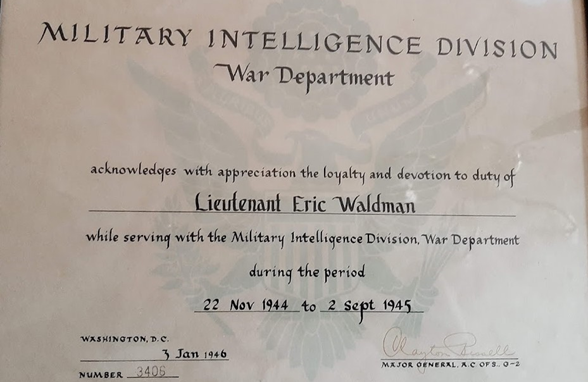 Lieutenant Eric Waldman, Military Intelligence Division, 22 November 1944 to 2 September 1945
 -
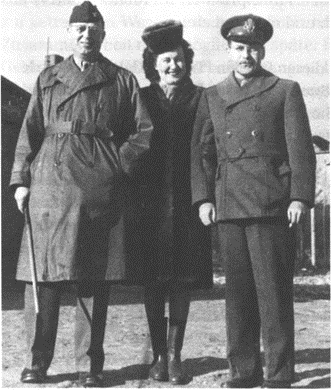 Colonel Philips, Commanding Officer Camp King, then in Pullach with Jo Ann and Eric Waldman, 1949
 -
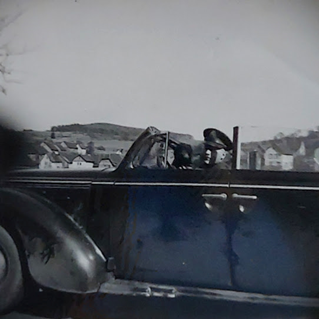 Captain Eric Waldman with his co-pilot, Peter
 -
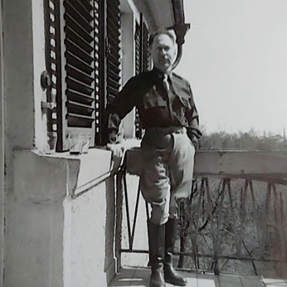 Captain Eric Waldman in Germany
 -
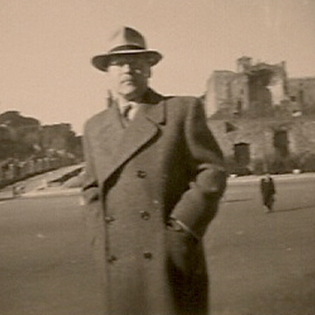 Captain Eric Waldman on assignment in Rome
 -
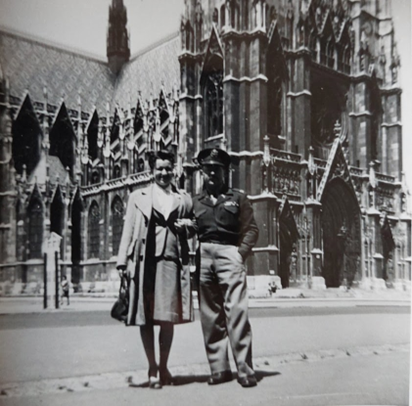 Jo Ann & Eric Waldman in Esslingen, Germany
 -
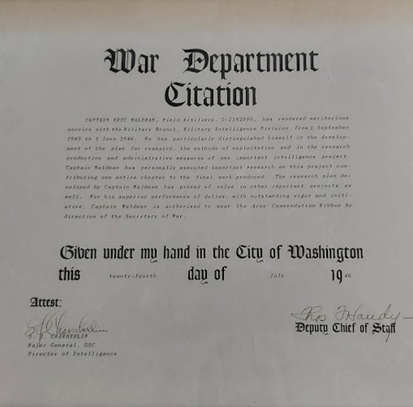 War Department Citation, 1946
 -
-
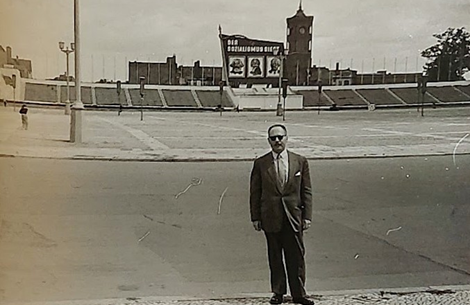 Eric Waldman Max-Engels Plaza East Berlin, Soviet Sector July 1961
 -
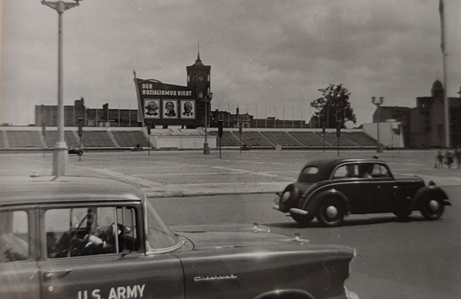 Maz-Engals Plaza East Berlin, Soviet Sector, July 1961
 -
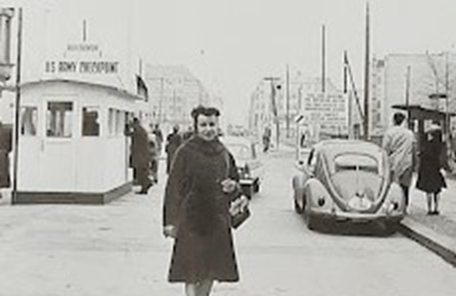 Jo Ann Waldman at Check Point Charlie
 -
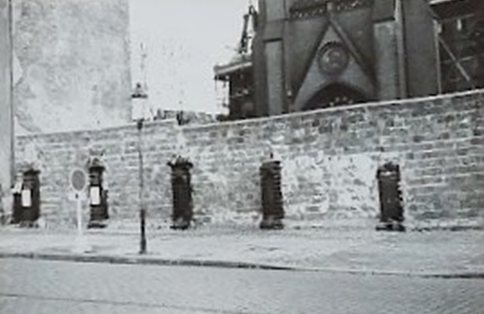 Berlin Wall
 -
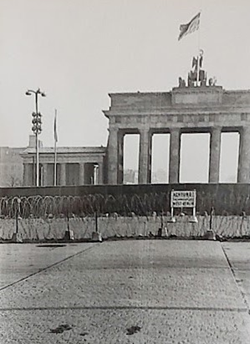 Brandenburg Gate 1961
 -
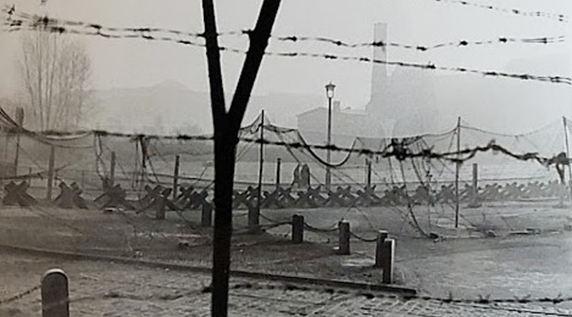 No man’s land between East and West Germany
 -
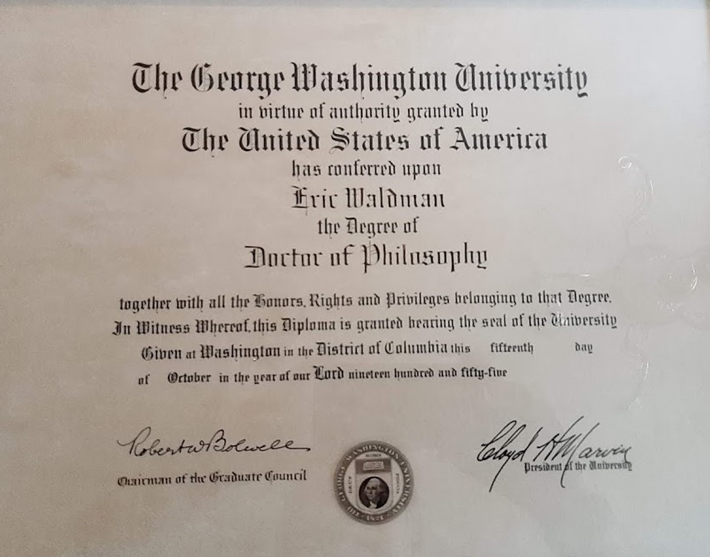 Eric Waldman, Doctor of Philosophy, October 15, 1955
 -
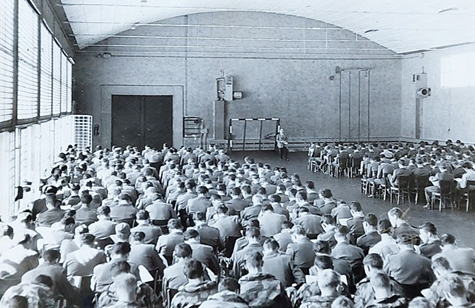 Eric Waldman North Atlantic Treaty Organization (NATO) presentation in Germany
 -
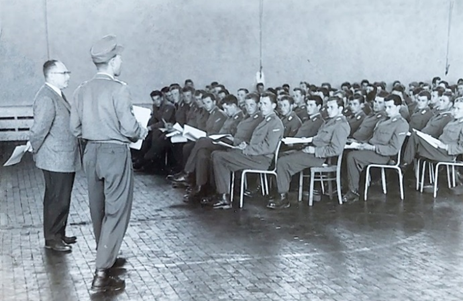 Eric Waldman North Atlantic Treaty Organization (NATO) presentation in Germany
 -
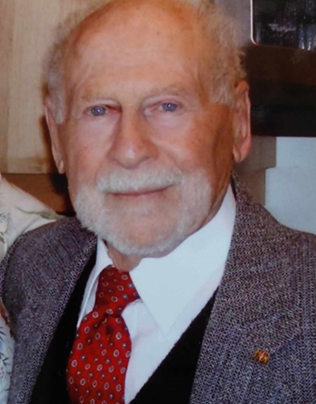
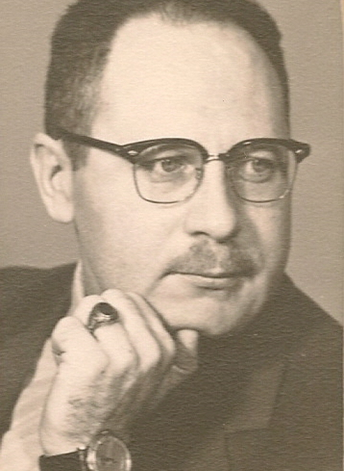 Dr. Eric Waldman
 -
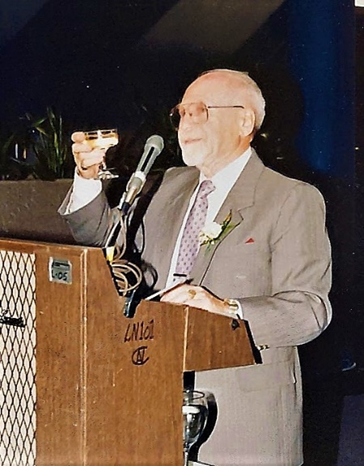
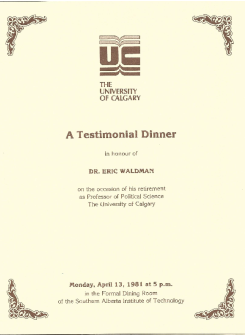 A Testimonial Dinner
 -
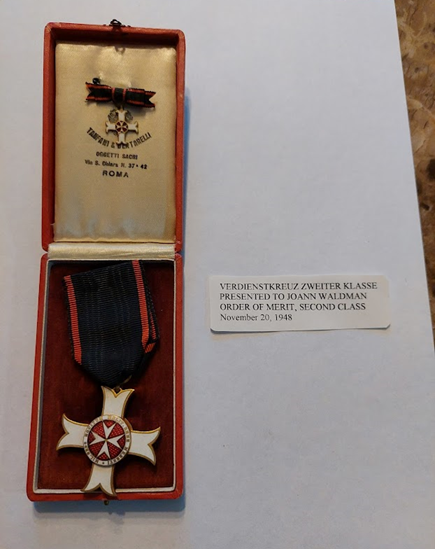 Verdienstkreuz Zweiter Klasse, Order of Merit Second Class, November 20, 1948
 -
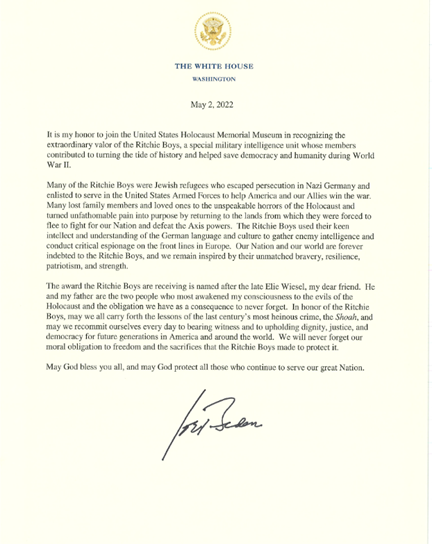 Elie Wiesel Award, May 2nd, 2022
 -
-
-
 Debriefing of Eric Waldman 30 September 1969


Technical record
| Field | Imported value |
|---|---|
| Approx Age at Death | 93 |
| Class_ASN | 182990 |
| Class_Name | WALDMAN, Eric |
| match_method | asn_partial_name_exact |
| row_source | both |
Timeline
- Born 21 September 1914 in Vienna.
- 3 December 1943 — Assigned to Faculty (Section V).
Sources
- Camp Ritchie Museum, Inc. (The Ritchie History Museum), Classes 1–31 roster data
- Dan Gross research spreadsheets, including original Excel timeline/roster work, combined with other research and records
- NARA World War II Army enlistment records (where a NARA ASN is present)
- 1940 U.S. Census (where a census match is present)
- The Stories essay
- Dan Gross, Timeline of Eric Waldman for Camp Ritchie (private research document; 1 source documents reviewed)
- Dan Gross, Timeline of Waldman, Eric for Camp Ritchie (private research files; selected non-private narrative findings; 1 source files: ERIC WALDMAN.doc)