| Stefan Heym | |
|---|---|
 | |
| Personal details | |
| Birth name | Helmut Flieg |
| Born | 10 April 1913 Chemnitz, Germany |
| Died | 16 December 2001 Ein Bokek, Israel |
| Nativity | Germany |
| Religion | Jewish |
| Known for | Writer |
| Military service | |
| Allegiance |  United States United States |
| Branch |  United States Army United States Army |
| ASN | 32860259 |
| Rank | Technical Sergeant |
| Rank at Ritchie | Private |
| Camp Ritchie | Class 9 (21 June – 18 August 1943) |
| Section | 5D |
| Enlisted | New York City, New York |
{{Needs source}}, or explain disagreements on talk. Baseline import notes: About the data.
Stefan Heym (1913–2001) was a Ritchie Boy (born Flieg; Helmut; from Germany; Jewish) who trained at Camp Ritchie in class 9.
Biography edit
Stefan Heym was born Helmut Flieg on 10 April 1913 in Chemnitz, Germany, into a Jewish merchant family, and was an antifascist from an early age. In 1931, at the instigation of local Nazis, he was expelled from the Gymnasium in his hometown over an anti-military poem. He finished school in Berlin and began a degree in media studies there. After the Reichstag fire of 1933 he fled to Czechoslovakia, where he took the name Stefan Heym and wrote for German-language Prague newspapers such as the Prager Tagblatt and Bohemia under several pseudonyms, including Melchior Douglas and Gregor Holm.
In 1935 a grant from a Jewish student association took Heym to the University of Chicago, where he completed his degree in 1936 with a dissertation on Heinrich Heine. From 1937 to 1939 he was editor-in-chief of the New York German-language weekly Deutsches Volksecho, which was close to the Communist Party USA, and after it closed in November 1939 he worked as a freelance author in English; his first novel, Hostages (1942), was a bestseller.
Heym, by then a U.S. citizen, enlisted in New York City; the roster lists two years of college and his civilian occupation as author, editor, and reporter. He was assigned to Camp Ritchie in May 1943 with German and French, entered Class 9 (IPW Ge) on 21 June 1943, and graduated on 18 August 1943 as an assistant interrogator, linguist, and typist. According to historian Beverley Driver Eddy, after Camp Ritchie he went to Camp Sharpe near Gettysburg, Pennsylvania, for more training in psychological warfare. He then joined the psychological-warfare unit led by the émigré Hans Habe, writing texts aimed at Wehrmacht soldiers for leaflets, radio, and loudspeakers; he was promoted to technician third grade on 15 February 1944 and to technical sergeant on 3 March 1944. The experience inspired his novel The Crusaders and the collection Reden an den Feind (Speeches to the Enemy). He married Gertrude Gelbin, an American, in 1944. After the war he led the Ruhrzeitung in Essen and then worked as an editor at Die Neue Zeitung in Munich, but his refusal to soften his criticism of Nazism and the German elites who had collaborated with it, or to cast doubt on Soviet intentions in his editorials, led to his transfer back to the United States toward the end of 1945.
Heym worked as a freelance author again until 1951, when, fearing investigation by the House Un-American Activities Committee during the McCarthy era, he left the United States with his wife. In 1952 he returned all his American military commendations in protest against the Korean War and moved to Prague, and the following year to the German Democratic Republic, which restored his German citizenship. At first privileged as a returning antifascist, he lived in a state-provided villa in Berlin-Grünau, worked at the Berliner Zeitung from 1953 to 1956, and published his English-language works through Seven Seas Publishers, founded for him, with German translations in large print runs; he received the Heinrich Mann Prize in 1953 and the National Prize of the GDR, second class, in 1959.
Conflicts with the East German authorities grew from 1956, when his book on the 17 June 1953 uprising, Five Days in June, was rejected, and intensified after Erich Honecker attacked him in 1965. In 1969 he was convicted of violating exchange-control rules after publishing his novel Lassalle in West Germany. He signed the 1976 petition protesting the expulsion of Wolf Biermann, after which he could publish only in the West and began writing in German; in 1979 he was convicted again and expelled from the GDR Writers' Association, though he was still able to travel, including a two-month visit to the United States in 1978. He supported German reunification as early as 1982 and backed the East German civil rights movement, speaking at the East Berlin demonstrations in autumn 1989.
After reunification Heym criticized the treatment of East Germans and argued for a socialist alternative. Elected to the Bundestag in 1994 as an independent on the Party of Democratic Socialism's open list for Berlin-Mitte/Prenzlauer Berg, he gave the opening speech of the new parliament as its oldest member in November 1994 but resigned in October 1995 in protest against a planned rise in members' allowances. In 1997 he signed the "Erfurt Declaration." He remained a committed socialist despite his long criticism of the GDR. His honors included honorary doctorates from the University of Bern (1990) and the University of Cambridge (1991), the Jerusalem Prize (1993) for literature "for the freedom of the individual in society," the peace medal of the IPPNW, and honorary citizenship of Chemnitz (2001). Heym died suddenly of heart failure on 16 December 2001, aged 88, at Ein Bokek, Israel, while attending a Heinrich Heine conference, and was buried in Berlin's Weißensee Cemetery.
Research notes edit
- Author
- to 2nd MRBC, 12/31/43
- PI 23
- The Wandering Jew
Gallery edit
-
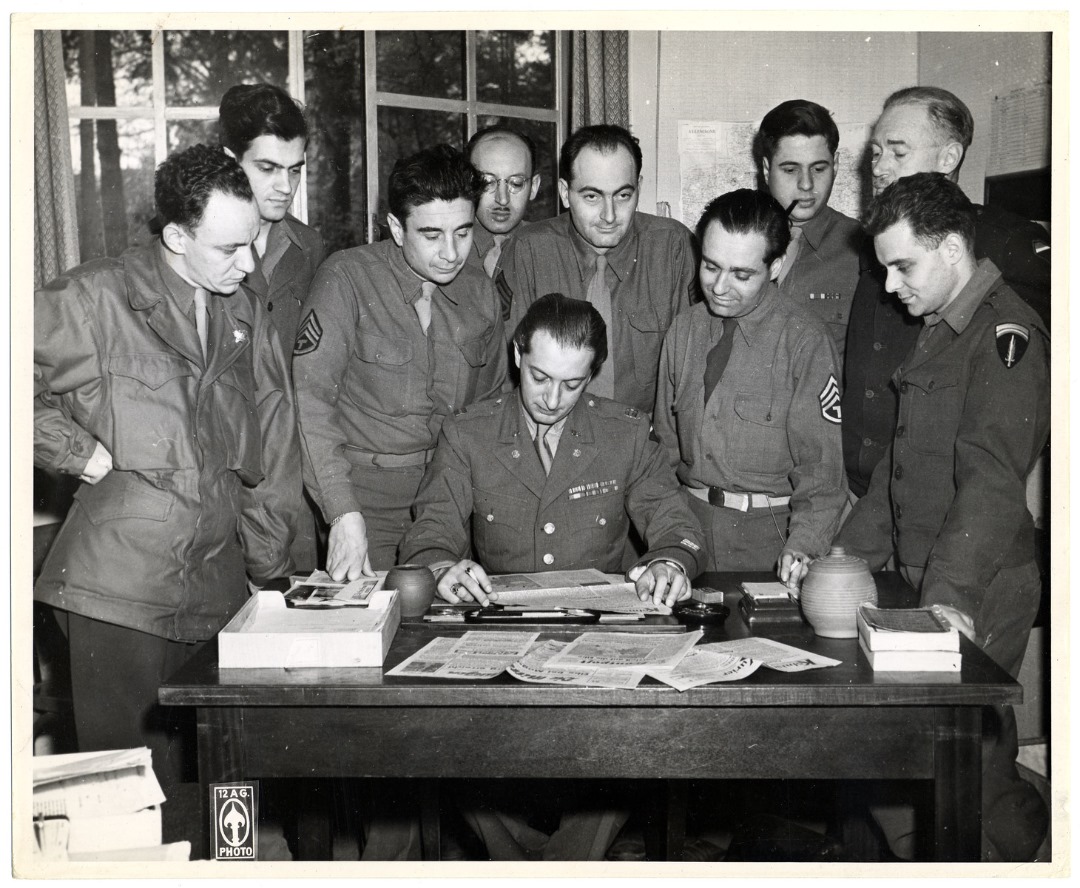 All the men identified in the pix are "Ritchie Boys." Seated - Hans Habe. Standing L-R - Unknown, Ernest Wynder, Konrad Kellen, unknown, Stefan Heym, Louis Atlas, Peter Weidenreich (last name later changed to Wyden), unknown, Joseph Eaton

Technical record edit
| Field | Imported value |
|---|---|
| MRBC2 | 2 |
| Approx Age at Death | 88 |
| Nara ASN | 32860259 |
| Nara Name | HEYM STEFAN |
| Nara State | 23 |
| Nara County | 61 |
| Nara POE | 2364 |
| Nara DOE | 110343 |
| Nara Grade Alpha | PVT8 |
| Nara Grade Code | 8 |
| Nara Branch Alpha | NO |
| Nara Branch Code | 2 |
| Branch | No branch assignment |
| Nara Term or Enlistment | 5 |
| Term of enlistment | Enlistment for the duration of the War or other emergency, plus six months, subject to the discretion of the President or otherwise according to law |
| Defer. Date | 0 |
| Nara Source | 0 |
| Nara Nativity | N1 |
| Nara Year of Birth | 13 |
| Nara Race | J |
| Nara Race Description | White not yet a citizen |
| Nara Education | 6 |
| Nara Civilian Occupation | 6 |
| Nara Marital Status | 6 |
| Nara Height (inches) | 20 |
| Nara Weight (lbs) | 138 |
| Class_ASN | 32860259 |
| Class_Name | HEYM, Stefan |
| match_method | asn_exact_name_exact |
| row_source | both |
Timeline edit
- Born 10 April 1913 in Germany (as Helmut Flieg) (Jewish).
- 1933 — Fled to Czechoslovakia and took the name Stefan Heym.
- 1936 — Completed his degree at the University of Chicago.
- 1942 — Published his first novel, Hostages.
- May 1943 — Assigned to Camp Ritchie. Languages German, French.
- 21 June 1943 — Entered Class 9 (IPW Ge).
- 18 August 1943 — Graduated with Class 9 (Asst Interrogator; linguist, typist).
- 1944 — Married Gertrude Gelbin.
- 15 February 1944 — Promoted to T/3.
- 3 March 1944 — Promoted to T/Sgt.
- 1952 — Returned his American military commendations and left for Prague; moved to the GDR in 1953.
- 1994 — Elected to the Bundestag.
- 16 December 2001 — Died at Ein Bokek, Israel.
Sources edit
- Wikipedia: Stefan Heym
- Beverley Driver Eddy, video interview on Camp Sharpe (YouTube) (Camp Sharpe training after Camp Ritchie)
- Camp Ritchie Museum, Inc. (The Ritchie History Museum), Classes 1–31 roster data
- Dan Gross research spreadsheets, including original Excel timeline/roster work, combined with other research and records
- NARA World War II Army enlistment records (where a NARA ASN is present)
- 1940 U.S. Census (where a census match is present)
- Ritchie Boys of WWII Facebook page, post dated 2021-08-11 (1 post)
- Dan Gross, Timeline of Stefan Heym for Camp Ritchie (private research document; 1 source documents reviewed)
- Dan Gross, Timeline of Heym, Stefan for Camp Ritchie (private research files; selected non-private narrative findings; 1 source files: STEFAN HEYM.doc)