Soft launch: Soldier biographies and research notes vary in completeness. Prefer class-roster, NARA, newspapers, and other cited sources for contested facts — treat Research notes as leads, not settled history. Anyone can correct a page; contact us with questions.
Konrad Kellen
| Konrad Kellen | |
|---|---|
| Personal details | |
| Birth name | Katznellenbogen |
| Born | 1913 |
| Died | 2007 |
| Nativity | Germany |
| Religion | Protestant |
| Military service | |
| Allegiance |  United States United States |
| Branch |  United States Army United States Army |
| ASN | 39701828 |
| Rank | Technician Fourth Grade |
| Rank at Ritchie | Private |
| Camp Ritchie | Class 13 (30 October – 23 December 1943) |
| Section | E |
{{Needs source}}, or explain disagreements on talk. Baseline import notes: About the data.
Konrad Kellen (born Konrad Moritz Adolf Katzenellenbogen; December 14, 1913 – April 8, 2007) was a German-born American political scientist, intelligence analyst, and author. thumb|upright|right|Konrad Kellen.
Biography
Konrad Kellen (born Konrad Moritz Adolf Katzenellenbogen; December 14, 1913 – April 8, 2007) was a German-born American political scientist, intelligence analyst, and author.
During World War II, Kellen trained at Camp Ritchie where he trained to become one of the Ritchie Boys. Service notes include Camp Ritchie class 13; class rank Pvt; final rank T/4; overseas service.
Konrad Kellen, also known as Katznellenbogen lived 1913–2007, with nativity listed as Germany, Protestant. He arrived in New York in 1935 and moved to Los Angeles, becoming an American citizen under the name Konrad Kellen. From 1941-1943, Kellen was the private secretary to author Thomas Mann.
Kellen wrote research papers and newspaper commentaries, as well as books including the biography Khrushchev (1961) and The Coming Age of Woman Power (1972), a study of male-female relationships. Contrary to his forecast, the communists launched the bigger than ever Easter Offensive in South-Vietnam in March 1972. In 1972, months before the U.S.
In 2003 he published his autobiography, Katzenellenbogen, named after his original family name. In 2013, six years after Kellen's death, journalist and author Malcolm Gladwell noted Kellen's life and career were based on his ability to listen, citing him as "a truly great listener" for his ability to listen without filtering what he heard through the biases of the times. thumb|upright|right|Konrad Kellen.
At different points in his career, Kellen analyzed postwar German soldiers, defectors from behind the Iron Curtain, Viet Cong who had been captured, and terrorists. He was among the first intelligence analysts to conclude that, contrary to prevailing U.S. administration assessments, enemy morale in the Vietnam War was, in fact high and the war was not winnable.
While at the RAND Corporation, he co-authored an open letter to the U.S. government urging withdrawal of troops. Kellen was a member of a prominent Jewish family in Berlin, the son of Ludwig Katzenellenbogen.
He was a distant relative of Albert Einstein and a cousin of economist Albert Otto Hirschman. After living in France, the Netherlands, and Yugoslavia, Kellen traveled to the United States. Army, he served as an intelligence NCO with 2nd Mobile Radio Broadcasting Company in Europe, For his compensation, he received one of the Chagall paintings, which he sold in the 1950s.
pullout pursuant to the Paris Peace Accords, investigative journalist Jack Anderson cited the open letter authored by Kellen as authority for the assertion that communist military morale in Vietnam was high. Kellen went on to become an analyst of terrorism, his reports from the late 1970s and early 1980s identifying trends in terrorism that manifested a decade later. Terrorism expert Brian Jenkins said Kellen often took a contrarian or independent view among RAND Corporation colleagues.
Konrad Kellen appears in a wartime group photograph of Ritchie Boys (see the gallery caption for identifications and photo credit).
He studied law in Munich before fleeing Germany with his family in March 1933 at age 19 to escape Nazi persecution. He lived in retirement in Los Angeles, dying at his home in Pacific Palisades.
Research notes
- Section V 1/7/44; to 2nd MRBC 1/19
Gallery
-
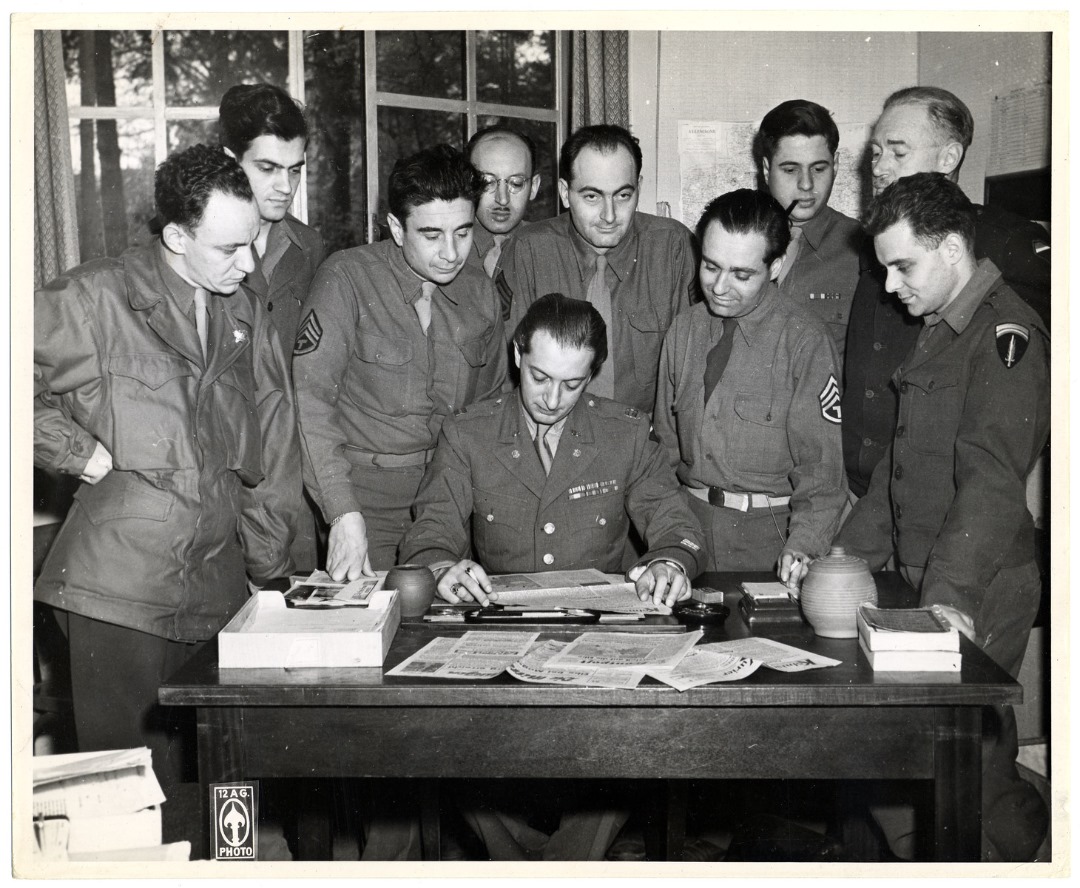 Thanks to Stephen Goodell for sharing this group photo. It can be found at the US Holocaust Memorial Museum, part of the Joseph Eaton collection. All the men identified in the pix are "Ritchie Boys." Seated - Hans Habe. Standing L-R - Unknown, Ernest Wynder, Konrad Kellen, unknown, Stefan Heym, Louis Atlas, Peter Weidenreich (last name later changed to Wyden), unknown, Joseph Eaton.

Technical record
| Field | Imported value |
|---|---|
| MRBC2 | 2 |
| Approx Age at Death | 94 |
| Class_ASN | 39701828 |
| Class_Name | Katzenellenbogen, Konrad |
| match_method | pass2_asn_first |
| row_source | both |
Sources
- Wikipedia: Konrad Kellen
- Camp Ritchie class roster (classes 1–31), merged research file
- NARA World War II Army enlistment records (where a NARA ASN is present)
- 1940 U.S. Census (where a census match is present)
- Ritchie Boys of WWII Facebook page, post dated 2021-08-11 (1 post)