Training materials
Training materials collects Camp Ritchie / MITC documents that apply to the camp as a whole — training manuals, course outlines, circulars, maps, and similar files — not papers about one soldier.
For a scan that should enrich a soldier profile (certificate, letter, team roster), use Contribute documents instead.
Add a file edit
Loading upload tools… (requires login).
You can also use Special:Upload. Prefer clear filenames such as MITC_interrogation_manual_1943.pdf. State the source and that you have permission to share the file. Individual files can be up to about 120 MB.
Logged-in editors can Remove an item from the Library list below (unlist only). Delete file (permanent) is shown to administrators only.
Featured: List of Directives edit
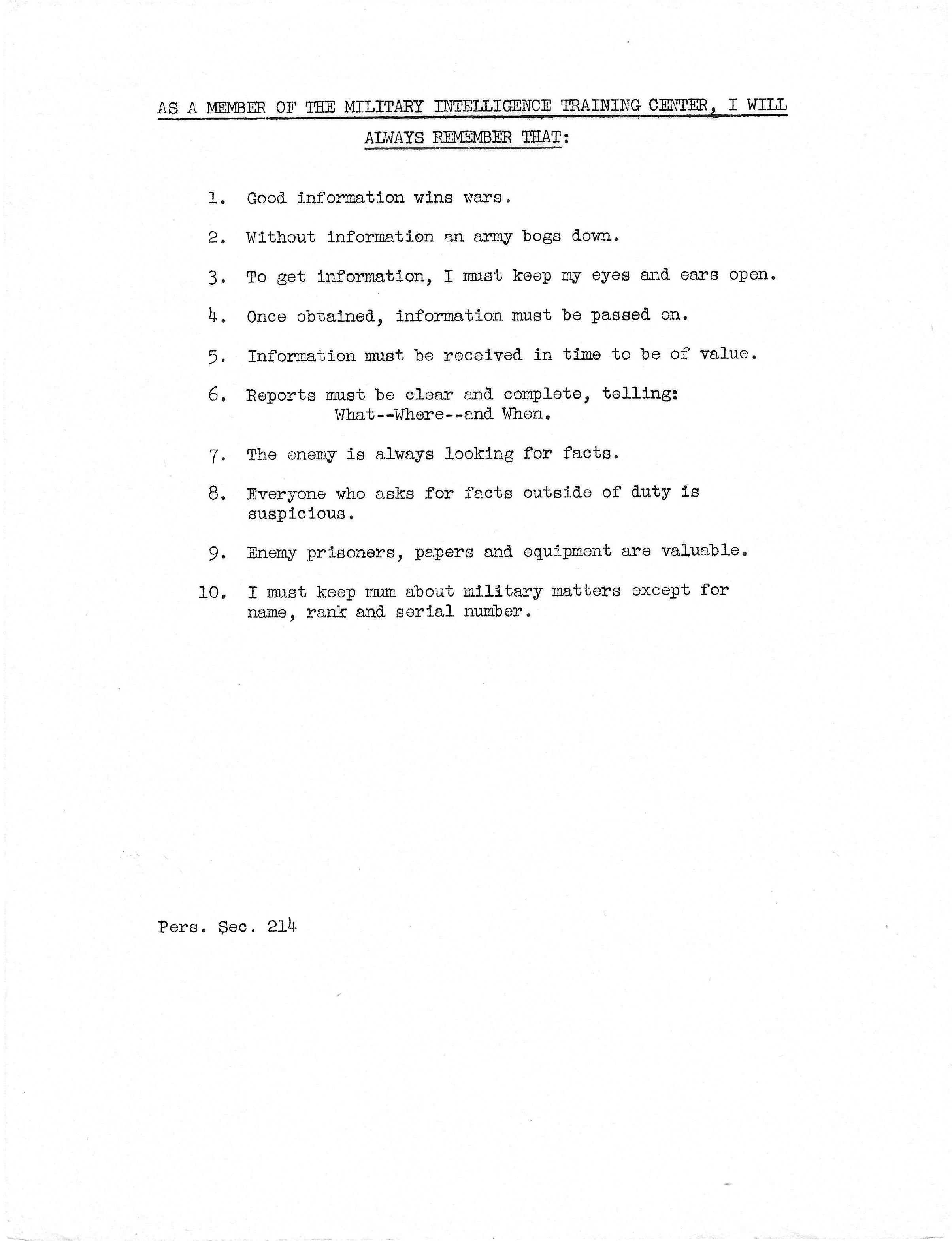
A short Personnel Section sheet (marked Pers. Sec. 214) summed up what trainees were to remember about information and security:
- Good information wins wars.
- Without information an army bogs down.
- To get information, I must keep my eyes and ears open.
- Once obtained, information must be passed on.
- Information must be received in time to be of value.
- Reports must be clear and complete, telling: What—Where—and When.
- The enemy is always looking for facts.
- Everyone who asks for facts outside of duty is suspicious.
- Enemy prisoners, papers and equipment are valuable.
- I must keep mum about military matters except for name, rank and serial number.
Source scan: Camp Ritchie List of Directives (archival credit not yet confirmed).

Featured: Enemy Equipment Intelligence Service (EEIS) edit
Signal Section monograph A Typical Enemy Equipment Intelligence Service, based on Enemy Equipment Intelligence Service Detachment Number 9 (Signal Section, Headquarters 9th U.S. Army, A.P.O. 339).
An Enemy Equipment Identification Team of five officers and six enlisted men formed at Fort Monmouth, New Jersey, then took a condensed two-week intelligence course at Camp Ritchie beginning 13 April 1944 (enemy signal equipment and weapons, enemy order of battle, map reading, and familiarization with IPW and photo-interpretation teams). After further Signal Corps preparation in New Jersey and the United Kingdom, the detachment entered the Continent in late August 1944 and operated under Ninth Army / Signal channels recovering and studying German electronic and signal equipment (including radar and crashed-aircraft material).
Full scan (8 pages, combined from Fold3 JPGs): A Typical Enemy Equipment Intelligence Service (EEIS Detachment No. 9, Signal Section, 9th U.S. Army).
Source: Fold3 — Signal Section Monographs / Histories (U.S. WWII European Theater Army Records).
Library edit
- German Uniform Chart (November 1942)
- Handbook on German Army Identification (1943)
- USA Organization (1 Sep 1944)
- Japanese Uniform Insignia (1 May 1945)
- Camp Ritchie List of Directives (Pers. Sec. 214)
- A Typical Enemy Equipment Intelligence Service (EEIS Detachment No. 9, Signal Section, 9th U.S. Army)
Privacy and rights edit
- Upload only material you may publish (public domain, museum permission, or your own cleared scans).
- Do not include Social Security numbers or private contact details for living people.
- See Contribute and About the data.
See also edit
- Camp Ritchie
- Contribute documents — OCR into soldier profiles
- Photos
- Books
- Contribute