Soft launch: Soldier biographies and research notes vary in completeness. Prefer class-roster, NARA, newspapers, and other cited sources for contested facts — treat Research notes as leads, not settled history. Anyone can correct a page; contact us with questions.
Robert Eliot Matteson
| Robert Eliot Matteson | |
|---|---|
 | |
| Personal details | |
| Born | 1914 |
| Died | 1994 |
| Nativity | United States |
| Military service | |
| Allegiance |  United States United States |
| Branch |  United States Army United States Army |
| ASN | 37575990 |
| Unit / division | 80th Infantry Division |
{{Needs source}}, or explain disagreements on talk. Baseline import notes: About the data.
Robert Eliot Matteson (1914–1994) was a Camp Ritchie–associated Counter Intelligence Corps officer with Patton’s Third Army (80th Infantry Division) who entered Ebensee after the SS fled, tracked and arrested Ernst Kaltenbrunner in the Austrian Alps, and later handled personnel security at the Nuremberg Palace of Justice.
Biography[edit | edit source]
Robert Eliot Matteson (1914–1994) attended Carleton College in Minnesota (a brother who died there is commemorated by a basketball cup he later recalled). During the Second World War he headed a Counter Intelligence Corps unit operating under the 80th Infantry Division in General George S. Patton’s Third U.S. Army. The Classes 1–31 / demographics roster associates him with Camp Ritchie.
Near the end of the war his unit met Soviet forces at Steyr, Austria, then withdrew toward the Salzburg–Vienna Autobahn. At Gmunden, Matteson and Yale-trained interpreter Sidney Bruskin picked up the first solid lead that SS Obergruppenführer Ernst Kaltenbrunner—head of the Reich Security Main Office after Reinhard Heydrich’s assassination, and by then among the most powerful figures under Hitler—had been in the area only days earlier, along with a tip on Nazi labor leader Robert Ley. Allied wanted lists still confused Kaltenbrunner with radio commentator H. V. Kaltenborn and lacked a usable photograph. Pushing south toward the supposed Alpine “national redoubt,” Matteson and Bruskin were among the first Americans into the Ebensee concentration camp after the SS guards fled overnight: they forced the lock, found skeletal survivors at the wire pleading for food, piles of bodies at the crematorium that could not be burned fast enough, and a chemical ditch used for executions, then radioed for medics and food for inmates still alive in the so-called hospital.
From Bad Ischl—working with Austrian underground contacts, including a Spanish Civil War veteran in the local Freiheitsbewegung and later Albrecht Gaiswinkler’s network and assistant burgermeister Johann Brandauer—Matteson followed Kaltenbrunner west to Strobl. There he interrogated the Nazi burgermeister, walked up through the woods to a villa guarded by Kaltenbrunner’s unarmed Dienststelle bodyguard, confronted Kaltenbrunner’s wife (who claimed her husband had left), recovered the first usable photograph of the SS general from a bookcase, and took her back to 80th Division headquarters for questioning. Fresh leads then pointed up into Altaussee in the Totes Gebirge (Dead Mountains) of the Salzkammergut, where a U.S. Detachment was also safeguarding Nazi-looted European art treasures stored in the salt mine—saved in part because local miners had swapped out dynamite the Gauleiter meant to use to destroy them.
After midnight Matteson set out from Altaussee with four armed Austrian mountain guides in spiked shoes (and a covering infantry squad ordered to stay out of sight) on a roughly six-hour climb through crusted snow and avalanche debris to a remote cabin. Posing as a cold traveler between valleys and carrying a note from Kaltenbrunner’s mistress, Gisela von Westarp—a young Prussian countess who had worked in Himmler’s Berlin headquarters—he knocked at the porch at dawn. When a guide inside refused him entry, then drew a revolver after spotting the armed Austrians, Matteson fell back; the party surrounded the cabin, forced the door, and four men came out with hands raised. Kaltenbrunner—about 6 feet 4, roughly 220 pounds, with Graz dueling scars—was among them, but wearing a Wehrmacht medical officer’s uniform and carrying a medical kit rather than SS insignia. In the stove ash receptacle Matteson recovered Kaltenbrunner’s Kriminalpolizei badge (number two; Himmler’s number-one badge was never found) and silver Gestapo badge, plus documents including a last communication to Himmler and Hitler about covering concentration-camp traces. The party marched the prisoners down to Altaussee, where Gisela von Westarp and Iris Scheidler (wife of adjutant Arthur Scheidler, also among those arrested) recognized the men in the street crowd. Kaltenbrunner was forwarded for higher interrogation, later held under harsh conditions at Britain’s Camp 020 outside Richmond, and eventually taken in handcuffs to Nuremberg—still denying personal responsibility for camp atrocities and claiming his main interest had been intelligence.
In November 1945 Matteson was transferred to personnel security for the Palace of Justice at Nuremberg, covering senior trial figures, visitors, and judges. He tested cell-block security himself on arrival: in CIC uniform he walked past successive guard posts on a pass that should not have admitted him past the iron grill (only a red interrogation pass signed by Colonel Amen of Justice Jackson’s staff should have), then briefly confronted major defendants including Julius Streicher, editor of Der Stürmer, and Hermann Göring, who stood at attention in his cell. Night security in the ruined city was complicated by people emerging from Nuremberg’s extensive tunnels and catacombs.
After the war Matteson directed research for Harold Stassen’s presidential bid. On 9 April 1947 he accompanied Stassen to Moscow for a meeting with Joseph Stalin (with Molotov and interpreter Pavlov present), taking near-verbatim notes of Stassen’s questions on coexistence, press freedom, and accreditation of a New York Herald Tribune correspondent; the resulting Stassen–Stalin transcript was later published and figured in Soviet succession debates. Matteson later served on the CIA Board of Estimates (1959–1962, overt side, by his account), visited Albert Speer in Heidelberg in 1978 for a long conversation that touched Speer’s wartime building plans and knowledge of camps such as Ebensee, and spent the 1979 Michaelmas term at Oxford working on the Kaltenbrunner story with Hugh Trevor-Roper and Sir Michael Howard. In later years, accredited to the Ashland Daily Press in northern Wisconsin under the U.S. Licensing Act, he pursued private “U.S.–Cuba photo diplomacy,” traveling repeatedly with his uncle’s 1904 Cuban photographs (including a rare image of General Máximo Gómez) and pressing for cultural contacts such as Cuban baseball exchanges. In June 1982 he recorded a video oral history at the University of Wisconsin–River Falls—an audience talk plus studio Q&A—that is held by the United States Holocaust Memorial Museum (RG-50.043.0005).
Research notes[edit | edit source]
No notes were in the source row. Add what you know.
Gallery[edit | edit source]
-
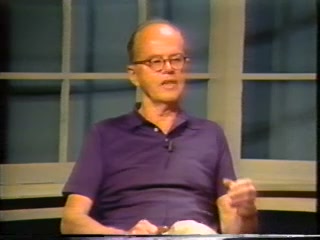 Still from the June 1982 USHMM / University of Wisconsin–River Falls oral history

Technical record[edit | edit source]
| Field | Imported value |
|---|---|
| row_source | demographics |
Timeline[edit | edit source]
- 1914 — Born (Robert Eliot Matteson).
- Attended Carleton College (Minnesota).
- WWII — Head of a CIC unit under the 80th Infantry Division, Third U.S. Army; Camp Ritchie association on roster.
- Spring 1945 — Met Soviet forces at Steyr, Austria; first lead on Kaltenbrunner (and tip on Robert Ley) at Gmunden with Sidney Bruskin.
- Spring 1945 — Entered Ebensee concentration camp after SS withdrawal; radioed for relief.
- Spring 1945 — At Strobl confronted Frau Kaltenbrunner; recovered first usable photograph of Ernst Kaltenbrunner.
- Spring 1945 — Midnight climb from Altaussee; arrested Kaltenbrunner and associates (including Arthur Scheidler) at a mountain cabin; recovered Gestapo/Kripo badges and documents.
- Spring 1945 — Kaltenbrunner forwarded for higher interrogation; later held at Britain’s Camp 020.
- November 1945 — Assigned to personnel security, Palace of Justice, Nuremberg; tested cell-block access; brief confrontations with Streicher and Göring.
- 9 April 1947 — In Moscow with Harold Stassen; meeting with Joseph Stalin; helped prepare the published conversation transcript.
- 1959–1962 — CIA Board of Estimates (overt estimates work, by his later account).
- 1978 — Visited Albert Speer in Heidelberg.
- 1979 — Michaelmas term at Oxford on the Kaltenbrunner story (Trevor-Roper / Sir Michael Howard).
- c. early 1980s — U.S.–Cuba cultural / “photo diplomacy” work while accredited to the Ashland Daily Press.
- June 1982 — Oral-history interview, University of Wisconsin–River Falls (USHMM RG-50.043.0005).
- 1994 — Died.
Sources[edit | edit source]
- USHMM oral history (video + transcript) video with Robert Eliot Matteson
- Interview still used as profile photo
- Robert E. Matteson oral-history English transcript (USHMM RG-50.043.0005)
- Oral history interview with Robert E. Matteson — United States Holocaust Memorial Museum
- Camp Ritchie Museum, Inc. (The Ritchie History Museum), Classes 1–31 roster data
- Dan Gross research spreadsheets, including original Excel timeline/roster work, combined with other research and records
- NARA World War II Army enlistment records (where a NARA ASN is present)
- 1940 U.S. Census (where a census match is present)