Soft launch: Soldier biographies and research notes vary in completeness. Prefer class-roster, NARA, newspapers, and other cited sources for contested facts — treat Research notes as leads, not settled history. Anyone can correct a page; contact us with questions.
Hugo David Weisgall
| Hugo David Weisgall | |
|---|---|
 | |
| Personal details | |
| Born | 13 October 1912 Ivančice, Moravia, Austria-hungary |
| Died | 11 March 1997 Long Island, New York |
| Nativity | Czechoslovakia |
| Military service | |
| Allegiance |  United States United States |
| Branch |  United States Army United States Army |
| ASN | 13072714 |
| Rank | Technical Sergeant |
| Rank at Ritchie | Technician Fifth Grade |
| Camp Ritchie | Class 2 (24 August – 17 October 1942) |
{{Needs source}}, or explain disagreements on talk. Baseline import notes: About the data.
Hugo David Weisgall (13 October 1912–11 March 1997) was a Moravia-born Class 2 Ritchie Boy, conductor, and composer who led the BBC Symphony at Royal Albert Hall in 1943 and later wrote major American operas.
Biography[edit | edit source]
Hugo David Weisgall was born on 13 October 1912 in Ivančice (Eibenschütz), Moravia, then in Austria-Hungary, into a family of Bohemian-Austrian cantors. His father, Abba Yosef (Adolph Joseph) Weisgall, was assistant cantor there under Hugo’s great-uncle Bacche, a last-generation student of Salomon Sulzer, and had sung light-opera roles; in America he added the second l to the surname, which his brother, the Zionist leader and producer Meyer Weisgal, did not. Weisgall’s first memory was Yom Kippur 1915, at age three: singing in the mixed synagogue choir (the organist was a non-Jewish woman) when Bacche received a telegram that his son was missing in action. Great-aunt Rosaneni never left the house again. His father was away as a telephone operator in the Austro-Hungarian army. The boy learned both Ashkenazi liturgy—Sulzer, Lewandowski, Naumbourg, Ersler, Heller—and the Western song-and-opera repertory from his father, whom he accompanied at the piano. On his mother’s side the family claimed descent from the Chatam Sofer of Pressburg; she had left home as a young woman to live with Rosaneni.
The family left in 1920, reaching New York and settling in Baltimore, where Abba Yosef served more than forty years at Chizuk Amuno Congregation. Hugo became a U.S. Citizen in 1926. He sang as a boy alto, studied piano with the synagogue organist, conducted the choir, organized the Chizuk Amuno Choral Society, and, with cantor Jacob Barkin, made an LP of cantorial-choral works. As a child he staged a neighborhood “Knights of the Round Table” play (casting himself as Arthur) and later acted in small repertory companies. He studied at the Peabody Conservatory, intermittently with Roger Sessions, and at the Curtis Institute with Fritz Reiner and Rosario Scalero, earning diplomas in conducting and composition. Shortly before the war he went to Europe hoping to study with Béla Bartók, who would take no more students. In 1940 Johns Hopkins University awarded him a Ph.D. For a dissertation on primitivism in seventeenth-century German poetry. He also led ensembles including the Baltimore String Symphony.
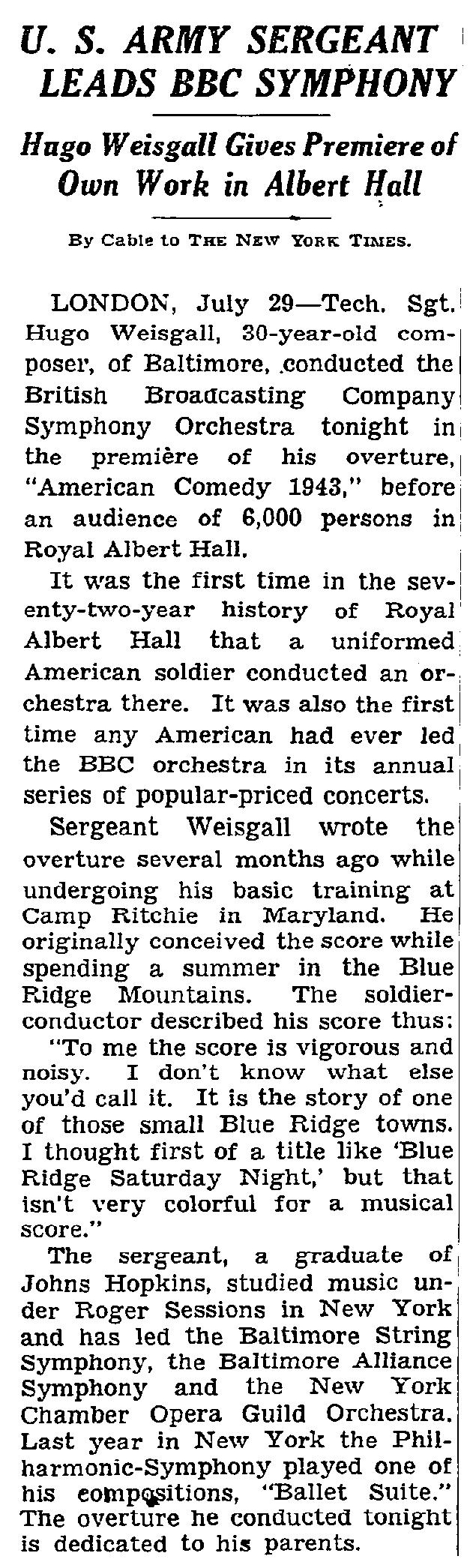
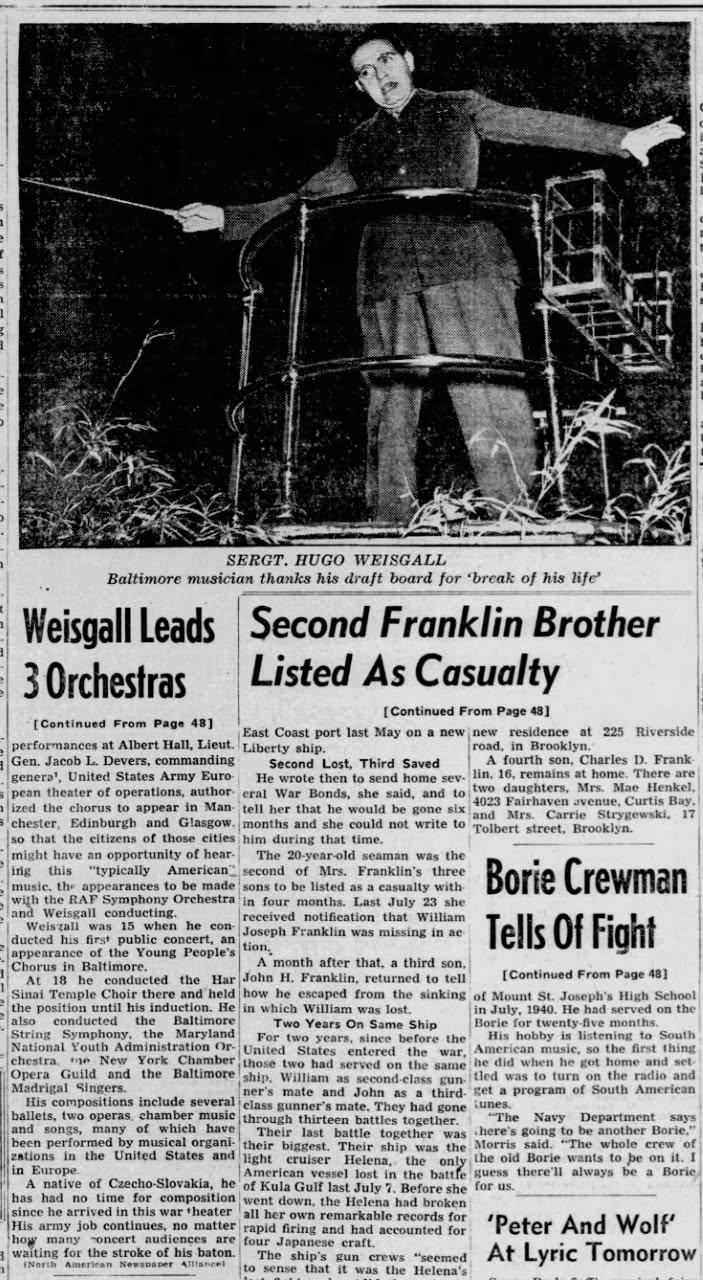
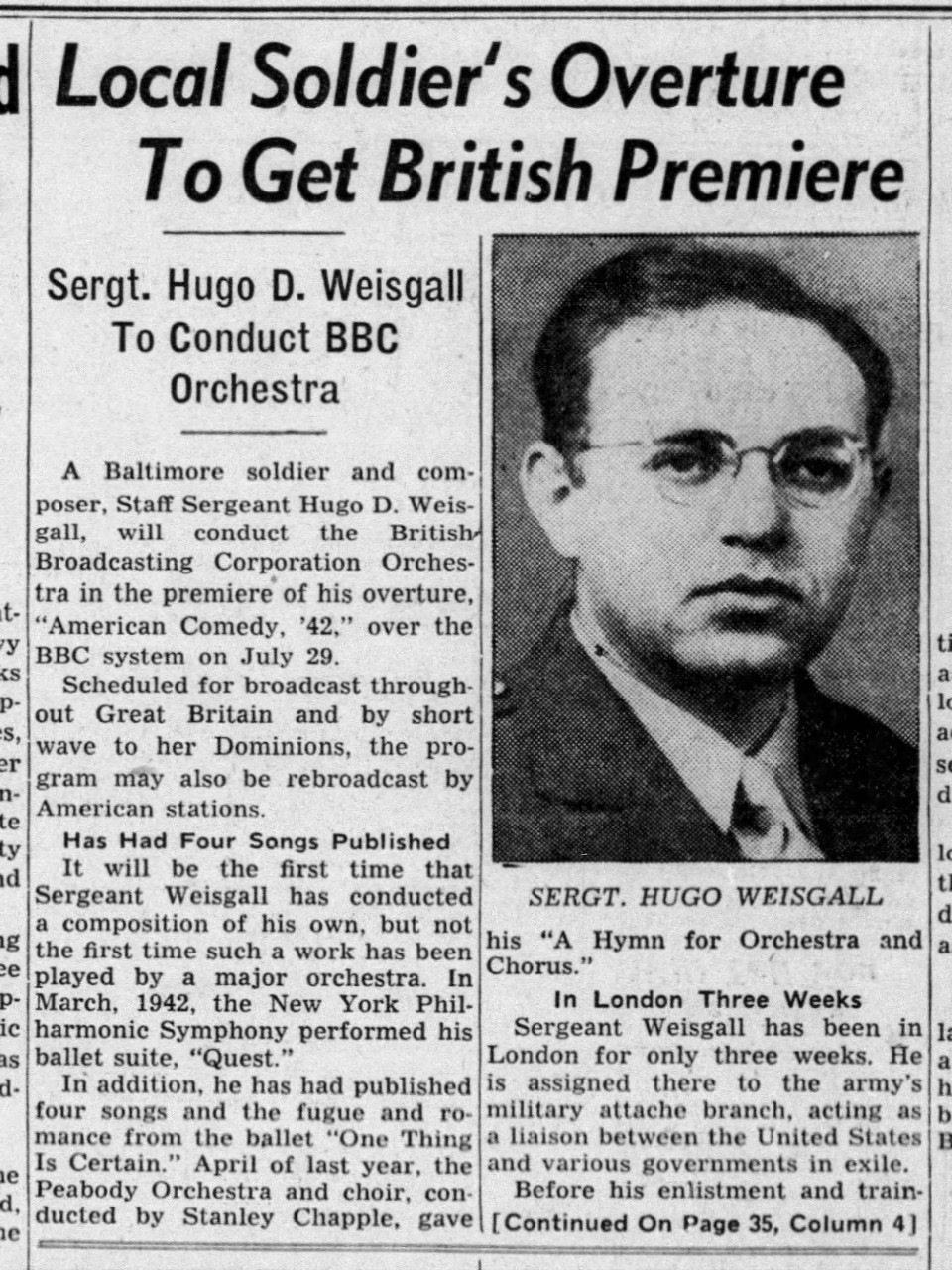
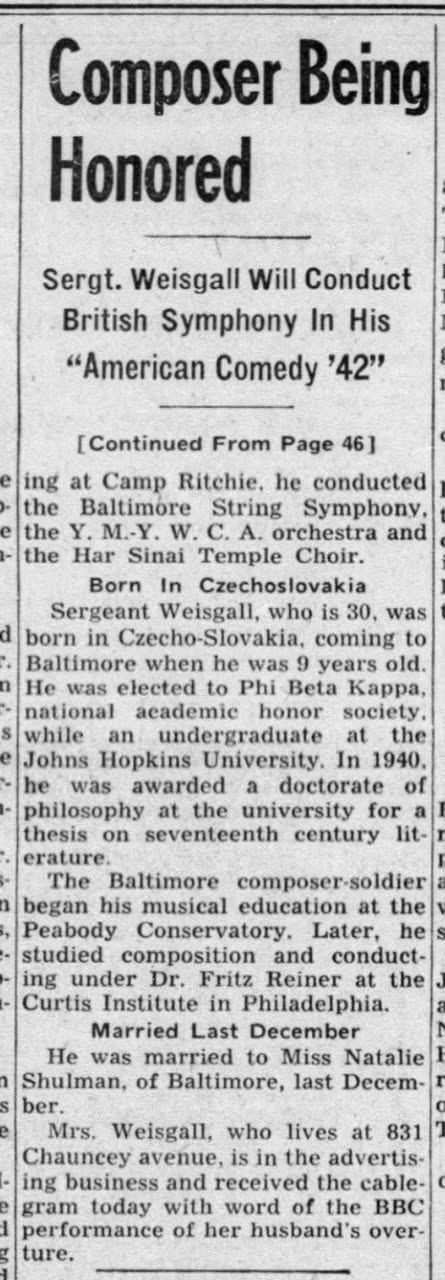
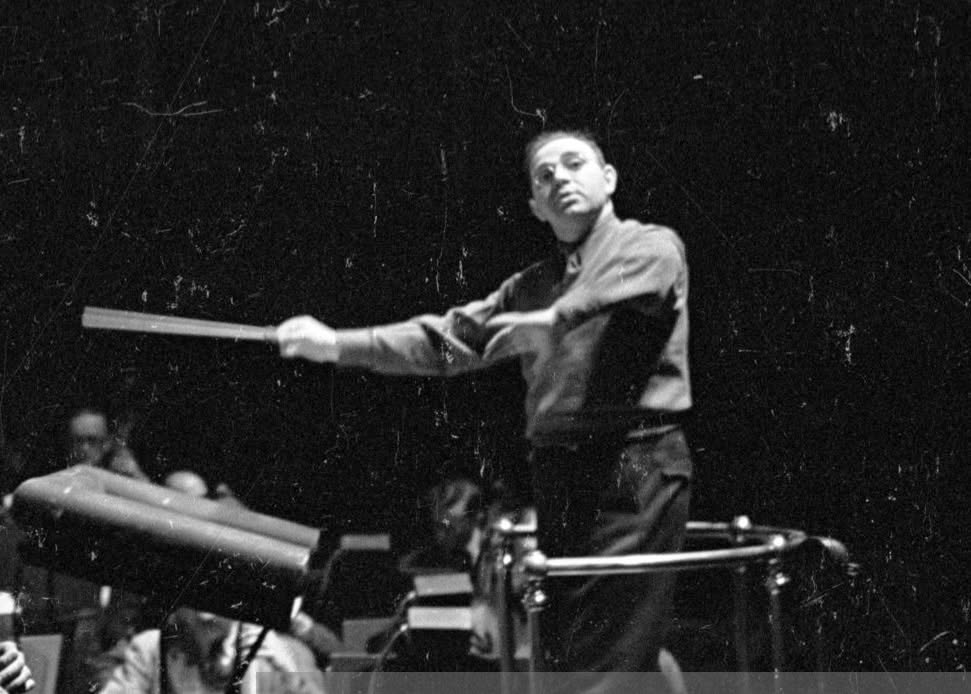
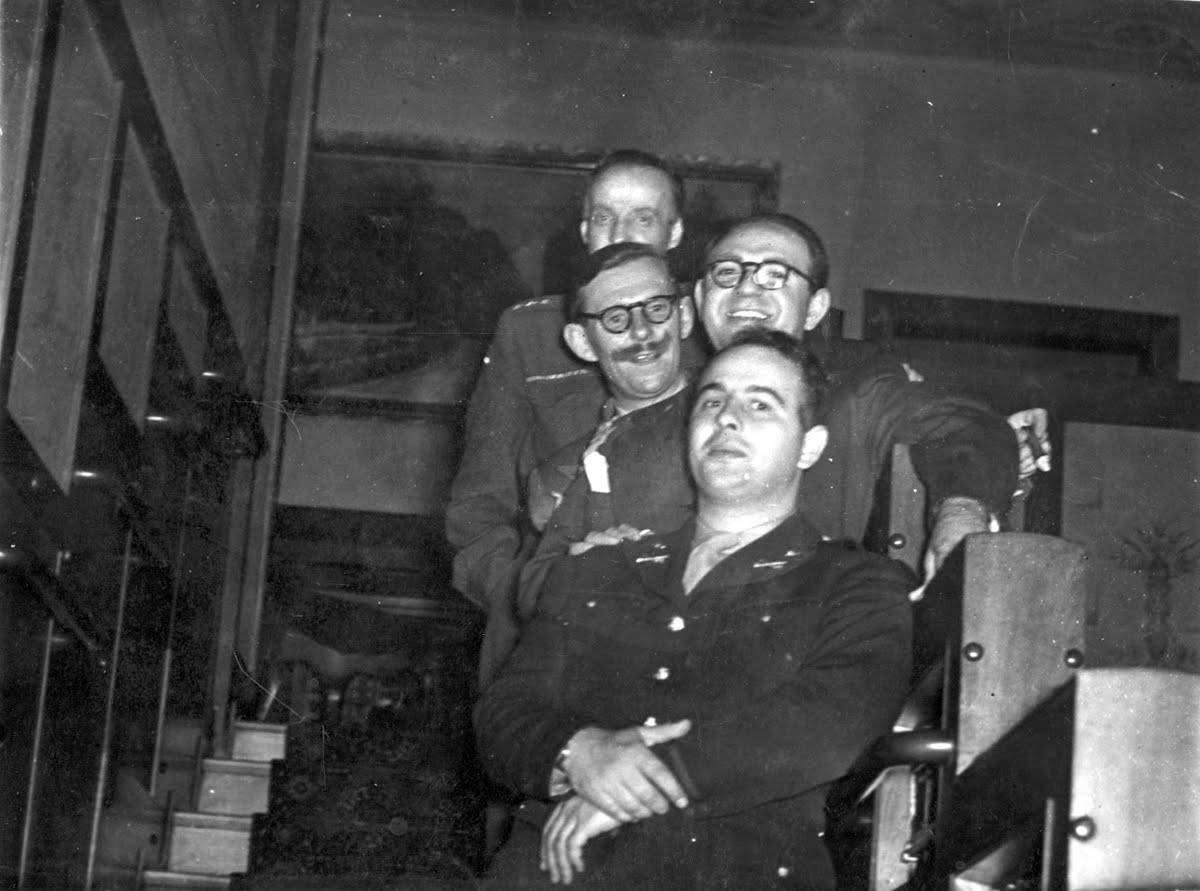
Weisgall enlisted rather than wait to be drafted. He trained at the Military Intelligence Training Center at Camp Ritchie, Maryland, with Class 2 and served as a technical sergeant. He later described an Atlantic crossing under U-boat attack and a brief leave on which he married Nathalie. A 1943 newspaper report places him in London as a liaison with governments in exile. On 29 July 1943 he conducted the BBC Symphony Orchestra at Royal Albert Hall before about 6,000 people in the premiere of his overture American Comedy 1943, begun while he was at Camp Ritchie—reportedly the first time an American had conducted the BBC orchestra in its promenade series. In London he also moved in wartime musical circles he named, including W. H. Auden, Benjamin Britten, and Myra Hess. The Milken Archive biography records that he was for a time an aide-de-camp to General George S. Patton and that language skill led to diplomatic work: assistant military attaché in London, then cultural attaché in postwar Prague, where he conducted leading European orchestras and programmed American music.
He kept composing in those posts. In London a war-poetry anthology prompted the song cycle Soldier Songs (1944–46), his first important work. In a Brussels air-raid shelter after the Battle of the Bulge he began The Dying Airmen, to words published anonymously that he believed were by Auden from the Spanish Civil War. After seeing hospital conditions at Theresienstadt (Terezín) he set Wilfred Owen’s “Futility.” Without waiting for his superior’s approval, he later delayed the sealing of certain Czech border areas so that more refugees and camp survivors could get out before the Iron Curtain closed; the officer, the Milken account says, congratulated him in private.
From 13 November 1946 he was assistant cultural officer in Prague for the Foreign Service. He later said he worked with Jan Masaryk, helped refugees, and was afterward declared an enemy of the state by Communist Czechoslovakia. He declined permanent European conducting posts and came home. He founded the Chamber Society of Baltimore and the Hilltop Opera Company, directed the Baltimore Institute of Musical Arts, and taught at Johns Hopkins from 1951 to 1957 while still working with synagogue choirs. Dearest to him was the Jewish Theological Seminary: from the 1952 opening of the Cantors Institute (later the H. L. Miller Cantorial School) until he retired in 1996 he chaired the faculty and shaped cantorial training in the United States, teaching synagogue prayer modes (nusah ha-tefillah) as well as composition, and advising doctoral work by composers including Herman Berlinski and Miriam Gideon. He became a professor at Queens College in 1961 (Distinguished Professor on retirement in 1983) and taught thirteen years at the Juilliard School.
His operas include The Tenor (1950), The Stronger (1952, for Hilltop), Six Characters in Search of an Author (1956), which first made his international name, Purgatory (1958, after Yeats), Athaliah (1964), Nine Rivers from Jordan (1968, on the Holocaust, Zionism, and European collapse), and Esther (1993). Judaic concert works include The Golden Peacock (1980), the Graven Images chamber pieces from a 1966 CBS film score, the Reform Friday-evening service Evening Liturgies, and Love’s Wounded, on poems of Yehuda Halevi. He was president of the American Music Center (1963–73) and of the League of Composers/ISCM, composer-in-residence at the American Academy in Rome in 1966 and at Lyric Opera of Chicago (1988–97), and president of the American Academy of Arts and Letters (1990–93) after election in 1975. Honors included three Guggenheim fellowships, Opera America’s Lifetime Achievement Award and the Academy’s Gold Medal for music (both 1994), Columbia’s William Schuman Prize, and honorary doctorates.
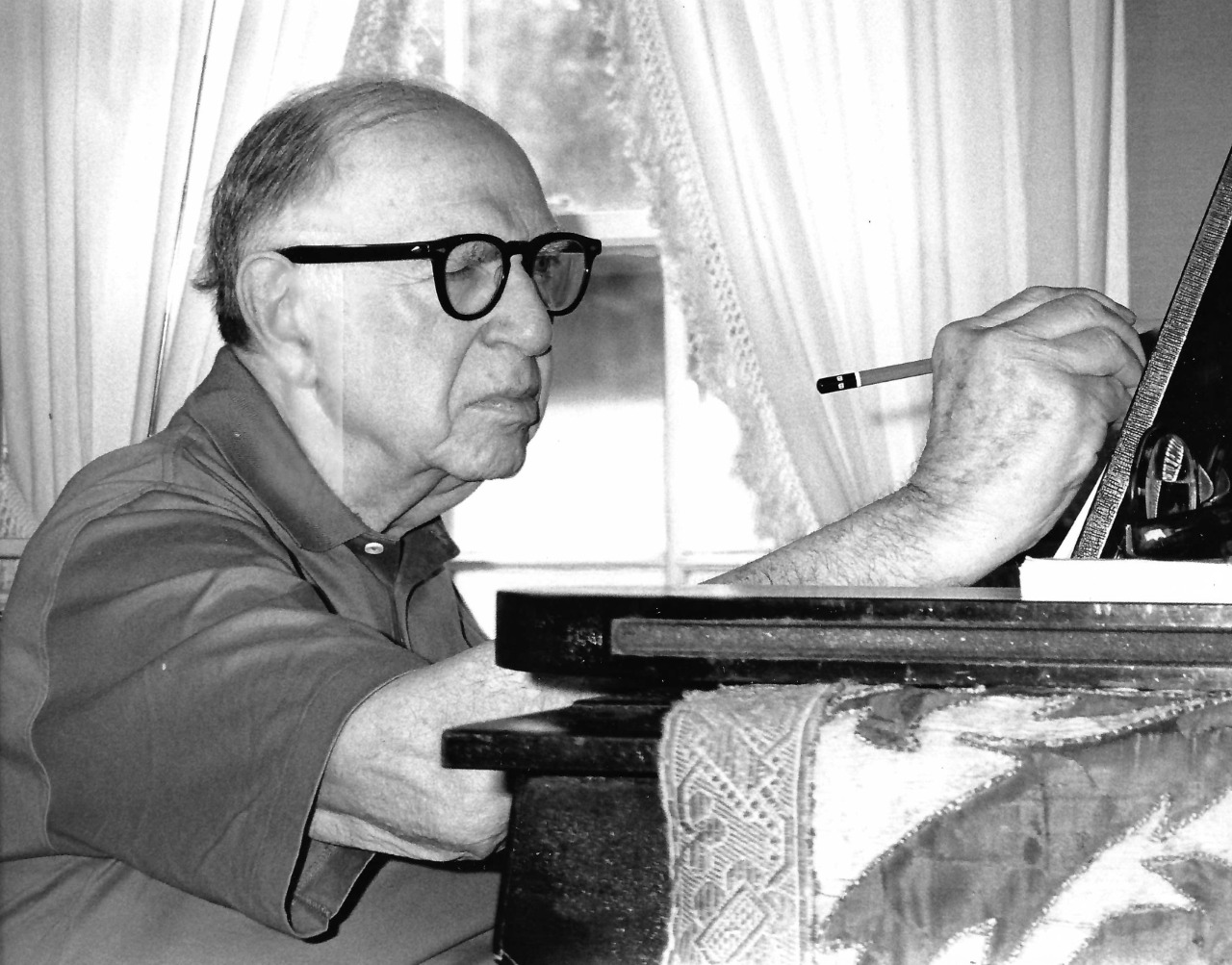
At his death he was sketching further Yiddish folksong settings, operas after Jean Anouilh, and, with librettist Charles Kondek, a New York City Opera project on John Hersey’s The Wall about the Warsaw Ghetto. He described himself as a Jew of the twentieth century living in America. Weisgall died on 11 March 1997 on Long Island, New York.
Research notes[edit | edit source]
- DEML instruction team.
- OCR (83%) of File:5774657545889452.jpg — rank mentioned: Sergeant; page keeps Technical Sergeant from the 1943 BBC/Stars and Stripes coverage.
- Father added a second l in America (Weisgall); uncle Meyer Weisgal did not.
- 31 May 1995 Milken oral history: great-uncle Bacche and great-aunt Rosaneni (his spellings); he sang Amnam ken / Ki hinne kahomer. A condensed summary’s “Hassan Sofer” is the Chatam Sofer of Pressburg.
- He treated “Czech-born” as an accident of his father’s Ivančice post (father Polish-born, mother Hungarian-born); infobox nativity remains Czechoslovakia from the roster.
- Milken Archive artist biography (Neil W. Levin and Bruce Saylor) is the source for the Patton aide-de-camp claim (the Milken text says “George F. Patton”), the Czech border delay, and the Terezín / Soldier Songs wartime composing episodes.
- Interview summary: volunteered rather than wait for the draft; U-boat attack on the crossing; married Nathalie on leave (surname not given); London contacts Auden, Britten, and Myra Hess; Prague work with Jan Masaryk; later “enemy of the state” under the Communist regime. A condensed write-up’s MI5/MI6 and resistance-coordination claims are not used.
- Foreign Service list: Assistant Cultural Officer, Prague, assigned 13 November 1946 (interview summary said 1945–47).
Gallery[edit | edit source]
-
-

-
-
-
-
-
-
-
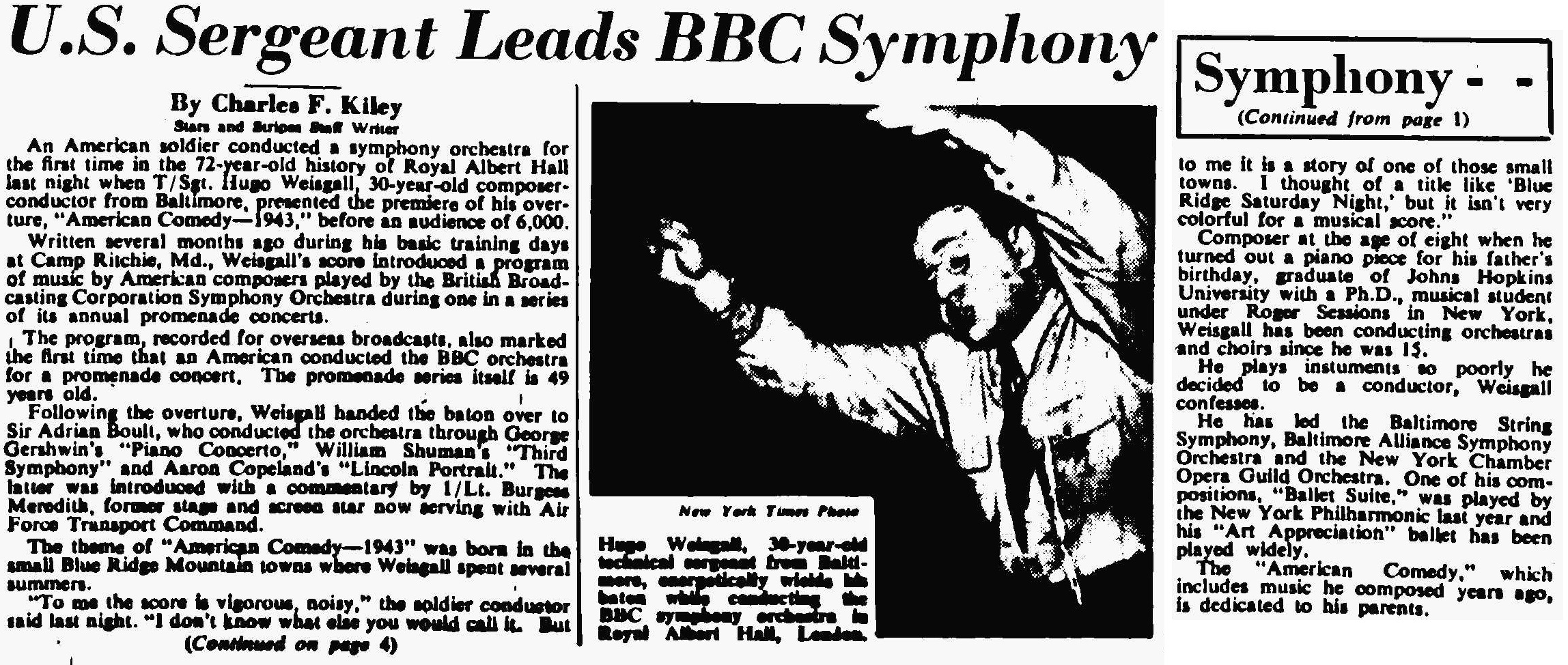 Stars and Stripes, 30 July 1943 — “U.S. Sergeant Leads BBC Symphony” (composite clipping; RB Archive)


Technical record[edit | edit source]
| Field | Imported value |
|---|---|
| Approx Age at Death | 85 |
| Nara ASN | 13072714 |
| Nara Name | ROYER JOHN M |
| Nara State | 1 |
| Nara County | 11 |
| Nara POE | 3110 |
| Nara DOE | 140542 |
| Nara Grade Alpha | PVT |
| Nara Grade Code | 8 |
| Nara Branch Alpha | BI |
| Nara Branch Code | 0 |
| Branch | Branch Immaterial - Warrant Officers, USA |
| Nara Term or Enlistment | 5 |
| Term of enlistment | Enlistment for the duration of the War or other emergency, plus six months, subject to the discretion of the President or otherwise according to law |
| Defer. Date | 0 |
| Nara Source | 0 |
| Nara Nativity | 31 |
| Nativity.1 | MARYLAND |
| Nara Year of Birth | 21 |
| Nara Race | 1 |
| Nara Race Description | White citizen |
| Nara Education | 3 |
| Nara Civilian Occupation | 819 |
| Nara Marital Status | 6 |
| Nara Height (inches) | 67 |
| Nara Weight (lbs) | 122 |
| Class_Name | Weisgall, Hugo D. |
| match_method | unique_name_no_asn |
| row_source | both |
Timeline[edit | edit source]
- 13 October 1912 — Born in Ivančice (Eibenschütz), Moravia, Austria-Hungary.
- Yom Kippur 1915 — First memory: synagogue choir; great-uncle Bacche learns his son is missing in action.
- 1920 — Family leaves via New York; settles in Baltimore (Chizuk Amuno Congregation).
- 1926 — Naturalized U.S. citizen.
- 1940 — Ph.D., Johns Hopkins University (primitivism in 17th-century German poetry).
- Camp Ritchie Class 2 — Enlists; military intelligence training; begins overture American Comedy 1943.
- Wartime — Atlantic crossing under U-boat attack; marries Nathalie on leave.
- 29 July 1943 — Conducts the BBC Symphony Orchestra at Royal Albert Hall (technical sergeant; London liaison).
- 1944–1946 — Soldier Songs; Brussels after the Bulge; Terezín; Czech border delay for refugees.
- 13 November 1946 — Assistant Cultural Officer, Prague (Foreign Service).
- 1951–1957 — Teaches at Johns Hopkins; Chamber Society of Baltimore / Hilltop Opera.
- 1952–1996 — Chairman of the faculty, JTS Cantors Institute.
- 1956 — Six Characters in Search of an Author.
- 1961–1983 — Professor, then Distinguished Professor, Queens College; Juilliard.
- 1975 — Elected to the American Academy of Arts and Letters (president 1990–1993).
- 1993 — Opera Esther.
- 11 March 1997 — Died on Long Island, New York.
Sources[edit | edit source]
- Milken Archive artist biography of Hugo Weisgall (Neil W. Levin and Bruce Saylor)
- Milken Archive oral history (watchlist card)
- Stars and Stripes, 30 July 1943 — coverage related to Weisgall (RB Archive)
- RB Archive wartime clippings (Stars and Stripes; BBC Symphony coverage)
- Milken Archive Aviary recording — Hugo Weisgall interview
- Milken Archive oral history — Hugo Weisgall (31 May 1995)
- Wikipedia — Hugo Weisgall
- Camp Ritchie Museum, Inc. (The Ritchie History Museum), Classes 1–31 roster data
- Dan Gross research spreadsheets, including original Excel timeline/roster work, combined with other research and records
- NARA World War II Army enlistment records (where a NARA ASN is present)
- 1940 U.S. Census (where a census match is present)
- Ritchie Boys of WWII Facebook page, post dated 2022-10-09 (2 posts)
- Ritchie Boys of WWII Facebook page, post dated 2022-10-16 (2 posts)
- New York Times report on Weisgall conducting the BBC Symphony, 29 July 1943
- Baltimore newspaper report, "Weisgall Leads 3 Big British Orchestras"
- Continuation of Baltimore newspaper report
- Newspaper report, "Local Soldier's Overture To Get British Premiere"
- Continuation of newspaper report on Weisgall