Training materials collects Camp Ritchie / MITC documents that apply to the camp as a whole — training manuals, course outlines, circulars, maps, and similar files — not papers about one soldier.
For a scan that should enrich a soldier profile (certificate, letter, team roster), use Contribute documents instead.
Add a file
Loading upload tools… (requires login).
You can also use Special:Upload. Prefer clear filenames such as MITC_interrogation_manual_1943.pdf. State the source and that you have permission to share the file. Individual files can be up to about 120 MB.
Logged-in editors can Remove an item from the Library list below (unlist only). Delete file (permanent) is shown to administrators only.
Featured: List of Directives
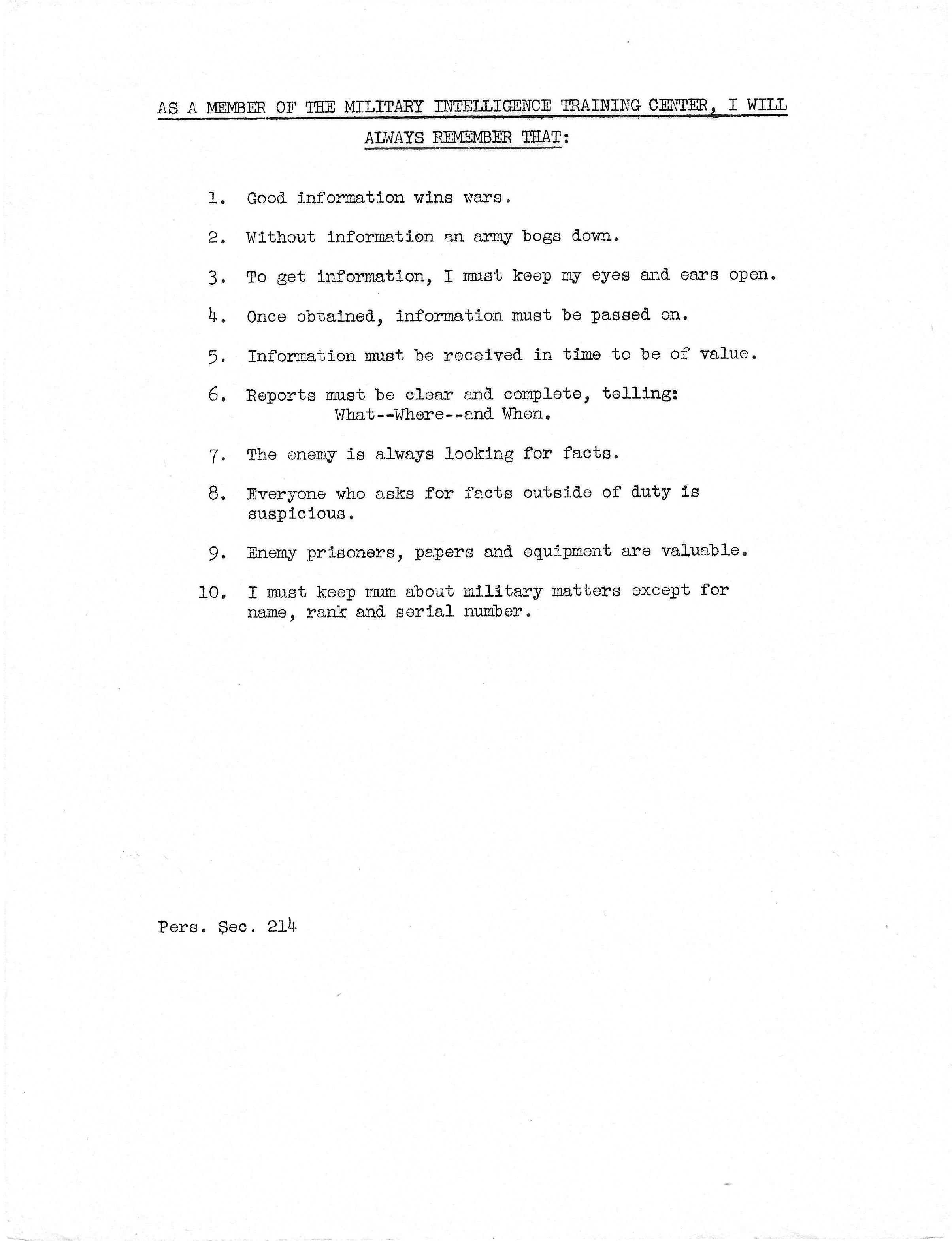
A short Personnel Section sheet (marked Pers. Sec. 214) summed up what trainees were to remember about information and security:
- Good information wins wars.
- Without information an army bogs down.
- To get information, I must keep my eyes and ears open.
- Once obtained, information must be passed on.
- Information must be received in time to be of value.
- Reports must be clear and complete, telling: What—Where—and When.
- The enemy is always looking for facts.
- Everyone who asks for facts outside of duty is suspicious.
- Enemy prisoners, papers and equipment are valuable.
- I must keep mum about military matters except for name, rank and serial number.
Source scan: Camp Ritchie List of Directives (archival credit not yet confirmed).

Featured: Enemy Equipment Intelligence Service (EEIS)
Signal Section monograph A Typical Enemy Equipment Intelligence Service, based on Enemy Equipment Intelligence Service Detachment Number 9 (Signal Section, Headquarters 9th U.S. Army, A.P.O. 339).
An Enemy Equipment Identification Team of five officers and six enlisted men formed at Fort Monmouth, New Jersey, then took a condensed two-week intelligence course at Camp Ritchie beginning 13 April 1944 (enemy signal equipment and weapons, enemy order of battle, map reading, and familiarization with IPW and photo-interpretation teams). After further Signal Corps preparation in New Jersey and the United Kingdom, the detachment entered the Continent in late August 1944 and operated under Ninth Army / Signal channels recovering and studying German electronic and signal equipment (including radar and crashed-aircraft material).
Full scan (8 pages, combined from Fold3 JPGs): A Typical Enemy Equipment Intelligence Service (EEIS Detachment No. 9, Signal Section, 9th U.S. Army).
Source: Fold3 — Signal Section Monographs / Histories (U.S. WWII European Theater Army Records).
Featured: Early ETOUSA G-2 organization (Settle, 1944)
Appendix from the G-2 History / ETOUSA monograph recording an interview with Lt. Col. Henry C. Settle (Chief of Administration, G-2 ETO, May 1942 – October 1943), dated 27 October 1944.
Camp Ritchie–relevant points from the account:
- Settle states that most early Theater G-2 officers were C and GSS graduates of the 6th Special Class at Camp Ritchie (a three-month course he dates from March 1942)—an early pipeline of MITC-trained officers into Hq ETOUSA intelligence work.
- Under Colonel Conrad (Intelligence Field Units / Training), Colonel J. R. Elyachar organized Mobile Intelligence Training Units that toured troop areas demonstrating captured German equipment and techniques (Elyachar later received the Legion of Merit). These European-theater demonstration units are a different program from the mid-1945 Nisei / Pacific redeployment MITUs described on Nisei and Pacific.
- Field intelligence units were reorganized as MIS, ETOUSA (Colonel D'Alary Fechet named chief in early October 1943).
- After FUSAG stood up (16 October 1943), G-2 reorganized under figures including General Sibert (G-2 FUSAG); Operations Branch functions listed IPW among Escape & Evasion, PW & X, training, and photo interpretation.
- G-2 sought to overcome peacetime neglect of intelligence training and shortages of trained personnel; one plan, with the CG of the 29th Infantry Division, aimed to replace about 50% of that division’s intelligence personnel with Camp Ritchie graduates (and rotate others through American School Center courses).
Full scan (6 pages): Lt. Col. Henry C. Settle — Account of Early G-2 Branch Organization (ETOUSA), 27 October 1944.
Source: Fold3 — G-2 History, ETOUSA Monograph, 1941–44 (U.S. WWII European Theater Army Records).
Featured: 1st Mobile Radio Broadcasting Company roster
Printed Unit History cover and Consolidated Roster (original pages 46–51) for the 1st Mobile Radio Broadcasting Company — a psychological-warfare radio company whose linguists often trained at Camp Ritchie / Camp Sharpe.
Full scan: Unit History cover + Consolidated Roster (PDF). Linked name transcription: 1st Mobile Radio Broadcasting Company.
Source: RB Archive packet (probable Fold3 / U.S. WWII unit-history scan; archival ID not yet confirmed).
Featured: Ardennes battle participation awards (USFET, 7 July 1945)
Headquarters, United States Forces, European Theater letter-order (AG 200.6 OpGA; formerly “RESTRICTED”), 7 July 1945, announcing additional units awarded Ardennes campaign battle credit under AR 260-10 and War Department General Orders No. 40 (1945). Eligibility supported wearing a bronze service star on the theater ribbon.
Among many support and combat units, the order names Military Intelligence Service–related detachments, including:
- IPW Team No. 19
- OB Team No. 35
- IPW Team No. 69
- IPW Team No. 141
- IPW Team No. 174
- MII Team No. 474-G
- 4th, 75th, and 502nd CIC Detachments
- Engineer Technical Intelligence Teams (2891st, 2892nd, 2897th, 2944th)
Full scan (3 pages): HQ USFET — Battle Participation Awards, Ardennes Campaign, 7 July 1945.
See also Secret Heroes/Battle of the Bulge. Source: RB Archive packet (U.S. WWII European Theater awards correspondence; likely Fold3 / NARA RG 498; image ID not yet confirmed). Filename on the packet: “38 - Awards and Decorations”.
Library
- German Uniform Chart (November 1942)
- Handbook on German Army Identification (1943)
- USA Organization (1 Sep 1944)
- Japanese Uniform Insignia (1 May 1945)
- Camp Ritchie List of Directives (Pers. Sec. 214)
- A Typical Enemy Equipment Intelligence Service (EEIS Detachment No. 9, Signal Section, 9th U.S. Army)
- Lt. Col. Henry C. Settle — Account of Early G-2 Branch Organization (ETOUSA), 27 October 1944
- 1st Mobile Radio Broadcasting Company — Unit History cover + Consolidated Roster
- HQ USFET — Battle Participation Awards, Ardennes Campaign, 7 July 1945
Privacy and rights
- Upload only material you may publish (public domain, museum permission, or your own cleared scans).
- Do not include Social Security numbers or private contact details for living people.
- See Contribute and About the data.
See also
- 1st Mobile Radio Broadcasting Company
- Camp Ritchie
- Contribute documents — OCR into soldier profiles
- Photos
- Books
- Contribute